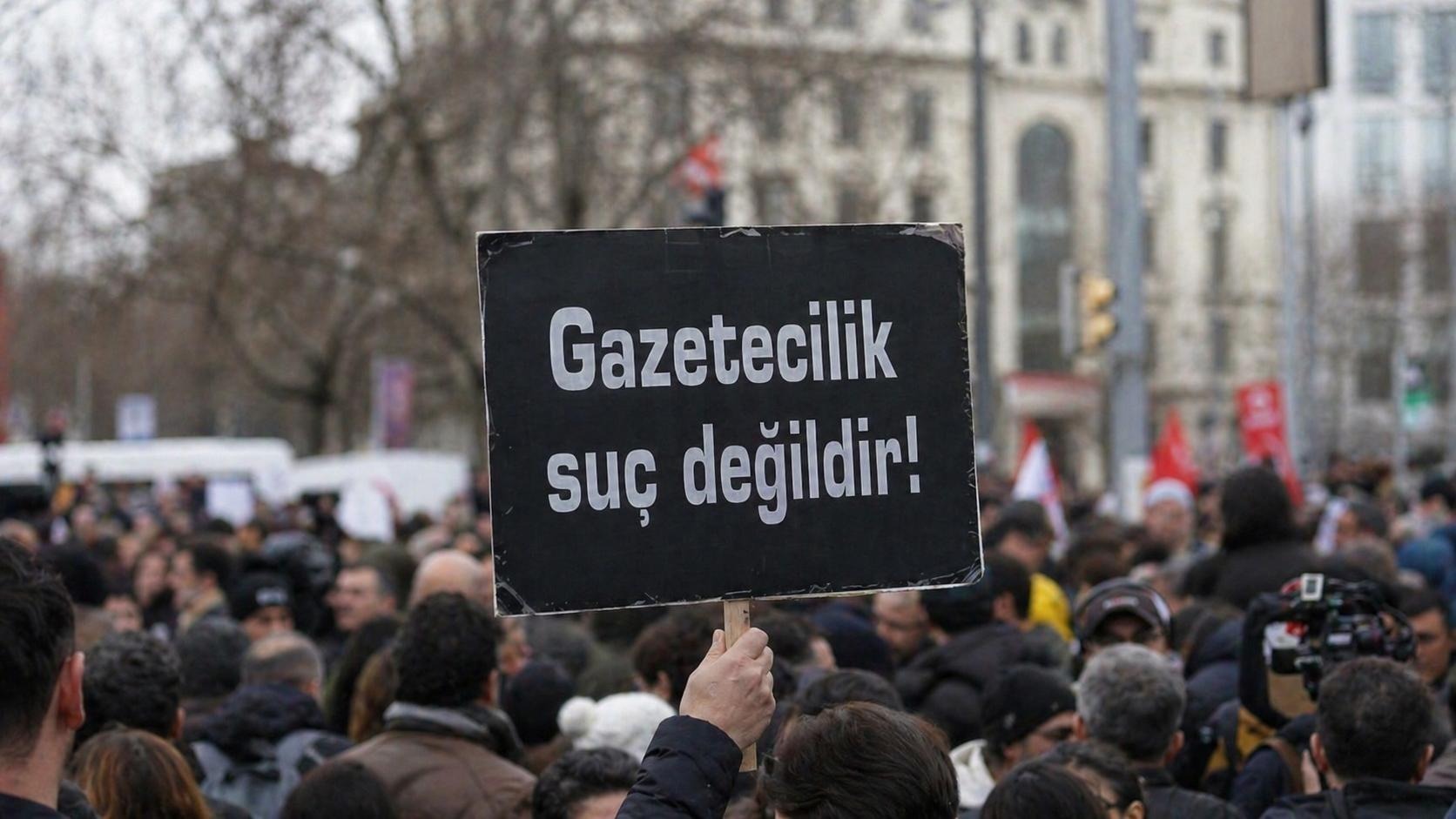
“I am here only because of my profession,” wrote journalist İsmail Arı in a recent letter from his prison cell in Ankara. Following his arrest in March 2026 on charges of “spreading disinformation,” Arı found himself in the same prison as those he had exposed in a report on the financial mismanagement of a public foundation — a report that had earned him three awards.
When Turkey’s 2022 “Disinformation Law” — which served as the legal basis for Arı’s arrest — was debated, its architects made assurances that it would never be used against journalists. Those pledges were quickly broken, as dozens of investigative reporters have become the targets of prosecutions built on this deliberately vague provision. Judicial proceedings against journalists are continuing at breakneck speeds: in April 2026, two separate courts proceeded, within hours of each other, to sentence two journalists to prison over their reporting.
Turkey’s crackdown on independent reporting is not limited to a single law. Courtrooms remain the most persistent battlefield for journalism in Turkey, where reporting is routinely criminalised through lengthy sentences, months of pretrial detention, house arrests, and travel bans. Among the charges most systematically deployed against journalists are “insulting the president” and anti-terror statutes.
The numbers from the first quarter of 2026 alone tell the story: at least seven journalists arrested, ten sentenced to prison, and 19 more detained. Regardless of the name on the file, the pattern suggests that it is the profession being put on trial.
This is familiar territory for journalist Furkan Karabay. He has been targeted so frequently by Turkish authorities that his recent sentence to house arrest was viewed with a grim relief, only because it meant avoiding a third prison term in less than three years.
“The politicised judicial pressure against journalists reshapes the very practice of journalism in our country,” said Karabay to IPI Turkey. “As we cannot fully escape this judicial vise, censorship mechanisms emerge at both the individual and institutional levels to minimise the damage.”
Independent media strives to prevent these mechanisms from reaching a point where they destroy the essence of the news, underlines Karabay. But this commitment comes at a price.
“The right to access healthcare is the most pressing issue here,” journalist Pınar Gayıp warned from her prison cell in Istanbul, where she shares an overcrowded ward with several of her colleagues. She describes a reality of total medical abandonment: “The prison doctor neither examines us nor provides our medication.”
The wider siege
The courtroom is only the frontline. Turkey’s war on the media is best understood as a systemic siege, documented through years of IPI monitoring, where legal threats overlap with physical violence, verbal intimidation, and a culture of impunity.
During the protests following the March 2025 arrest of Ekrem İmamoğlu, the mayor of Istanbul and the main opposition party’s presidential candidate, journalists documenting the scene were met with widespread police brutality. Yet, when hundreds gathered to attack the headquarters of the satirical LeMan magazine over a cartoon, the response from authorities was markedly different. The building was besieged and damaged.
Consider Hakan Tosun, a journalist and documentary filmmaker who spent his career uncovering environmental destruction, documenting mining sites, dam projects, and forest destruction across Turkey. On October 13, 2025, he was ambushed on a street in Istanbul and beaten to death in what his family describes as a coordinated attack. One of the three individuals present was detained only as a witness and released for lack of evidence. Since then, his family has faced a wall of procedural irregularities and a total lack of transparency from the Turkish authorities purportedly investigating his murder.
This is a familiar silence in Turkey, a haunting echo of a decades-old history of unsolved crimes against the press, ranging from the 1993 car bombing that killed investigative journalist Uğur Mumcu to the 2007 shooting of Hrant Dink, and countless other cases.
A rigged marketplace
Financial precarity constitutes yet another kind of hardship for Turkey’s journalists. Amid shifting business models and economic headwinds, media outlets across the globe are being forced to cope with new challenges, and Turkey is no exception. Between August 2024 and March 2025, a series of algorithmic updates by Google has effectively dismantled the digital reach of the country’s few remaining independent outlets, while pro-government outlets became more prominent in timelines and search results.
The “algorithmic shock,” as it is widely referred to in Turkey, has resulted in unprecedented traffic losses for independent outlets, ranging from 60% to 80% in Google News and Discover. The sudden loss of visibility triggered institutional crises for a number of outlets, the most alarming consequence of which was the closure of Gazete Duvar, which had been one of the few remaining outlets committed to quality journalism amid declining press freedom.
This global pressure is intensified by a uniquely Turkish crisis: a media ownership structure designed to prioritise political loyalty over public good. Put more simply, outlets are forced to navigate a market that has been fundamentally rigged against them.
While the government has long consolidated ownership of Turkey’s mainstream media outlets through forced seizures, it has also perfected a system of economic coercion. State advertising and public funds are funnelled exclusively to a narrowing circle of government-aligned conglomerates, while independent outlets are met with punitive fines from the media regulator.
Despite the multifaceted forces against them, the resilience of Turkey’s independent media remains intact. Many journalists continue to treat their work as a shared commitment, despite the costs. “We are journalists, we don’t set our course by the wind,” Gayıp wrote from Bakırköy Women’s Prison.
From his prison cell in Ankara, journalist Alican Uludağ described the struggle for truth as a relay race. “I am imprisoned now,” he wrote, “but I am certain that someone else will carry this work forward.”