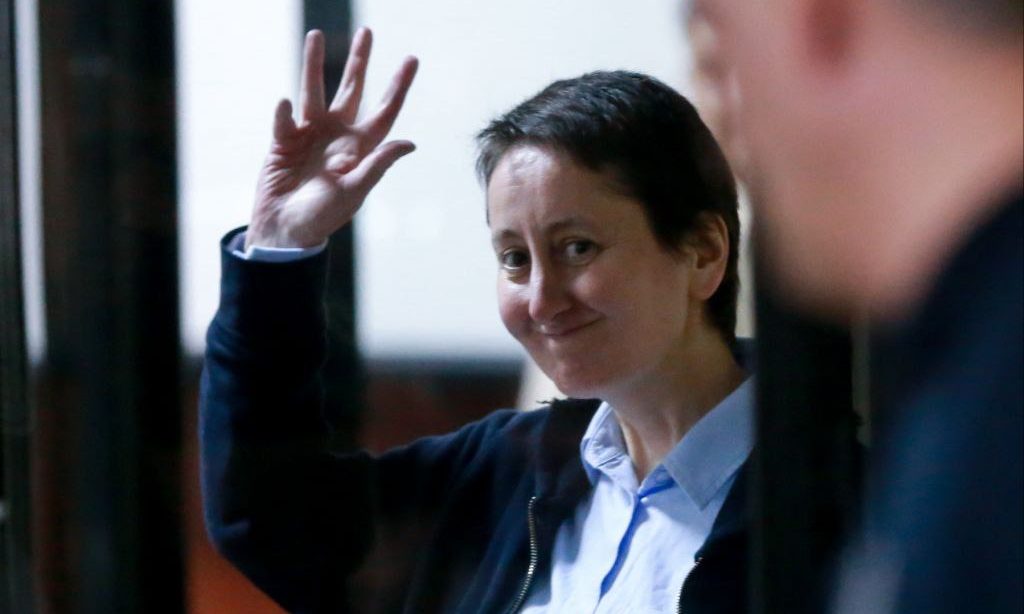
On August 6, 2025, following more than 200 days in unjust pretrial detention and a highly-politicized trial, Georgian journalist and IPI member Mzia Amaglobeli was sentenced to two years in prison as the world watched and protesters gathered outside a courtroom in Batumi, Georgia. She is the first female journalist to be imprisoned in Georgia’s 34 years of independence.
On January 12, 2025, Mzia, the co-founder and CEO of two of Georgia’s most prominent independent media outlets, Batumelebi and Netgazeti, was arrested and held on politically motivated charges following a minor altercation with a police chief during a crackdown on democratic protests in Batumi.
The grossly disproportionate nature of the charges that followed – which carried a possible sentence of up to seven years in prison – made clear that the veteran journalist was being targeted and punished for her decades-long work and dedication to independent reporting that exposes corruption, political repression, and human rights violations.
The World Press Freedom Hero award is given annually to journalists who have made significant contributions to promoting press freedom despite great personal risk. In recognizing Mzia as one of this year’s Press Freedom Heroes, the selection committee honours her fearless investigative journalism and commitment to press freedom in the face of extreme government pressure, as well as all of Georgia’s independent journalists who refuse to be silenced. As the Georgian government continues to crack down on opposition and press freedom, Mzia has come to symbolize the power of media resistance to authoritarianism.
This award also recognizes the contributions Mzia has made to independent journalism long before her arrest. Mzia’s commitment to the power and importance of free media has inspired generations of journalists in Georgia. Her courage as she faces unjust imprisonment in Georgia continues to inspire independent journalists everywhere fighting for media freedom.
“To be among the recipients of the prestigious World Press Freedom Hero award is both an honour and a responsibility,” said Mzia, in a communication from prison. “This award is not just about me; it recognizes the struggle of many journalists in Georgia who bravely stand for the truth despite immense pressure. This award highlights the work of Batumelebi and Netgazeti, along with all my colleagues who are committed to watchdog journalism, even in the face of threats and attacks.”
“My imprisonment and the injustice I face are part of the larger issue of the hostile environment in which Georgian journalists must operate,” Mzia continued. “This award is a reminder that our sacrifices are not invisible and that the international community supports us. Most importantly, it serves as encouragement for all of us to continue defending press freedom, for in doing so, we are also defending democracy itself.”
A media pioneer
For most of her adult life, Mzia has played a key role in developing Georgia’s independent media landscape, and shaping journalistic standards in the country, which declared its independence from the Soviet Union in 1991. In 2001, Mzia co-founded Batumelebi alongside her colleague Eter Turadze, with the goal of providing a platform for the local community of Georgia’s Adjara region, which at the time was under the rule of pro-Russian authoritarian separatist leader Aslan Abashidze.
In 2009, Batumelebi expanded to national coverage via its online platform, Netgazeti. Together, the outlets, which often cover human rights and corruption, quickly became two of Georgia’s most popular and respected online news sources, winning several awards for their work. In 2023, Batumelebi was shortlisted for the IPI-IMS Free Media Pioneer Award for its dedication to independent quality journalism.
Every step of the way, Mzia and Batumelebi and Netgazeti have faced difficulties, as Georgia continued to suffer political turmoil, revolutions, and war in the decades following independence. The outlets’ dedication to holding power accountable, and uplifting Georgia’s most vulnerable voices and communities earned them constant attention from authorities, who have harassed employees, destroyed equipment, and targeted the outlets with smear campaigns.
In recent years, the state of independent media in Georgia has become increasingly precarious, as the ruling Georgian Dream party accelerates efforts to restrict the space for critical voices through targeted violence, the introduction of repressive laws, deliberate economic pressure, and impunity for crimes against journalists. As protests spread across Georgia in November 2024 in response to the Georgian Dream’s decision to pause EU membership negotiations, journalists covering the demonstrations were brutally assaulted, arrested, or otherwise obstructed from carrying out their work in police crackdowns.
In 2025 alone, the Georgian Dream party has enacted several pieces of legislation intended to censor and silence independent media, including the Foreign Agents Registration Act, as well as amendments to the Law on Grants and the Law of Broadcasting, among others. Authorities also upped their pressure on specific outlets and individual journalists – following Mzia’s arrest in January 2025, authorities ordered the seizure of Batumelebi and Netgazeti’s bank accounts in a blatant attempt to exert further pressure on Mzia in advance of last month’s verdict.
“Fight before it is too late”
Mzia’s case has become a major obstacle in Georgian Dream’s years-long effort to consolidate power and dismantle the institutions of democracy in Georgia. The journalist’s refusal to bend to the will of authorities has not only drawn the attention of the international community to the plight of Georgia’s journalists, but also set a powerful example for what effective civil society resistance to autocratic takeover looks like.
Mzia has refused to let Georgia’s ruling party make an example out of her. In a letter written from prison, which Batumelebi and Netgazeti published, Mzia captured the importance of her continued resistance: “Freedom is far more valuable than life, and it is at stake. Fight before it is too late.” Her determination to fight back against attempts to snuff out the very institutions she helped build has captured global attention, and galvanized calls within the journalistic community to stand in solidarity with colleagues facing extreme governmental pressure.
Despite her mental fortitude, the conditions and stress of Mzia’s imprisonment have taken a serious toll on her physical health. Since her arrest in January, her eyesight has rapidly deteriorated due to a lack of proper medical treatment for an existing degenerative eye disease that has resulted in near total blindness in both eyes. Early in her detention, Mzia underwent a five-week hunger strike in protest of her illegal imprisonment, the effects of which were so acute she had to be transferred to a rehabilitation clinic. Throughout her detention, Mzia has also experienced harassment and mistreatment at the hands of authorities, including verbal abuse, physical intimidation, and denial of basic necessities.
The highly politicized proceedings surrounding Mzia’s prosecution and conviction have drawn media coverage and condemnations from the European Union, U.S. senators, diplomatic missions, and human rights defenders worldwide. A campaign launched by IPI to raise awareness about Mzia’s detention was joined by around 400 human rights, media freedom and journalists organisations and individual journalists and press freedom advocates. Several foreign diplomats, representatives of international bodies and prominent Georgian political figures, including Georgia’s former president, Salome Zourabichvili, were present at her final court appearances as her trial wrapped up.
In her closing statement before the court, days before her conviction, Mzia thanked her legal team and her journalistic colleagues who stood in solidarity with her. She also addressed the prosecutor and the judge presiding over her case, rejecting the baseless charges against her and reiterating their inability to break her: “Whatever decision you make, I want you to know that I consider myself a winner.”
As Mzia was transported back to her jail cell from the courthouse a final time before her conviction, her supporters cheered loudly in the streets, chanting her name and waving signs calling for her release, their outspoken support a reflection of Mzia’s final words to the court: “There is still time. The fight continues — until victory!”
The World Press Freedom Hero awards
IPI will present the World Press Freedom Hero awards at a special ceremony on October 24 at the University of Vienna as part of the 2025 IPI World Congress, which annually brings together leading editors and journalists from around the world. As Mzia remains behind bars, her colleague and friend Tamar Rukhadze will accept the award on her behalf.
As IPI marks its 75th anniversary this year, we have chosen to recognize seven individuals who have displayed tremendous courage and resilience in fighting for media freedom. In addition to Mzia, the World Press Freedom Hero award will also be given to Martin Baron (United States), Mariam Abu Dagga (Palestine), Gustavo Gorriti (Peru), Jimmy Lai (Hong Kong), Victoria Roshchyna (Ukraine), and Tesfalem Waldyes (Ethiopia).
“This year’s awardees are exemplary of the current threats facing journalists worldwide as authoritarianism gains ground, impunity prevails, and new challenges to freedom of expression emerge,” IPI Executive Director Scott Griffen said. “With this award, we honour their courage, commitment, and legacy – while renewing our urgent call to protect and defend media freedom as a pillar of free society.”
“Each of the recipients of this year’s World Press Freedom Hero award have faced acute dangers and threats merely for doing their job,” IMS Executive Director Jesper Højberg said. “Two of them – Victoria Roshchyna and Mariam Abu Dagga – paid with their lives. With immense courage and persistence, the awardees have uncovered corruption, war crimes, persecution of vulnerable groups and multiple other transgressions. We all owe them our deep gratitude for their fearless commitment to exposing what those in power seek to hide.”
Since 2000, IPI has recognized more than 75 journalists who have displayed tremendous courage and resilience in fighting for media freedom and the free flow of news with the World Press Freedom Hero award. Notable past awardees include imprisoned Guatemalan journalist José Rubén Zamora, slain Palestinian-American journalist Shireen Abu Akleh, and Mexican investigative journalist Carmen Aristegui. Since 2015, IPI has been proud to present the award in partnership with IMS.