
For this case study, we talked to Shirin Shity, Senior Marketing Manager at Project Syndicate.
For over 30 years, Project Syndicate has published expert commentary for a global audience, reaching readers across regions and languages through an extensive network of media partners. Its contributors include leading economists, policymakers, academics, and thinkers shaping debates on global issues: from politics and economics to technology and public health.
Despite a strong and loyal core audience of around 10,000 paying subscribers, growth has plateaued. Audience research conducted with FT Strategies revealed a key opportunity: increasing traffic from women and younger readers who were not converting into subscribers.
Internally, the organisation also faced constraints in how it understood and acted on audience behaviour. Performance was assessed in static cycles, and the tech stack allowed for little flexibility when it came to experimentation and personalisation.
Building a data-driven foundation
Through the Transition Accelerator, Project Syndicate focused on a central question: could a more personalised reader journey improve engagement, conversions and retention?
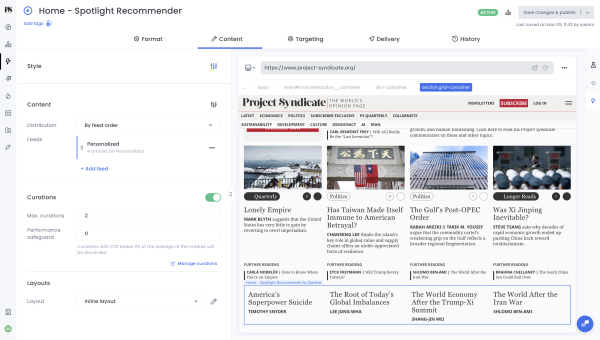
To address this, the team implemented a more robust data infrastructure, integrated with Marfeel, a platform used for real-time analytics and on-site personalisation, and started collecting first-party data.
It allowed a shift from static, retrospective analysis to a more dynamic understanding of audience behaviour with:
- real-time analytics to track content performance and reader engagement
- personalised content recommendations tailored to user interests and behaviour
- more flexible on-site promotion and experimentation, including A/B testing of titles, images, and placements
The new setup supports faster decision-making, more relevant content recommendations, and ongoing experimentation, helping Project Syndicate better connect with its audience and grow in a more sustainable way.
From intuition to experimentation
Previously, performance was assessed over longer cycles (often longer than 30 days), which limited the ability to respond quickly.
The new system introduced a more experimental approach, allowing the team to test titles, serve personalised content recommendations based on various settings, and iterate user journeys in real time. At the same time, it helped create the space for “failing safely” and knowing when to end or hit pause on experiments.
“We can now see the impact much faster, and it has changed a broader company culture from intuition-led decisions to continuous testing and iteration”, Shirin noted.
Personalisation as a growth lever
Project Syndicate introduced personalised content recommendations, targeted on-site promotions and tailored user journeys based on behaviour, preferences, and the RFV metric.
Early results have been promising:
- a doubling of click-through rates on featured content
- a 39% increase in registrations
- strong conversion rates from targeted mobile promotions
These improvements reflect a shift from a uniform user experience to a more differentiated approach that responds to the needs of different audience segments.

Rethinking the conversion funnel
Previously, users encountered a relatively rigid paywall structure, with limited opportunities to engage before being asked to subscribe. This created friction, particularly for new audiences unfamiliar with the brand.
The team is now exploring more flexible approaches, including improved onboarding flows, clearer communication of value and personalised offers based on location and behaviour. The team believes that “the retention starts from the very first visit.”
Building sustainable growth through data
For Project Syndicate, the challenge is not simply increasing subscriptions: it is ensuring long-term sustainability while staying true to its mission. As a non-profit organisation, it must balance accessibility with financial viability.
By investing in data infrastructure, personalisation, and experimentation, the team is laying the groundwork for a more adaptive and responsive product.
The Transition Accelerator has helped accelerate this shift by providing not only technical direction but also a framework for continuous iteration.
The Transition Accelerator is part of the Media Innovation Europe programme (MIE), made possible with the support of the European Union.