Analysis: Tisza’s victory offers historic opportunity for media freedom reform in Hungary
IPI op-ed: While Tisza’s landslide election victory offers opportunity to rejuvenate press freedom, unwinding Fidesz’s media capture model will be complex, but essential for achieving wider democratic reform
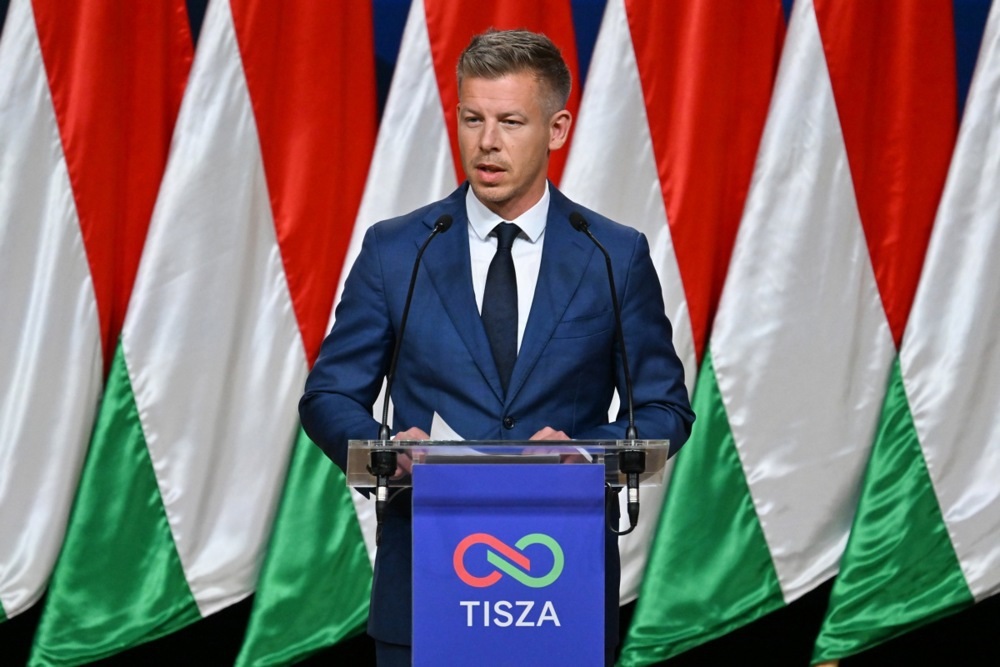
Tisza party leader and future Prime Minister Peter Magyar holds a press conference in Budapest, Hungary, 13 April 2026. EPA/Tibor Illyes
This op-ed by IPI was originally published in Balkan Insight on 4 May 2026 to mark World Press Freedom Day. Click here to read the original article
The end of the Viktor Orban era offers a historic opportunity for a democratic reset and a new era for media freedom in Hungary after a decade and a half of sustained backsliding.
During 16 years of rule, the Fidesz party of Orban built and then maintained the most sophisticated system of media control ever developed within the EU, while at the same time applying sustained pressure to independent and watchdog media.
Over the years these policies had disastrous effects on press freedom in Hungary, which plummeted to among the lowest on the European continent and cemented the country as the EU’s poster child for media capture and authoritarian backsliding.
For the incoming Tisza government of Peter Magyar, there are indications that reform of this distorted media ecosystem – and the dismantling of the Fidesz propaganda machine that defined it – will be a priority issue. Its two-thirds majority in parliament provides both the mandate and political tools to do so. However, this will require a major legislative overhaul of 2010-2011 laws, the dismantling of Fidesz-era institutions, and the creation of a new legal and regulatory framework that fosters free and independent journalism, in line with EU values.
Even with a constitutional majority, this will be no easy task. Media framework reform is a sensitive issue. If done wrong, it could create political pitfalls and bring EU scrutiny over rule of law. But if handled carefully, Hungary could offer a timely example of democratic revitalisation for both Europe and the world at a time of global media freedom erosion.
Confronting the Fidesz media empire
Inevitably, media freedom progress in Hungary will mean a direct confrontation with the system developed by Fidesz over 16 years of rule.
As the International Press Institute (IPI) has long documented, this media empire was constructed through an interlocking combination of regressive media legislation, sustained dominance over public media, the concentration of private outlets under the ownership of political allies, and the distortion of the media market via state advertising.
Through this coordinated exploitation of legal, regulatory and economic powers, it is estimated that Fidesz wielded direct or indirect control over 80 per cent of the media market. This drove a dramatic erosion of media pluralism and the solidification of political control over public discourse in a way not thought possible in an EU member state.
Taken together, this represented the most sustained assault on press freedom ever seen within the EU. While the removal of Fidesz from power will mean an end to politically motivated attacks on the press, the system of media capture it created remains in place. A system constructed over more than a decade will not be easy to dismantle.
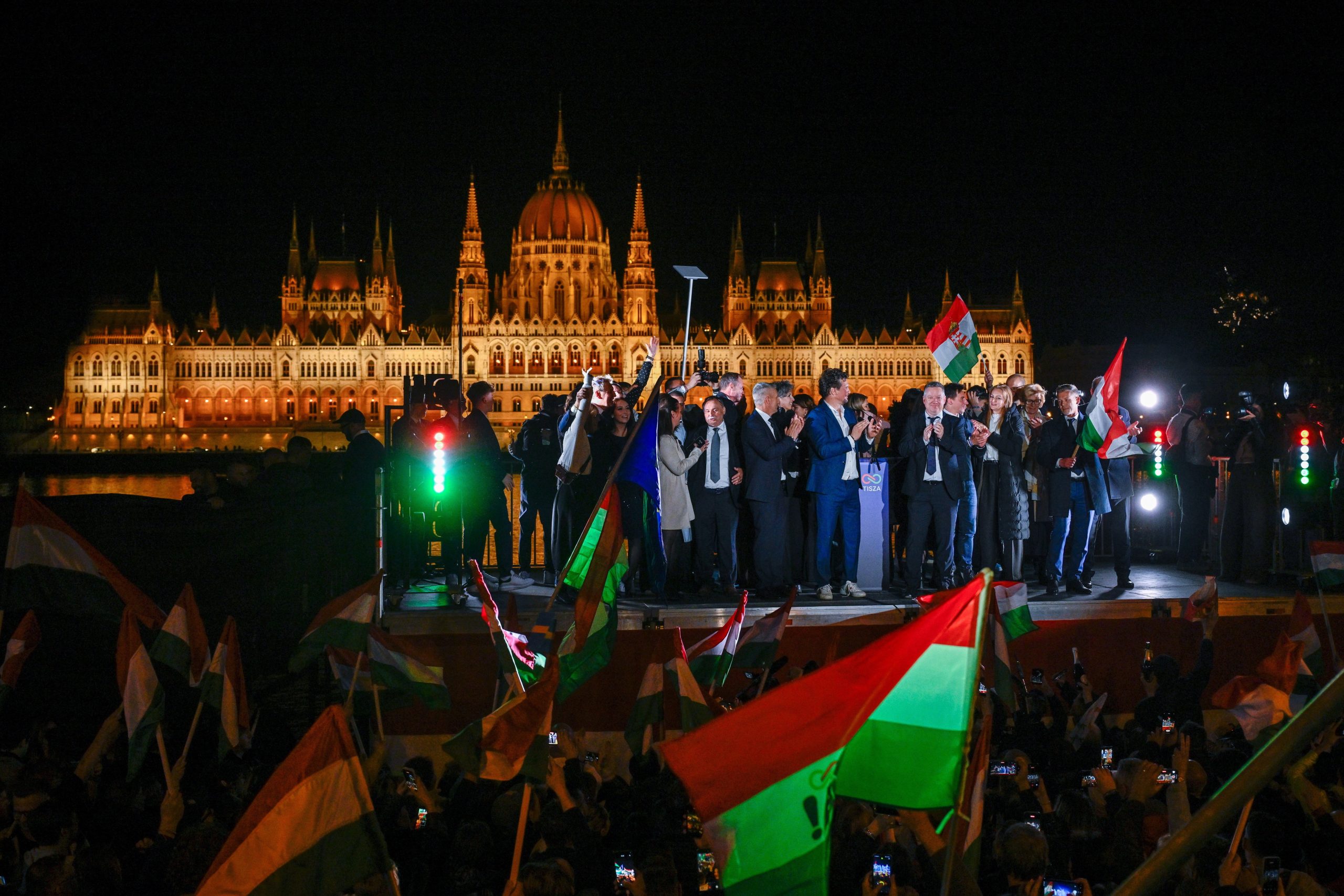
Peter Magyar (R) celebrates with supporters after his party won landslide victory in the general elections in Budapest, Hungary, 12 April 2026. EPA/Robert Hegedus
Tisza manifesto pledges
As the experience in Poland after the election loss of Law and Justice (PiS) has shown, unwinding entrenched media capture and creating a new media ecosystem which fosters pluralistic journalism will be challenging.
To do so, Tisza outlined in its election manifesto a number of policies aimed at addressing state propaganda. The most eye-catching is the immediate suspension of the news programming of the public broadcaster, MTVA, until reforms are carried out to improve its independence and neutrality. In the wake of his election, Magyar doubled down on this pledge during a fiery interview in the MTVA studio, in which he vowed to shut down what he called a “factory of lies” and suspend the “deceitful news service”.
Tisza’s manifesto also committed it to passing new media legislation; ending the public funding of state propaganda; placing a moratorium on state advertising to the media; and investigating Fidesz-era spyware abuses.
While these policies certainly point in the right direction, the details of exactly how they will be carried out and whether they are part of a wider strategy for media reform are, at present, unclear.
While the form that these changes will take and the impact they will have should emerge in the coming months, in other areas positive developments have been clear to see, even before Tisza took power. In Magyar’s three-hour press conference on the day after the election, independent media were permitted to ask questions for the first time in many years. This upended a years-long practice in which independent media were excluded from major events and press conferences held by political authorities.
Elsewhere, early signs have emerged that the Fidesz propaganda machine is already beginning to crack. At the politically captured state news agency MTI, more than 90 journalists signed a letter criticising direct censorship and demanding the restoration of editorial autonomy and impartial reporting. At TV2, the leading private pro-government TV channel, the news director was dismissed and other presenters were taken off air.
These indications from Tisza, both before and after the election, point to a fast-paced and wide-ranging restructuring of the country’s media framework. While this reform agenda will have the backing of the EU, the challenge for Tisza will be how to dismantle this captured system using only legal and democratic means. Maygar’s threat to suspend the public news service will be an early flashpoint here and could define Tisza’s approach moving forward.
System change
To truly restore media freedom in Hungary, the new government will need to go far beyond narrow amendments and cosmetic management changes. Reform of the country’s media framework in a way which safeguards press freedom requires systemic change – one that fixes the flawed media architecture put in place during Fidesz’s 2010-2011 media overhaul. It is from here that so many of the current issues stem.
A first legislative priority for the new Tisza government for media will need to be reform of the current laws regarding public media. In 2010, Fidesz passed Act CLXXXV on Media Services and on Mass Media, which unified the various public service broadcasters and state media entities under one centralised framework, placed under the politicised control of the state-run MTVA. Within this governance and funding system, management and senior editorial positions became deeply politicised and media institutions were deformed into audiovisual state propaganda tools.
Legislation overseeing the public media system needs to be replaced with a modern framework that guarantees independent public media, in line with Article 5 of the European Media Freedom Act (EMFA). These changes should ensure that national media regulation should be institutionally separated from public media governance, to limit the possibility of integrated institutional capture.
A second legislative priority should be addressing the law on media regulation. The current media regulatory system is also shaped by laws passed by Fidesz in 2010-2011 that created the National Media and Infocommunications Authority (NMHH) and its Media Council. Under this centralised architecture, Hungary’s media regulatory system also became the most politically captured in the EU.
Within this legal framework, Fidesz repeatedly abused its two-thirds majority to nominate and appoint its candidates to all five seats on the Media Council. Under this leadership, a majority of media tender decisions over the past decade favoured outlets aligned with Fidesz, and the authority often prioritised pro-government interests in media mergers and frequency allocations. A clean break from this captured regulatory framework, and its replacement with an independent body, is essential.
A third priority for the new government should be a fundamental modification of the role of the state in the advertising market. Under Fidesz, the Hungarian state was one of the largest advertisers in the market. As there are no legal provisions ensuring fair and transparent distribution of state advertising, Fidesz, through the National Communications Office, allocated advertising based on political allegiance rather than objective criteria, warping the market in favour of a pro-government narrative.
The normalisation of state advertising practices for media and the defunding of state propaganda will cause a major realignment of the market. Propaganda media that survived off these bloated advertising funds will suddenly find themselves cut off. While larger pro-Fidesz TV stations and tabloids will probably survive this adjustment, smaller outlets fused to this financial system look likely to collapse. While this will be a bumpy process, ensuring fair advertising practices is central to normalising the market, creating a level playing field and bolstering media pluralism.
To ensure these three core issues are handled in line with EU standards, the blueprint for legislative and policy design should be the European Media Freedom Act. The EMFA has clear and mandated rules on public media, media regulators and state advertising that, if implemented in Hungary, offer the path forward for democratic reform. Hungary currently faces infringement proceedings from the European Commission over its lack of alignment with the regulation. For Tisza, dropping Hungary’s legal challenge against EMFA at the Court of Justice of the EU would be an early sign of goodwill to Brussels.
To guide this reform process, IPI has called on Tisza to establish a high-level parliamentary working group for media reform, supported by independent media experts, domestic civil society and academics. This working group should be tasked with developing a comprehensive and long-term blueprint and providing detailed input on legislative design. It should also ensure the development of media legislation in Hungary meets the highest democratic standards set out by the Council of Europe and the EMFA.
Beyond these three key pillars, IPI has outlined a further seven reform priorities for the Tisza government. This includes regenerating media pluralism and limiting media concentration, especially at the local level; providing accountability and safeguards for spyware surveillance of journalists; improving the legal climate and creating protections against SLAPPs; and guaranteeing fair access to information for the press.
Crucial also will be the immediate repeal of the Act on the Protection of National Sovereignty and the subsequent dismantling of the Sovereignty Protection Office. This institution represents one of the most serious threats to democracy, the rule of law and media freedom in Hungary. Since its establishment in 2023, the authority has systematically abused its powers in a discriminatory manner to target critical and investigative media that receive foreign grants or funding and falsely portray them as the agents of foreign interests.
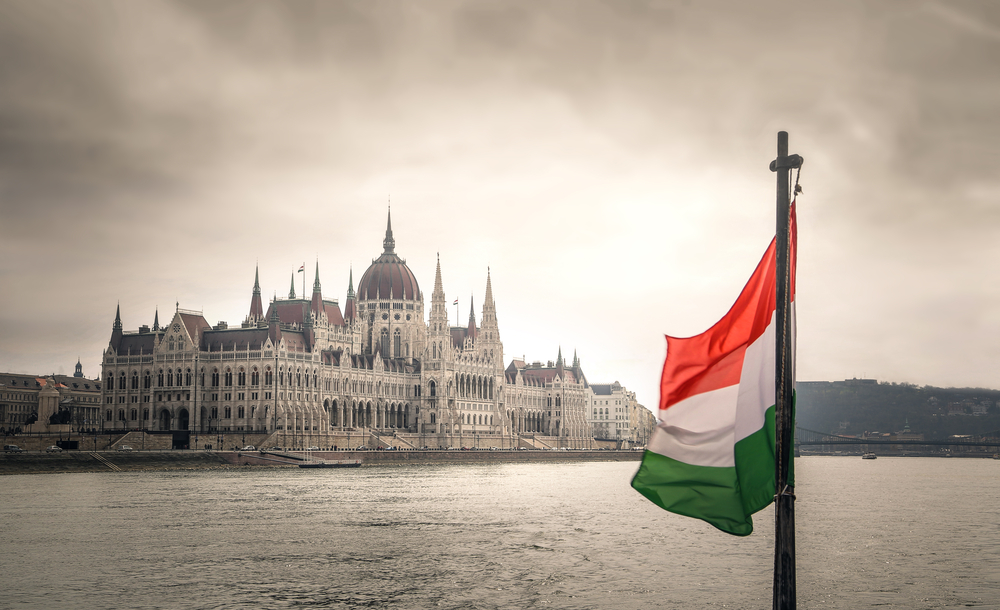
Hungarian Parliament Building, Budapest, Shutterstock/Merla
Challenges and opportunities
Even with Tisza’s two-thirds majority, after more than 15 years of the steady erosion of media freedom and pluralism in Hungary, the process for reversing this trend will be long and complex.
Nothing will bring back the independent newsrooms shuttered or lost to political capture. Accountability for past abuses will be hard to secure. Efforts to rebuild media pluralism eroded over more than a decade and a half will take more than one political term. EU scrutiny will be strong.
Yet for Hungarian democracy to revive, media freedom reform is essential. This should not be aimed simply at dismantling the old system, but building a new set of laws, a regulatory framework and fostering a media market in which independent journalism can naturally regenerate.
If there is hope for this project, it comes not from politics but from the independent journalist community in Hungary themselves. Over the past 16 years, this group of editors, journalists and media owners have refused to compromise on their values, stayed loyal to the truth, and helped hold power to account and sustain democracy, especially during the election.
If given a level playing field, these media outlets can be the vanguard in the wider development of a thriving independent media landscape. However, the road to rebuilding media pluralism in Hungary will be challenging, and smaller and investigative media in particular will require continued support to navigate the coming market realignment.
If Tisza is successful in establishing a new framework for media freedom in Hungary that allows this kind of independent media to flourish, the country could offer an example of press freedom revitalisation for both Europe and the world – one sorely needed in a time of global media freedom erosion.
Despite all the challenges ahead, as we mark World Press Freedom Day on May 3, hopes are high that one year from now media freedom in Hungary will offer a very different picture to the one today.