The International Press Institute (IPI) today hails the remarkable resilience of our members and the wider independent media community in Hungary, who helped hold power to account and sustain democracy through more than a decade-and-a-half of authoritarian backsliding under the government of Prime Minister Viktor Orbán.
Over the past 16 years, independent media in Hungary faced the most sustained assault on press freedom ever seen within the European Union. In response to coordinated financial, political and regulatory pressures, these journalists, editors, and media entrepreneurs refused to be silenced or compromise their commitment to independent journalism or the truth.
IPI is proud to count these journalists and media outlets amongst our global membership network. Today, we hold up their story as a powerful example of resilience in the face of political control and economic pressure – one that contains lessons for journalists and media outlets around the world facing similar undemocratic attacks.
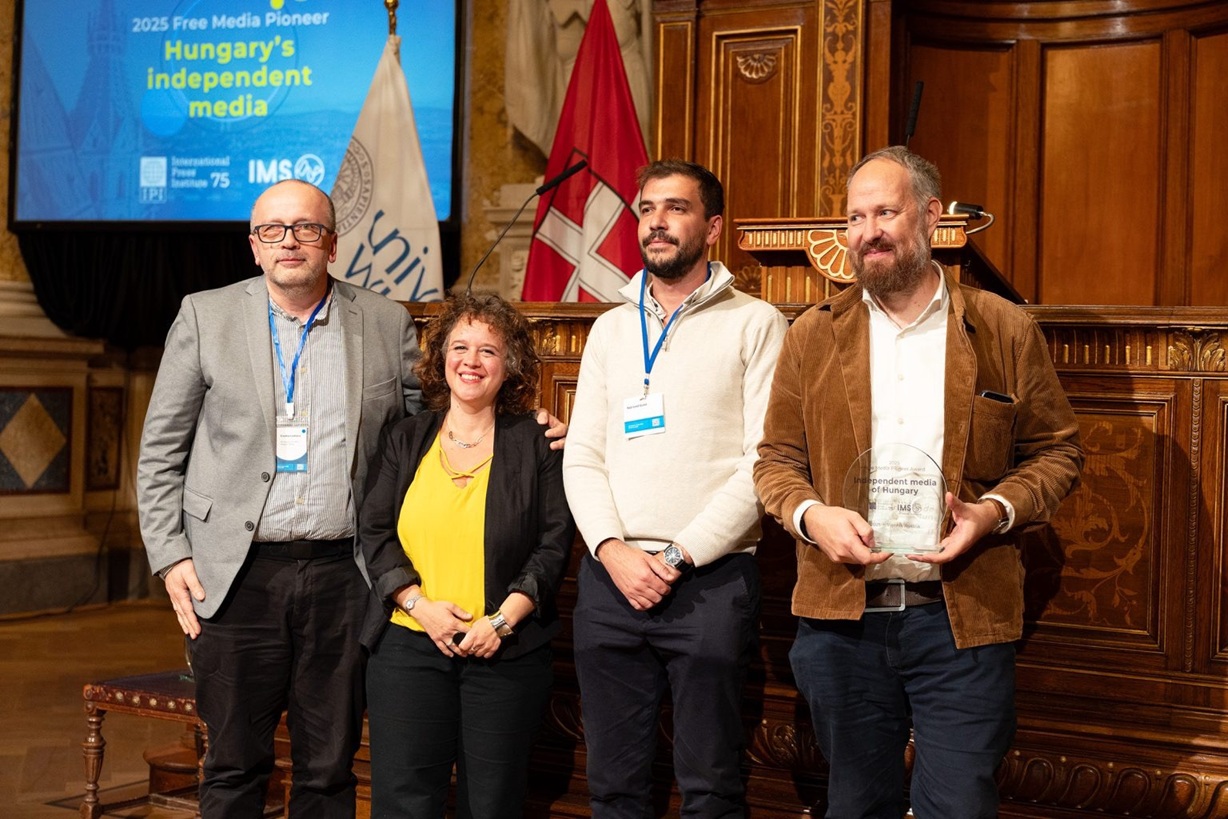
In October 2025, IPI awarded the Hungarian independent media community with the IPI-IMS Free Media Pioneer Award at a ceremony in Vienna, in recognition of their innovation, and adaptation under sustained attacks. Since then, the essential role these media outlets have played in reporting, investigating and informing citizens has been clear to see.
Nowhere was this watchdog role more important than ahead of the recent election, where independent media experimented with long form documentaries exposing corruption, shone a spotlight on crumbling public services, broke bombshell investigative stories about Russian meddling, and provided a crucial space for whistleblowers to come forward in the last weeks of the campaign.
For years before the election, print, online and investigative media, as well as individual and freelance journalists, kept public interest journalism flowing, revealed widespread corruption and scandals, and kept severely eroded media pluralism alive. Their reporting offered a crucial source of factual information for the public, against a tide of relentless state propaganda and disinformation.
While these efforts rightly received international recognition and awards, their success is even more remarkable considering the scale of pressures against independent media by the Orbán government, which over the past 16 years abused economic and regulatory powers to distort the country’s media market in favour of pro-government alignment at the expense of independent or critical reporting, severely eroding media pluralism and media freedom.
In response, journalists broke away from captured media and launched their own news outlets, while others reinvented existing ones. To survive in this new economic reality, they developed innovative new funding models, experimented with creative community-based and crowdsourcing models, engaged in collaborative cross-border projects, and profited from high levels of reader trust in receiving donations. Even those independent media who managed to carve out a market position still faced years of smear campaigns, spyware surveillance, cyber attacks, abusive lawsuits and arbitrary investigations from the Sovereignty Protection Office.
The removal of Fidesz from power now offers a historic opportunity for a democratic reset on press freedom in Hungary, for which IPI has already outlined our top media reform priorities. While the most serious threats against independent journalism are hopefully behind us, the challenges for independent media have by no means subsided. International donors and institutions bear a continued responsibility to support independent media with financial assistance and grants. The road to rebuilding media pluralism in Hungary will be long and challenging, and smaller and investigative media in particular will require continued support to navigate the coming market realignment.
The survival of independent media in Hungary is a story of a dogged community which, even after 16 years of democratic backsliding, refused to give up their commitment to the values of independent journalism. Their defiance offers an example of journalistic innovation and funding evolution in a captured media environment. More widely, it shows that even in hostile political climates, independent journalism and a free press can be sustained wherever citizens continue to value truth, transparency and accountability.
Hungary offers a story of hope in a world where press freedom is receding globally: that wherever there are journalists committed to doing their jobs and holding power to account, independent journalism can endure.
- Click here for more information on how to join IPI’s global membership network. IPI membership is open to anyone active in the field of journalism, in news media outlets, as freelancers, in schools of journalism or in defence of press freedom rights, who supports the principle of freedom of the press and desires to co-operate in achieving IPI’s objectives.