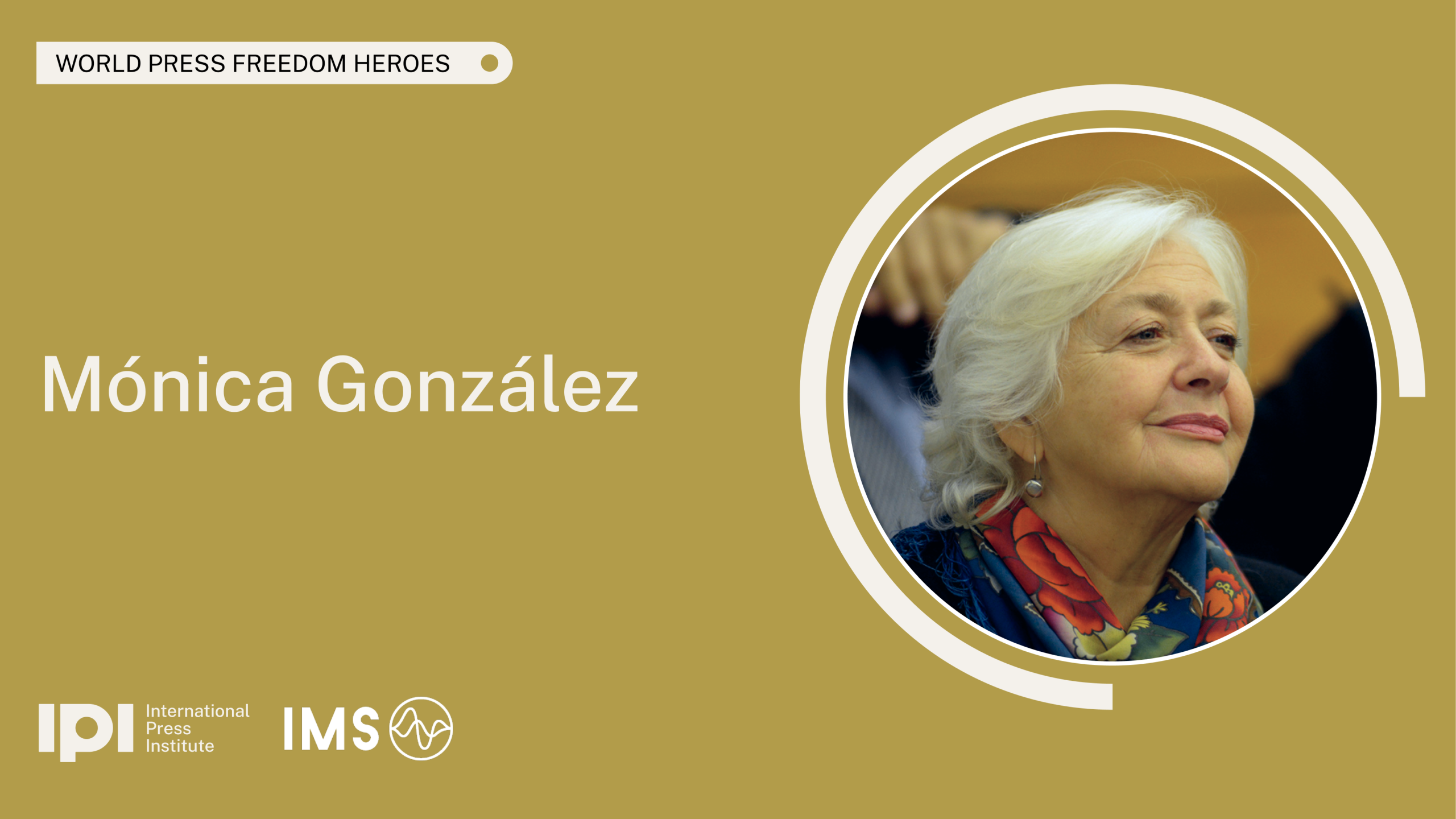
Before Chilean dictator Augusto Pinochet came to power in 1973 in a violent military coup, Mónica González wanted to be a doctor. After her father died in a railway accident, she had to forgo her studies and find another profession. She landed on journalism.
“I felt it was similar to an intensive care unit in a hospital. A public service,” González told IPI in an interview. Her first job was at El Siglo, where she investigated the origins of the black market in Chile, the spread of which was a precursor to the 1973 coup.
Then Pinochet came to power, and González’s world — and the world of so many ordinary Chileans — changed drastically. “Many people I loved were either taken prisoner, died, or had to leave,” González told IPI.
For 17 years, the Pinochet regime presided over a state of terror in Chile, marked by widespread human rights abuses carried out by the military junta against those deemed to be opponents of the regime. Thousands of Chileans were forcibly “disappeared” by the regime and tortured and executed in secret detention sites. According to reports from several Chilean truth commissions convened after Pinochet’s fall, more than 40,000 people were victims of human rights violations.
Yet rather than avoiding coverage of the regime for fear of becoming a victim herself, it was exactly these high stakes that fuelled González’s dogged work to uncover and reveal the widespread corruption and atrocities of the Pinochet dictatorship. “I had two young daughters, so dismantling the death machine became a priority,” she explained.
In recognition of González’s dedicated commitment to independent, investigative reporting — despite the enormous personal risk — IPI is honoured to name her a 2026 recipient of the World Press Freedom Hero Award.
Building a human chain of stories
One of the questions that drove González as she reported on story after story of secret prisons, torture, rape, and murder was unraveling how men and women became willing recruits of the regime. Over her years covering the Pinochet dictatorship, she began to understand.
“The killing machine is a mechanism that is set up before it starts killing; it is oiled beforehand; it has men and women who finance it…The important thing about the death machine is identifying it before it is set in motion to kill.”
In bringing the abuses to light, González hoped to interrupt the cycle of violence. “My main motivation in continuing to pursue investigative journalism was to stop the killing machine, to return to a country where, when you heard a car approaching, you didn’t feel ice creeping into your blood,” González explained.
Through her reporting, González hoped to create a “human chain” that kept alive the stories of the tens of thousands of anonymous individuals victimised by the regime. “It’s about making sure it never dries up, that that river, even if it’s just a trickle, keeps flowing.”
González’s work did not come without cost. Over nearly two decades covering the Pinochet dictatorship, she faced imprisonment, exile, and repeated judicial prosecutions for her work.
“You don’t know what you’re capable of until things happen to you,” González told IPI when asked how she continued despite the forces against her. “I don’t like to talk about it much — I’m a journalist, and people want to see the result, not how much it cost. Meeting people who suffered far greater horrors than I did taught me to be brave.”
Much of the time, it was the small kindnesses of strangers that kept her going: “In prison, I met amazing women. Even in the most horrific and violent places, there’s always someone who comes up and with a gesture, a whisper, a glass of water, tells you: you’re not alone, you’re never alone.”
Even after enduring such hardships, González views her role as a journalist as a kind of privilege to confront “the best and worst of humanity, and of yourself.” As she told IPI, González believes that by telling the stories of those victimised by the Pinochet regime, and bearing witness to the suffering of so many, we can prevent future atrocities.
“Knowing the horror, describing it, and making visible what happened is very impactful. It is urgent to tell the story so that there can be justice and healing,” González emphasised. “We journalists today have a key role in reconstructing the true history…History serves to break the cycle of impunity and recreate hope.”
A new fight for the truth
In the years since Pinochet’s rule ended in 1990, González has dedicated much of her time to passing on the lessons she learned to the next generation of investigative reporters covering systemic corruption and democratic backsliding across the region. As González put it, “it’s a magic formula. When the ‘older’ journalists work with the younger ones together, we are unstoppable.”
Yet as authoritarianism gains ground across Latin America, and the world, González believes we have never faced a historical turning point like today’s. From the rise of fake news and the increasing concentration of wealth and media ownership to technofascism, independent journalism faces a slew of new, unprecedented challenges.
In González’s view, the key to sustaining independent journalism is working together across borders to ensure no story goes untold. “We’ve learned to unite, that when we work as a team and collaborate, we are more powerful than an army of tanks.”
Despite the challenges, González has no shortage of reasons to be optimistic about the future of independent journalism in Latin America. “We are doing the best journalism in the world today, and I don’t say that out of pretension or arrogance…I see what colleagues in countries like Guatemala, Mexico, and El Salvador are doing, and I am deeply moved by their quality, rigour, ethics, and investigative methods.”
Reflecting on her decades as a journalist, González feels grateful to be “part of a generation that could truly dream of changing the face of misery and loving intensely, being happy, making love with the strength we possessed to change the imprints of poverty and suffering.”
For González, it is the continued dedication of her colleagues, and her belief that “love comes first” that keeps her inspired to continue. In her words, the practice of journalism is worthwhile because “we all have the right to truly live. Journalism is the lifeline that allows us to achieve that right.”
About the World Press Freedom Hero Award
The IPI-IMS World Press Freedom Hero Award honours journalists who have made significant contributions to independent journalism, particularly in the face of great personal risk. The 2026 recipients of the award are Mónica González, Patricia Evangelista (Philippines), and Hungary’s independent journalists.
Last year, as IPI marked its 75th anniversary, seven journalists from Ethiopia, Georgia, Hong Kong, Palestine, Peru, Ukraine, and the United States were named World Press Freedom Heroes. See all past award recipients.
This year’s awards will be presented together with the IPI-IMS Free Media Pioneer Award at a special event at this year’s Gabo Festival (July 24-26, Bogotá, Colombia), the leading event for journalists in Ibero-America.