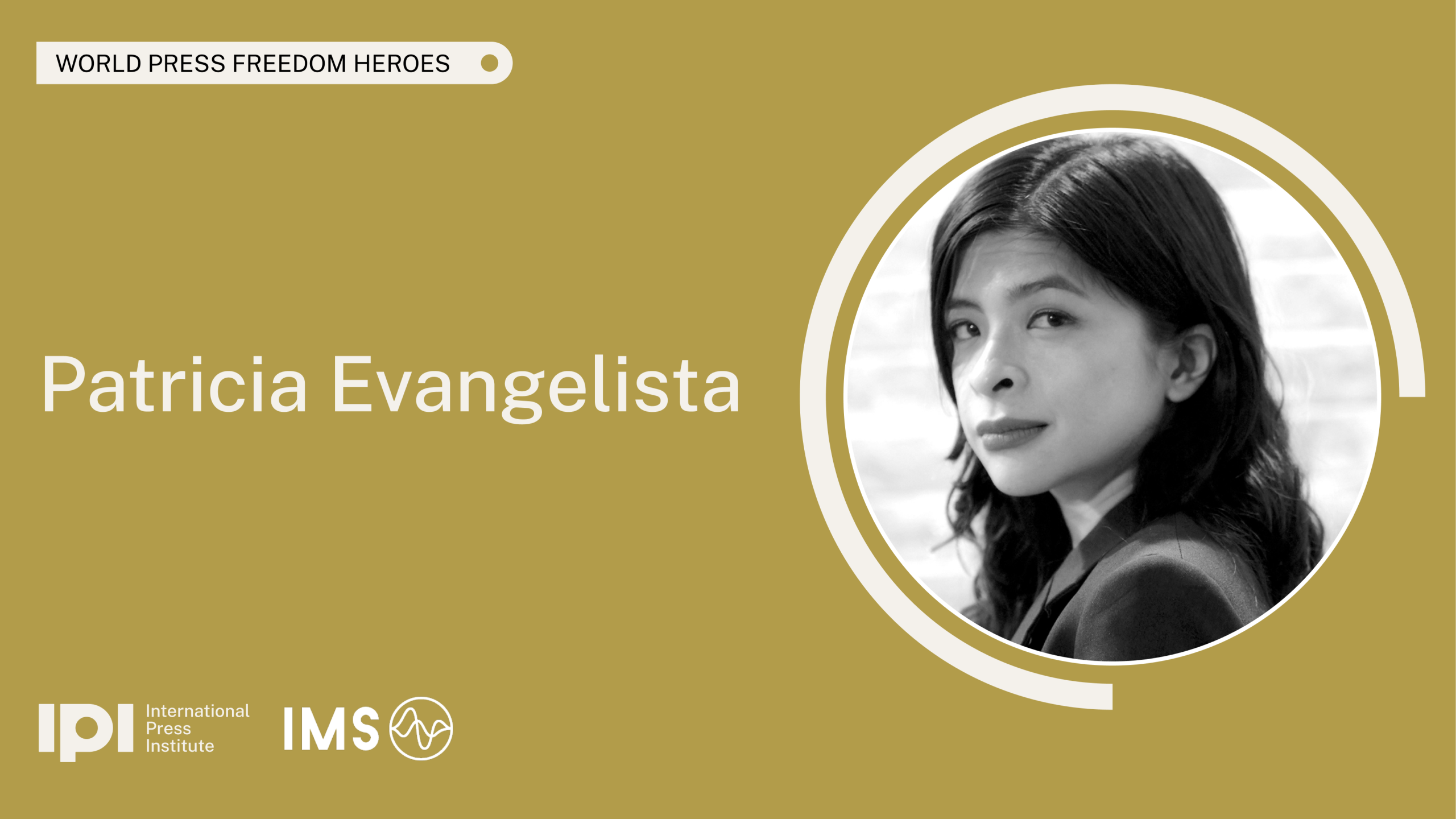
Patricia Evangelista was a recent university graduate with a degree in communications when she heard that two young women she had gone to school with had been “disappeared” by the state military.
“At that time, I didn’t even know that there was a different usage of the word ‘disappeared’…I was not aware my government was in the business of torture and murder,” Evangelista told IPI in an interview. “I felt the compulsion to find out what had happened.”
On June 26, 2006, Sherlyn Cadapan and Karen Empeño, student organisers at the University of the Philippines, were kidnapped by armed men, tortured, and accused of communist ties, a practice known as “red-tagging”.
For years, Evangelista covered their story. “I thought that the reason [the disappearances] were happening was because people didn’t know about it, and that if I wrote about it, it would stop.” On September 17, 2018, a Filipino general nicknamed “The Butcher” was found guilty and sentenced to life in prison for his involvement in the abductions, yet the girls’ ultimate fate remains unknown. Last month marked the 20th anniversary of their disappearance.
Since Cadapan and Empeño’s abductions, Evangelista has reported on an untold number of state-sanctioned killings and disappearances of civilians carried out by police and vigilantes as part of former Filipino President Rodrigo Duterte’s infamous “war on drugs.” For seven years, Evangelista worked as an investigative reporter for the Philippine news company Rappler, where she led the outlet’s award-winning “Impunity Series,” a longform, multimedia narrative account of the drug war.
It was early in her time reporting on the extrajudicial killings (or, EJKs as they became known) that Evangelista realised her success as a journalist couldn’t necessarily be measured by a change in the government’s actions. Rather, she saw her role as a memory keeper, preserving the names and stories of the drug war’s victims despite the government’s attempts to erase them from societal memory. As she told IPI, “It’s about keeping a record.”
Over the course of the six-year drug war, Evangelista documented the human impact of violence, shedding light on the struggles of marginalised communities in the Philippines, culminating in her debut book “Some People Need Killing: A Memoir of Murder in My Country.” In recognition of her courageous reporting, IPI is honoured to name Evangelista a 2026 World Press Freedom Hero.
Countering the official narrative
From the day he took office on June 30, 2016, Duterte and the members of the death squads that carried out his vision sought to justify the mass killings of civilians by labelling the victims as drug addicts and dealers that deserved to die.
Evangelista has reported how police routinely falsified evidence, fabricated causes of death, and staged crime scenes to rationalise their targeting of some of the Philippines’ most impoverished communities.
Through her reporting, Evangelista sought to counter the government narrative about the drug war’s victims by painting a fuller, truer picture of who they were. “You can’t reduce a victim of the drug war to just what happened to him. You have to see the whole person.”
Justice for the survivors and families of the drug war’s victims has been, for the most part, nonexistent. As Evangelista put it, “truth, like safety, is a privilege very few can afford.”
The government has acknowledged around 6,000 killings over the six-year course of Duterte’s administration. Human rights organisations believe the number of victims is much higher, with some estimates putting the total near 30,000. Yet due to the extrajudicial, often clandestine nature of the killings, the true number may never be known.
“What we do as reporters, photographers, filmmakers, is we tell individual stories about individual lives that have been upended by what happened to them,” Evangelista said. “It’s like when a bullet goes through a brain, the exit wound is bigger than the entry. The radiating fractures are unpredictable, so we tell those stories to show the long term impact.”
Who tells the story
“I meet a lot of people after they die,” Evangelista explained, describing where so many of her reports on the drug war began. “I start at a crime scene, or at the morgue, then I talk to their families…I get an image of the person, so I can tell people, this is who he is, this is who he was, and this is what happened to him.”
Evangelista spent much of her time in the field, building trust with the surviving members of the victims’ families, many of whom were justifiably concerned about the risks of speaking out. “In the case of my book, it took a lot of courage for people to say, put my name to that story.” But in the end, most everyone eventually agreed.
In telling these human stories, Evangelista soon came to the realisation she was not just challenging the government narrative, but also the way many of her fellow citizens understood their country’s past and present.
“For decades, the abuse of power by the state has been diligently documented by generations of journalists in my country,” Evangelista explained. Yet, “our relationship with history, with the past, is very negotiable.”
“There will be people who read my book who will say ‘this is fake news, this is not real’…We [journalists] keep a record. And hopefully, if we do our jobs well enough, that record will matter someday.”
On March 11, 2025, nearly three years after leaving power, Duterte was arrested under an International Criminal Court warrant and charged with crimes against humanity. He will be tried in The Hague, where — as Evangelista wrote in the days after his arrest — he will enjoy the due process his administration denied to his thousands of victims.
The cost of bearing witness
It was not long into her journalism career that Evangelista became acutely aware that her reporting on the human rights abuses of her government carried a certain amount of risk.
In November 2009, when she was still freelancing for several different newsrooms, Evangelista heard news of a massacre in the town of Maguindanao, during which 32 journalists were killed in one of the most deadly days for the press in recent history. In spite of the risk — and the cost — she spent her own money to fly down to cover the massacre.
As the van Evangelista was travelling in with a group of other journalists approached a security checkpoint, an officer asked who they were. Evangelista recalls that after one of the group identified themselves as reporters, the security officer told them “good luck.” “It was then I understood there was no safety in numbers.”
Despite the explicit protections for press freedom codified in the Philippines’ constitution, the country remains one of the most dangerous in the world for the practice of journalism. Two journalists have been killed in the last six months alone, while many more are unjustly imprisoned on spurious charges ranging from money laundering to terrorism.
One young journalist, Frenchie Mae Cumpio, was just 21 years old when she was first arrested. In January 2026, she was sentenced to a maximum of 18 years in prison on spurious charges of financing terrorism.
“We remain one of the most dangerous countries for journalists, and this is at a time when newsrooms are shrinking and funding is disappearing,” Evangelista said. Under such a restrictive operating environment, some degree of self-censorship becomes inevitable.
Every time she publishes a story, Evangelista makes a calculation. “Is this the story that will send me to jail? Is this the story that will get me killed?” And the one that haunts her the most: “Is this a story that will get someone else killed?”
About the World Press Freedom Hero Award
The IPI-IMS World Press Freedom Hero Award honours journalists who have made significant contributions to independent journalism, particularly in the face of great personal risk. The 2026 recipients of the award are Patricia Evangelista, Mónica González (Chile), and Hungary’s independent journalists.
Last year, as IPI marked its 75th anniversary, seven journalists from Ethiopia, Georgia, Hong Kong, Palestine, Peru, Ukraine, and the United States were named World Press Freedom Heroes. See all past award recipients.
This year’s awards will be presented together with the IPI-IMS Free Media Pioneer Award at a special event at this year’s Gabo Festival (July 24-26, Bogotá, Colombia), the leading event for journalists in Ibero-America.