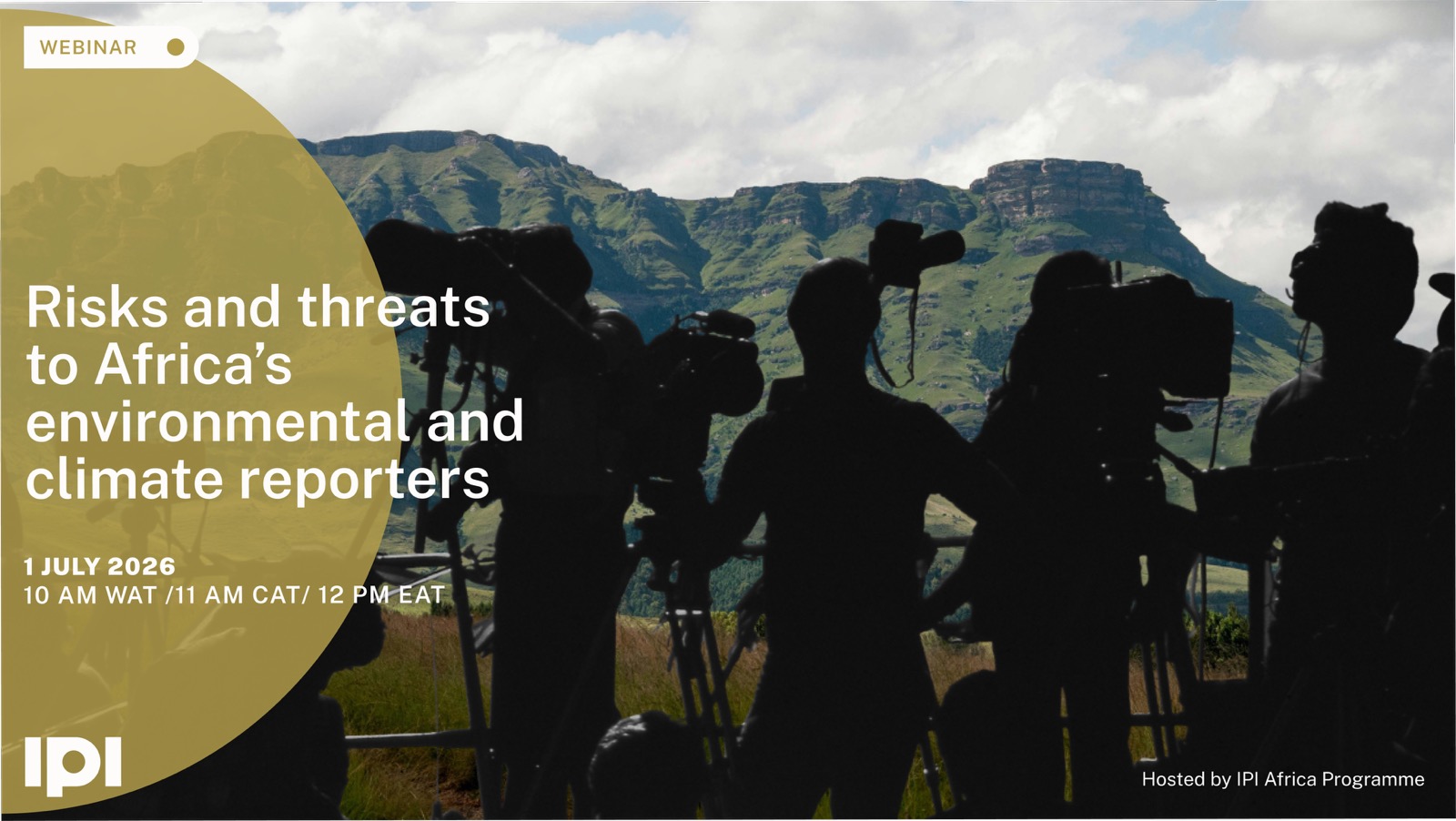
Countries across Africa face escalating climate and environmental challenges brought on by extreme weather events, water scarcity, and the adverse effects of natural resource extraction. Robust reporting on these topics is critical to raising public awareness, holding governments and businesses accountable, and driving meaningful action and policy responses.
Yet journalists in Africa covering climate and environmental issues face a wide range of barriers to their work, as actors with vested interests seek to silence critical reporting.
The International Press Institute (IPI)’s latest monitoring report documents more than two dozen incidents of attacks and threats to journalists working across environmental topics in sub-Saharan Africa from October 2025 to March 2026.
IPI’s data shows that journalists reporting on natural resource exploitation — especially illegal mining, deforestation, and oil management —as well as water and land management issues affecting local communities, are at particular risk. Reporters across the continent faced physical assault, intimidation, and legal harassment (see IPI’s recent report on SLAPPs). State actors remain a key source of threats, though IPI’s monitoring also underscores the role of other actors, including local and foreign companies, non-state actors such as armed rebel groups, and local inhabitants.
This webinar brings together IPI experts with journalists and civil society actors from Ghana, Somalia, and the Democratic Republic of the Congo — all of which face serious environmental and climate challenges — to discuss IPI’s latest findings and the wider risks and challenges to environmental reporting in sub-Saharan Africa.
Moderator: Nompilo Simanje, IPI Africa Programme Lead
Speakers:
- Edzodzi Ahiadou, IPI Africa Programme Officer
- Abdalle Mumin, Secretary General, Somali Journalists Syndicate, Somalia
- Mavis Okyere, Journalist, Ghana Broadcasting Corporation (GBC), Ghana