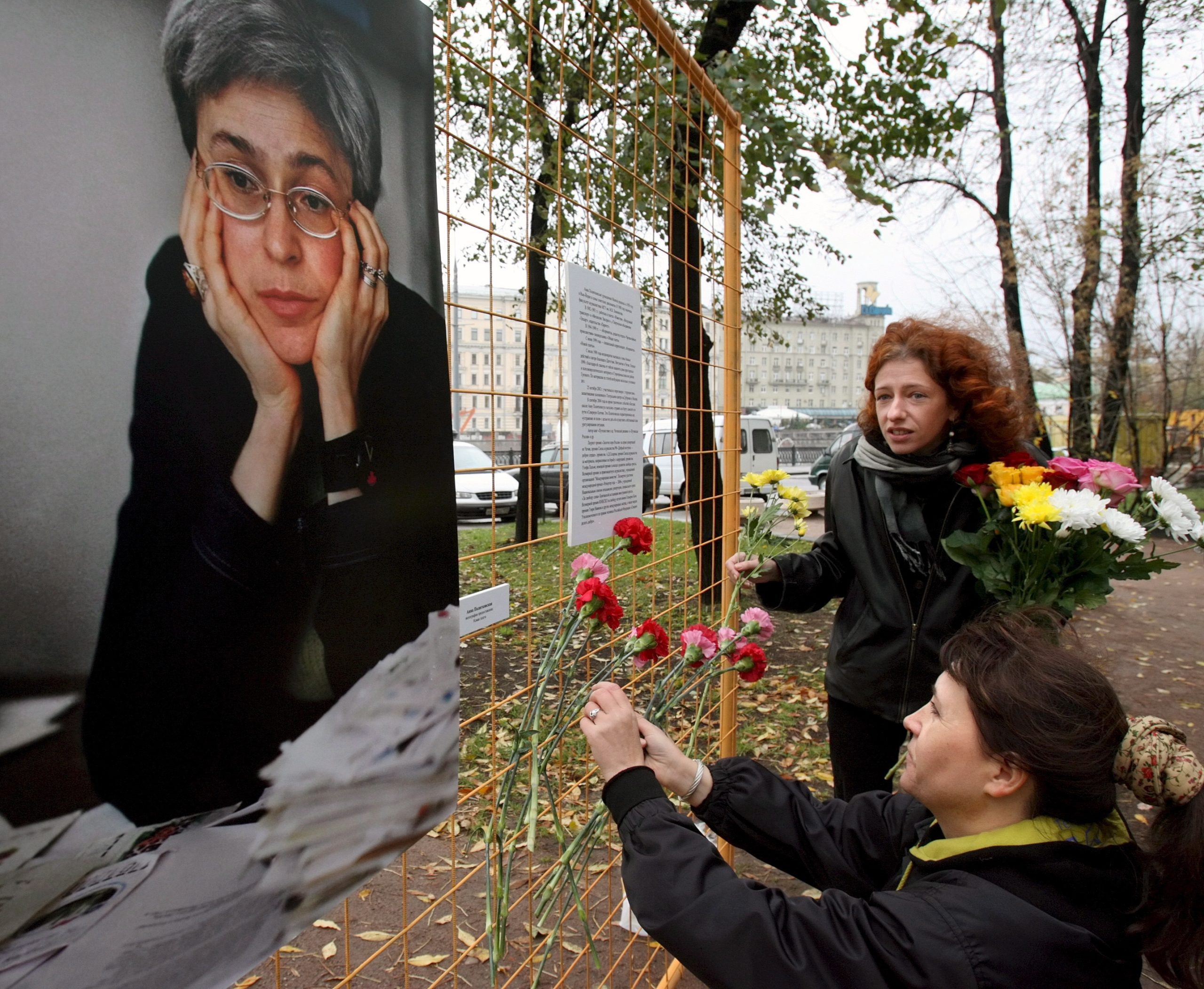
Twenty years after Russian journalist Anna Politkovskaya was shot dead in her Moscow apartment building, the International Press Institute (IPI) repeats its demand for accountability. IPI also renews its call to strengthen international mechanisms for investigating crimes against journalists when states fail to meet that obligation.
Politkovskaya was shot four times, including once in the head, in the elevator of her Moscow apartment building on October 7, 2006. She was 48 and a special correspondent for Novaya Gazeta. Months after her death, Politkovskaya was named an IPI World Press Freedom Hero.
Russian courts have convicted six men in connection with the killing. No one has ever been tried as the person who ordered the murder.
In 2021, the statute of limitations in the case expired. Under Russian law, those who ordered Politkovskaya’s murder can no longer be prosecuted for it.
Two years later, Russian President Vladimir Putin pardoned Sergei Khadzhikurbanov, a former Moscow police officer serving 20 years for his role in the murder, after Khadzhikurbanov signed a contract to fight in Ukraine following Russia’s full-scale invasion.
“Twenty years since Anna Politkovskaya’s brutal murder, those ultimately responsible have never been brought to justice,” IPI Director of Advocacy Amy Brouillette said. “This highlights the urgent need for an independent, international mechanism empowered to investigate crimes against journalists when the state responsible for carrying out these investigations and securing justice will not.”
Politkovskaya built her reputation on seven years of reporting from Chechnya, covering the Second Chechen War that began in 1999, where she documented torture, disappearances, and abuses by Russian forces. Her work drew sustained retaliation.
Russian security agents detained her in Chechnya in February 2001 and held her in a pit for three days without food or water while an officer threatened to shoot her. She fled to Austria later that year after receiving death threats. In 2004, she was poisoned on a flight to Russia while travelling to cover the Beslan school siege.
In 2004, she also interviewed Ramzan Kadyrov, then deputy prime minister of Chechnya and now its head, who threatened and insulted her during the exchange.
After the 2012 conviction of a former police officer who organised the surveillance of Politkovskaya, investigators pointed to exiled businessman Boris Berezovsky and Chechen envoy Akhmed Zakayev. Lawyers for Politkovskaya’s family dismissed that claim as unfounded and politically motivated.
In 2018, the European Court of Human Rights ruled in Mazepa and Others v. Russia that the country had violated the right to life under Article 2 of the European Convention on Human Rights by failing to investigate Politkovskaya’s killing effectively.
The Court accepted that Russia had convicted the men who carried out the murder. It held that investigators had taken no adequate steps to find who commissioned the killing, had followed a single theory without explaining how, and had never pursued the lines of inquiry raised by Politkovskaya’s family, including alleged involvement by the FSB or the Chechen administration.
Russia left the European Convention on Human Rights in September 2022, closing that route for any future case. It remains bound by the U.N.-backed International Covenant on Civil and Political Rights, which carries the same duty to investigate a killing, but no court can now enforce that duty against Moscow.