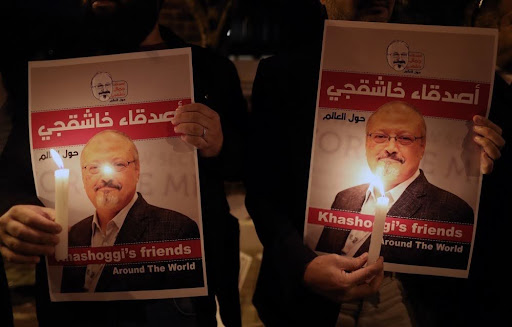
Eight years after Washington Post columnist Jamal Khashoggi was violently murdered by Saudi operatives in Istanbul, the International Press Institute (IPI) repeats its demand for accountability. IPI also renews its call on the international community to prioritise strengthening international mechanisms for investigating crimes against journalists — an essential step in tackling impunity when states fail to uphold their obligation to investigate and bring all perpetrators to justice.
On October 2, 2018, Khashoggi, a Saudi national and vocal critic of the regime, entered the Kingdom’s consulate in Istanbul to collect a document needed for his marriage while his fiancée waited outside for more than 10 hours. He never came back out.
Subsequent investigations revealed that the Saudi regime planned and perpetrated Khashoggi’s murder inside the consulate, sending a team of 15 operatives who injected the journalist with a drug, killed him, and then dismembered his body with a bone saw. His remains have never been recovered.
An October 2019 investigation by Agnès Callamard, the U.N. Special Rapporteur on extrajudicial, summary or arbitrary executions, concluded that Khashoggi’s murder was “overseen, planned and endorsed by high-level officials,” and found credible evidence the killing was premeditated.
Eight unnamed Saudi individuals were sentenced in December 2019 for their involvement in Khashoggi’s killing after a closed-door trial in the Kingdom that human rights and watchdog groups have widely criticised for allowing senior officials to evade punishment. Callamard’s report also highlighted serious procedural flaws in the trial.
Her report also recommended the establishment of an international task force to investigate crimes against journalists and human rights defenders and for an instrument within the UN to support and carry out such investigations.
In 2020, Turkey indicted and put on trial in absentia 20 Saudi nationals in connection to Khashoggi’s killing after Saudi Arabia rejected Turkish extradition requests. In 2022, Turkey suspended and transferred the trial to Saudi Arabia, effectively halting the case.
A 2021 U.S. intelligence assessment concluded that Saudi Crown Prince Mohammed bin Salman approved the operation to “capture or kill” Khashoggi, a U.S. resident.
To date, Bin Salman and the senior officials around him have faced no accountability.
“The lack of real accountability for Jamal Khashoggi’s killing has become emblematic of the troubling pattern of impunity for crimes against journalists globally,” IPI Director of Advocacy Amy Brouillette said. “This pattern has been enabled by the failure of states to properly investigate and prosecute when crimes occur and by the international community’s inability or unwillingness to hold states accountable for these obligations. This case also underscores the urgent need to bolster existing mechanisms for addressing crimes against journalists, including by establishing an international task force to investigate such crimes.”
In 2021, then-U.S. President Joe Biden announced sanctions and visa bans targeting Saudi citizens, but not the crown prince himself. The following year, the U.S. State Department determined that he had immunity from a lawsuit brought by Khashoggi’s fiancée and a non-profit organisation.
U.S. President Donald Trump called the killing of Khashoggi the “worst cover-up in history” weeks after the murder, but has since repeatedly declined to blame the crown prince.
In May 2026, France’s National Anti-Terrorism Prosecutor’s Office said an investigating judge would investigate Khashoggi’s killing after reviewing a complaint filed by a group of civil society organisations.
A 2024 UNESCO report found that the impunity rate for killings of journalists worldwide stands at 85%, a statistic that remains unchanged for more than a decade.