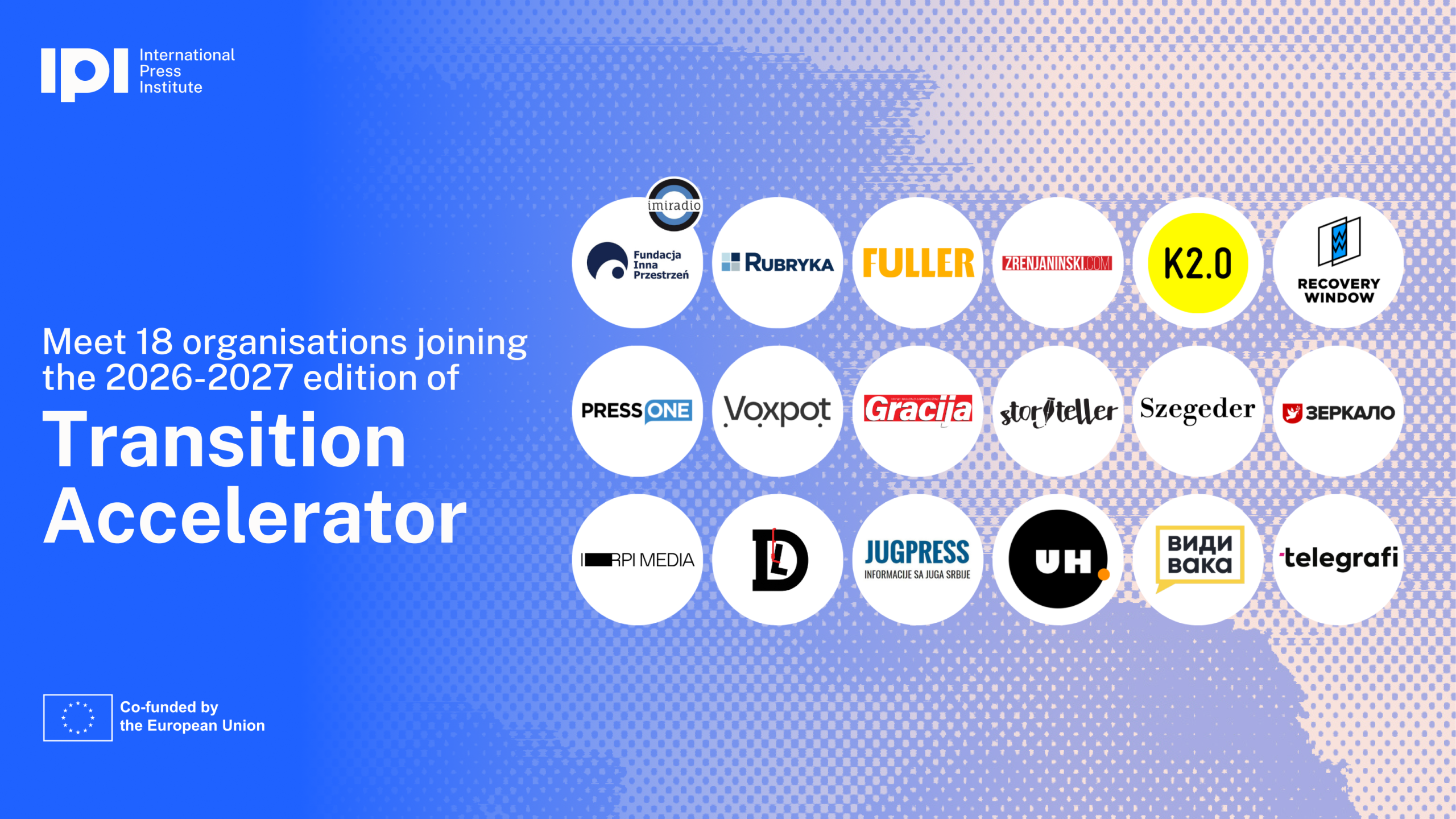
The 2026-2027 edition of the Transition Accelerator kicked off this October, bringing together 18 established media organisations from 11 countries, all of them outlining plans to future-proof their digital and revenue strategies.
The independent Media Innovation Europe jury selected them from over 100 applications. The organisations will receive eight months of support and up to €25,000 in funding to grow and strategise through investment in audience relationships, revenue generation, and technology adoption.
“From Kosovo and Ukraine to Hungary and Serbia, these publishers are stripping back their assumptions so that shifts in technology, revenue, and audience behaviour work to their benefit. Their product ideas are intentional, grounded in audience data and deadset on capturing value through their journalism, archives and context.” – Ryan Powell, IPI’s director of media innovation.
Following two successful editions, the programme builds on its model, integrating funding, design sprints, interdisciplinary workshops from AI use to community needs, expert coaching, and peer learning, to increase long-term viability and competitiveness in the media’s respective markets and niches.
Meet the 2026-2027 Transition Accelerator cohort:
1. Dead Lawyers Society, Ukraine
Dead Lawyers Society (DLS) is a community-driven legal media outlet writing about the legal market serving an audience of lawyers and legal professionals. Its goal within the accelerator is to turn scattered academic records into a tool for journalists and the public.
2. Fuller, Belgium
Fuller is a global newsroom producing reporting that drives real change for women and gender-diverse people. Its team will prototype a paywalled newsletter tackling reporting on anti-rights groups, taking it from pilot to sustainable product with a defined audience, a tested format, and a sustainable revenue model that relies on individual and organisational subscriptions rather than grants.
3. Gracija Press, Bosnia and Herzegovina
Gracija is a women’s media brand combining independent, socially engaged journalism with culture, lifestyle, and human stories, creating a distinctive space where women’s everyday experiences meet the wider issues shaping society. Its project will focus on transforming 21 years of print archives into a digital product relevant to today’s audiences.
4. Irpi Media, Italy
Investigative Reporting Project Italy (IRPI) is the only nonprofit investigative journalism centre in Italy producing transnational public interest journalistic investigations. In the accelerator, the team will develop the IRPI Investigative Lab, IrpiMedia’s academy for professionals—individuals, foundations, NGOs, or corporations—who need tools to investigate for good.
5. JUGPress, Serbia
JUGPress is an independent local media outlet in South Serbia. Within the accelerator, its team will launch “Public Voice, Public Money”, a hybrid project combining a membership club with crowdsourced investigative journalism.
6. Kosovo 2.0, Kosovo
Kosovo 2.0 is an independent, multilingual media platform that brings Kosovo and the region into deeper focus through diverse formats and underrepresented voices. Its project, K2.0 Explain, is a reusable digital format for turning in-depth journalism into a web experience with clearer entry points for audiences.
7. Other Space Foundation, Poland
Other Space Foundation (Fundacja Inna Przestrzeń) established IMI Radio — the only multilingual, multicultural, and integration-focused internet radio station in Poland that fosters the active engagement of migrants. With the support of the accelerator, the team plans to launch new interactive daily broadcasts for migrant couriers and taxi drivers around Poland.
8. PressOne, Romania
PressOne is an independent publication that serves civically engaged Romanians, helping them navigate polarisation and information overload through in-depth analysis, reporting, and investigations. In the accelerator, it will consolidate supporters from multiple platforms into one record for a reader-focused membership programme.
9. Recovery Window, Ukraine
Recovery Window is a national media network that connects trusted regional media, civil society,and recovery experts to turn local evidence and community needs into credible journalism, scalable campaigns, and nationwide impact. In the accelerator, the team will develop a commercial service model for businesses, international organisations, and recovery actors that need credible regional reach, local insight, and high-quality content.
10. Rubryka, Ukraine
Rubryka is Ukraine’s number one media outlet in the format of solutions journalism. The team will focus on stronger direct relationships with audiences and more predictable revenue beyond short-term grants. The accelerator will help the team research current and potential supporters and understand what motivates them, as the basis for a membership model.
11. Storyteller, Serbia
Storyteller is a bilingual, Serbian-Slovak, media and community space. It serves socially engaged audiences, including multilingual and minority communities, seeking in-depth journalism but lacking opportunities to meet reporters, discuss public-interest stories, or shape follow-up reporting. The team will work on bilingual live-journalism experiences, a Serbian-language newsletter, and a clearer membership journey.
12. Szegeder.hu, Hungary
Szegeder is an independent local news outlet combining original reporting on public affairs and urban development with practical city information for people who want to understand Szeged beyond institutional communication and national media coverage. Alongside ad revenue models, its project will develop a small set of measurable offers to test what types of offers can be automated for local paying businesses within the market.
13. Telegrafi, Kosovo
Telegrafi is a news portal producing independent journalism for Albanian-speaking digital audiences, serving Kosovo, the Western Balkans, and a substantial diaspora in Europe. The Telegrafi team will work on tools to identify high-potential audience segments, and will research and test concepts to engage them.
14. Uh.ro, Romania
Uh.ro informs the Hungarians of Transylvania, the Odorheiu Secuiesc, and the surrounding settlements about local and national news and events in their native language. Identifying as a media laboratory, Uh.ro wants to reach a larger audience of potential supporters with a new utility newsletter and a better reader journey from social platforms to its own.
15. Vidi Vaka, North Macedonia
Vidi Vaka combines independent and solidarity journalism, and inventive visual storytelling, to help North Macedonia’s digital generation make sense of everyday life. The team will build a newsroom-backed news-creator product shaped by the needs of young adults in North Macedonia, combining familiar creator-style formats with verification and editorial safeguards.
16. VoxPot, Czechia
Voxpot is the Czech media outlet for readers who want depth: independent, investigative journalism on international politics and global trends. In the accelerator, the team will develop its video products, enhance its YouTube presence, and social media strategy, and build a viewer-to-member conversion funnel.
17. Zerkalo, Poland
Zerkalo is Belarus’s largest independent media outlet in exile, combining the editorial legacy of TUT.BY, once the country’s leading news platform, with a multiplatform strategy that enables verified public-interest journalism. Zerkalo’s goal is to turn 20 years of TUT.BY and Zerkalo archives into an AI-powered research assistant for its newsroom.
18. Zrenjaninski (AGENCIJA ZA VEB PORTALE ZIPORTAL DOO KLEK), Serbia
Zrenjaninski is an independent local media outlet covering the city of Zrenjanin and Central Banat District. Zrenjaninski will be working on a mobile-first civic media product that turns community input into verified local journalism, public follow-up, and deeper audience insight.
The Transition Accelerator is part of the Media Innovation Europe programme (MIE), made possible with the support of the European Union.