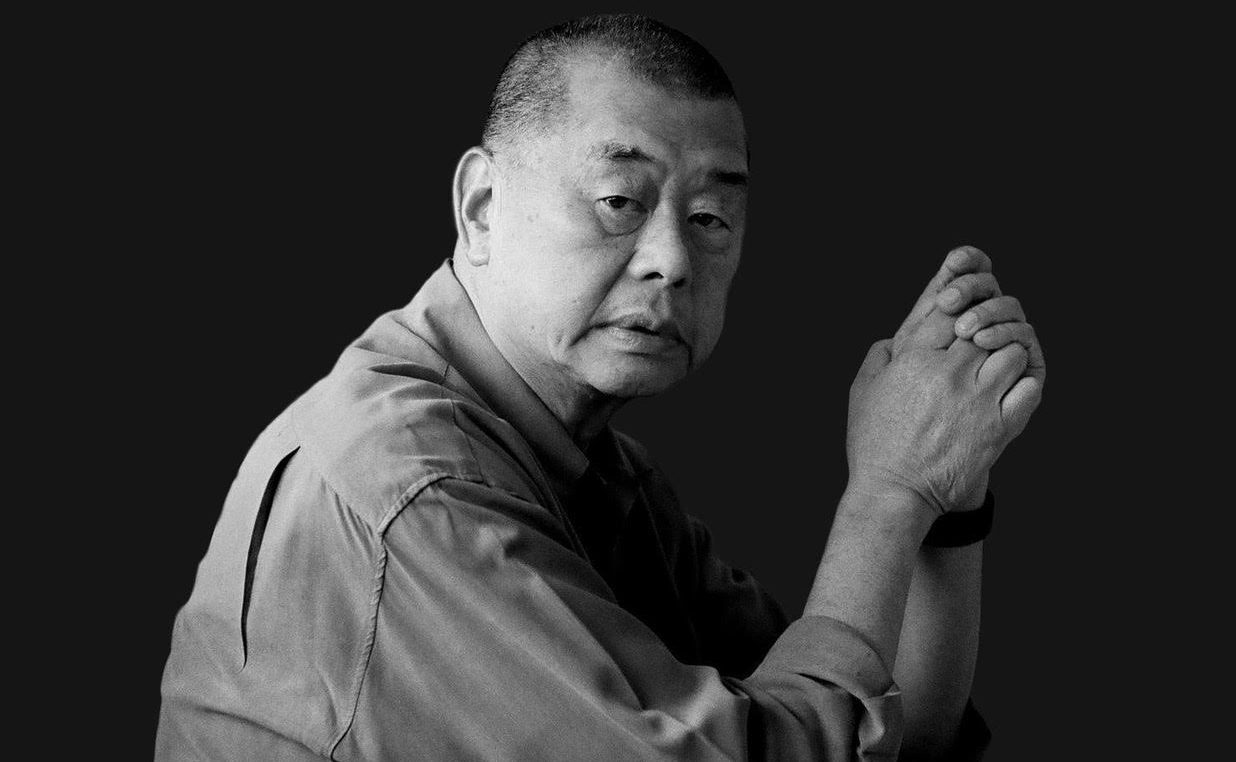
Hong Kong was once known as a safe haven for journalists, boasting a free and vibrant press. That changed dramatically over the past decade, as Beijing sought to impose its authoritarian rule on the territory, dismantling press freedom and free expression in the process. Hong Kong publisher Jimmy Lai, whose media titles had long challenged the Chinese Communist Party as well as Hong Kong’s power structures, stood against this wave. Now he’s being punished for it.
For nearly the past two years, Jimmy Lai, the founder of the now-closed pro-democracy outlet Apple Daily, has been on trial in Hong Kong on politically motivated national security charges. The landmark case, which has made headlines around the world, finally came to a conclusion in August 2025, as both the defense and prosecution wrapped up closing arguments. Now, Lai awaits a verdict. If convicted, he could face a life sentence behind bars.
The lengthy trial, which was marred by delays and postponements, has taken a toll on the physical health of the 77-year-old media mogul, who began suffering heart palpitations just as closing arguments were set to begin.
Yet despite authorities’ multi-year campaign to silence and break him, Lai has maintained his innocence, earning global recognition as a symbol of freedom of the press in authoritarian China.
IPI is proud to announce Jimmy Lai as one of the distinguished recipients of the 2025 World Press Freedom Hero award, in partnership with International Media Support (IMS). The World Press Freedom Hero award is given annually to journalists who have made significant contributions to promoting press freedom in the face of great risks. In recognizing Lai as one of this year’s Press Freedom Heroes, the selection committee honours Lai’s continued brave defense of press freedom and democracy, despite the immense personal cost. His principled stand serves as an urgent reminder of the myriad threats facing independent media globally.
“My father, Jimmy Lai, is showing extraordinary courage in standing up for the values of press freedom and democracy in the face of unspeakable abuses of his human rights,” said Lai’s son, Sebastien Lai, who will accept the award on his father’s behalf. “He is making an enormous sacrifice to defend principles that are vital for all of us, all over the world. The World Press Freedom Hero award is an important recognition of my father’s bravery and an act of solidarity that should inspire others to stand with him and do all they can to secure his immediate and unconditional release, before it is too late.”
A campaign of repression
Lai’s career in journalism began after he witnessed the horrific and violent actions of Chinese authorities in response to the pro-democracy movement that swept China and the communist world in 1989, culminating in the Tiananmen Square massacre. He founded Apple Daily in 1995 to create a space for conversations about democracy in Hong Kong and offer a platform for criticism of the Chinese Communist Party. The newspaper quickly became one of Hong Kong’s most successful independent Chinese-language outlets.
From the start, Lai knew Apple Daily’s boldness could lead to prosecution. He was soon proven right, as the paper became a direct target of authorities during Hong Kong’s 2019-2020 pro-democracy protests. Apple Daily’s extensive coverage of the demonstrations and critical reporting on Beijing’s efforts to control the territory led to Lai’s first arrest in connection to his journalistic work in August 2020. His detention came mere weeks after the passage of China’s draconian new National Security Law for the territory meant to quell the protests, which has since been weaponized to target and silence independent media and pro-democracy activists.
Lai was convicted in April 2021 of unlawful assembly in connection to the pro-democracy demonstrations and later sentenced to 12 months in prison. Only weeks into serving that sentence, authorities tacked on an additional 14 months on new charges of “participating and organizing an illegal demonstration.”
What followed was months, then years, of continued manufactured prosecutions on spurious charges all aimed at extending Lai’s imprisonment. Apple Daily itself also became the target of authorities, who raided the outlet’s offices, arrested staff, seized equipment, and froze financial assets. Unable to operate, the paper announced it would close in June 2021.
The latest prosecution against Lai, on charges of “colluding with foreign forces” and “conspiring with others to issue seditious publications,” has dealt a kind of final blow in the years-long campaign against him. Throughout his nearly five-year imprisonment, Lai has been held in solitary confinement in a maximum-security prison cell with no natural light. Years spent behind bars under such conditions would be difficult for anyone, but for the 77-year-old journalist, who is also a diabetic, continued imprisonment could be fatal.
His son, Sebastien, has said he fears his father may soon die behind bars.
“It is not wrong to support freedom of expression”
Before the pro-democracy demonstrations began in 2019, Hong Kong was widely known as a safe haven for journalists. However, with the passage of the 2020 National Security Law, which effectively imposes mainland China’s authoritarian rule on Hong Kong, a climate of fear and self-censorship now prevails. Journalists are required to be registered with the government, crippling independent media.
Despite unrelenting pressure, and increasingly dim hopes for his release, Lai’s refusal to break has captured the world’s attention. Throughout the sham proceedings against him, Lai has maintained his innocence, refuting the myriad accusations authorities have thrown at him.
Even more notable is Lai’s steadfast commitment to press freedom, despite the personal consequences. “It is not wrong to support freedom of expression. It is not wrong to support human rights,” Lai’s lawyer Robert Pang said in defense of Lai and Apple Daily in his final statement before the court in August.
As one of the highest profile people to be tried under the 2020 National Security Law, Lai’s case has become emblematic of the fight for free expression in Hong Kong, with many governments and international bodies calling for his release. The United Kingdom, where Lai holds citizenship, has said Lai’s case is a top priority. Prime Minister Keir Starmer expressed concerns about Lai’s health when he met Chinese President Xi Jinping in Brazil in 2024.
In November 2024, the United Nations Working Group on Arbitrary Detention found Lai to be unlawfully and arbitrarily detained, calling for his urgent release. In August 2025, U.S. President Donald Trump said he would do “everything he could” to try to “save” Lai.
As his trial closed, one of the three government-appointed judges presiding over Lai’s case said a verdict would come “in good time.” Many observers anticipate continued delays as the government continues to drag out the proceedings until the very end.
As Lai left the courtroom for a final time to begin his wait for a verdict, he smiled, nodded, and waved to the public gallery before he was escorted back behind closed doors.
The World Press Freedom Hero awards
IPI will present the World Press Freedom Hero awards at a special ceremony on October 24 at the University of Vienna as part of the 2025 IPI World Congress, which annually brings together leading editors and journalists from around the world. As Lai remains behind bars, his son Sebastien will accept the award on his behalf.
As IPI marks its 75th anniversary this year, we have chosen to recognize seven individuals who have displayed tremendous courage and resilience in fighting for media freedom. In addition to Lai, the World Press Freedom Hero award will also be given to Mzia Amaglobeli (Georgia), Martin Baron (United States), Mariam Abu Dagga (Palestine), Gustavo Gorriti (Peru), Victoria Roshchyna (Ukraine), and Tesfalem Waldyes (Ethiopia).
“This year’s awardees are exemplary of the current threats facing journalists worldwide as authoritarianism gains ground, impunity prevails, and new challenges to freedom of expression emerge,” IPI Executive Director Scott Griffen said. “With this award, we honour their courage, commitment, and legacy – while renewing our urgent call to protect and defend media freedom as a pillar of free society.”
“Each of the recipients of this year’s World Press Freedom Hero award have faced acute dangers and threats merely for doing their job,” IMS Executive Director Jesper Højberg said. “Two of them – Victoria Roshchyna and Mariam Abu Dagga – paid with their lives. With immense courage and persistence, the awardees have uncovered corruption, war crimes, persecution of vulnerable groups and multiple other transgressions. We all owe them our deep gratitude for their fearless commitment to exposing what those in power seek to hide.”
Since 2000, IPI has recognized more than 75 journalists who have displayed tremendous courage and resilience in fighting for media freedom and the free flow of news with the World Press Freedom Hero award. Notable past awardees include imprisoned Guatemalan journalist José Rubén Zamora, slain Palestinian-American journalist Shireen Abu Akleh, and Mexican investigative journalist Carmen Aristegui. Since 2015, IPI has been proud to present the award in partnership with IMS.