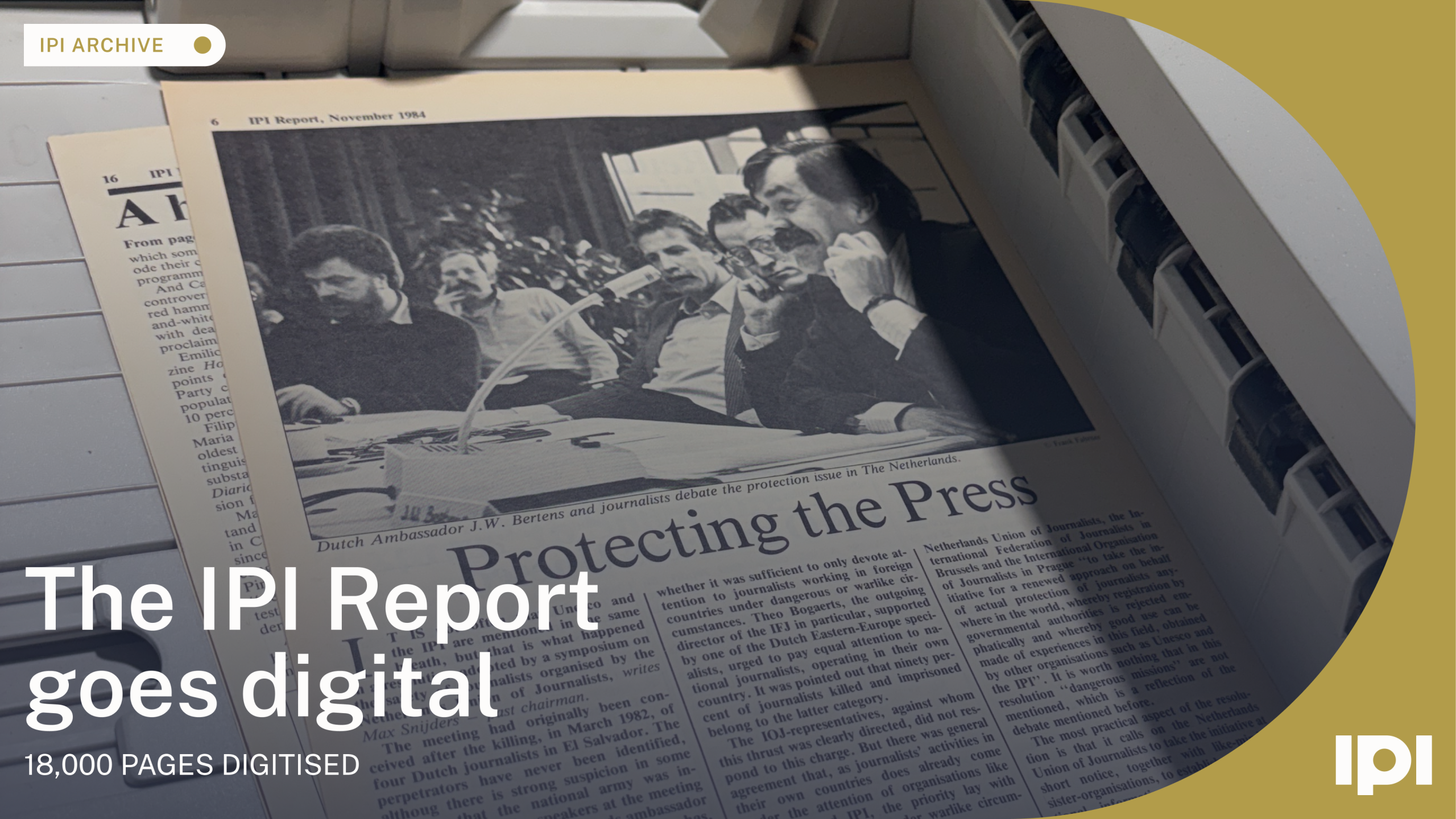
Seventy-five years and 18,000 pages of press freedom history are now available — in state-of-the-art, searchable format — to journalists, researchers, and the general public.
The International Press Institute (IPI) announces the digitisation of the IPI Report, the organisation’s flagship monthly publication between 1952 and 2005. The IPI Report was a central forum for documentation and debate on global developments in journalism, media, and media freedom. Spanning the post-World War II human-rights movement, the Cold War, decolonisation, and massive social and technological change, the IPI Report chronicles the evolving relationship between media, politics, and society.
Now, at a time when democracy and human rights are under threat globally, IPI is proud to make available these unique materials and the lessons they contain for the fight to preserve the public’s right to news and information.
The digitised IPI Report is available via Arcanum, a Budapest-based company with over 30 years of experience in digitisation technology and holding a vast repository of digitised news and scholarly archives. Arcanum partnered with IPI to digitise and carry out a full text and image recognition of the materials, allowing for seamless search. The materials can currently be accessed on Arcanum’s online platform via subscription or via more than 200 educational and partner institutions. Learn how to access the IPI Report online below.
In the future, digital copies of the IPI Reports will also be publicly and freely accessible via the Blinken OSA Archivum thanks to a new partnership between IPI and the Archivum. Details will be announced soon.
The digitisation of the IPI Report is the first step toward the full digitisation of IPI’s broader archive, which contains books, data, correspondence, and speeches — from Nelson Mandela to Katherine Graham — on the fight for media freedom over the past 75 years.
This milestone follows IPI’s 75th anniversary year in 2025, which included an in-person exhibition of IPI’s archival materials at the 2025 IPI World Congress and Media Innovation Festival in Vienna last October. This was complemented by two virtual exhibitions, one on the historic movement to protect and strengthen press and media freedom worldwide, and a second focusing on women and press freedom, exploring four decades of exceptional women at the IPI General Assembly and honouring the remarkable female journalists and editors who paved the way. These exhibitions, and our anniversary activities more broadly, aimed to draw from past experience to shape and energise the fight to defend the future of media freedom.
Our archive digitisation takes this mission now one step further — and we’re thrilled to share this news with our network and community. Read on to learn how to access the IPI Report online, partner with our archive project, and find out what’s next.
More about the IPI Report
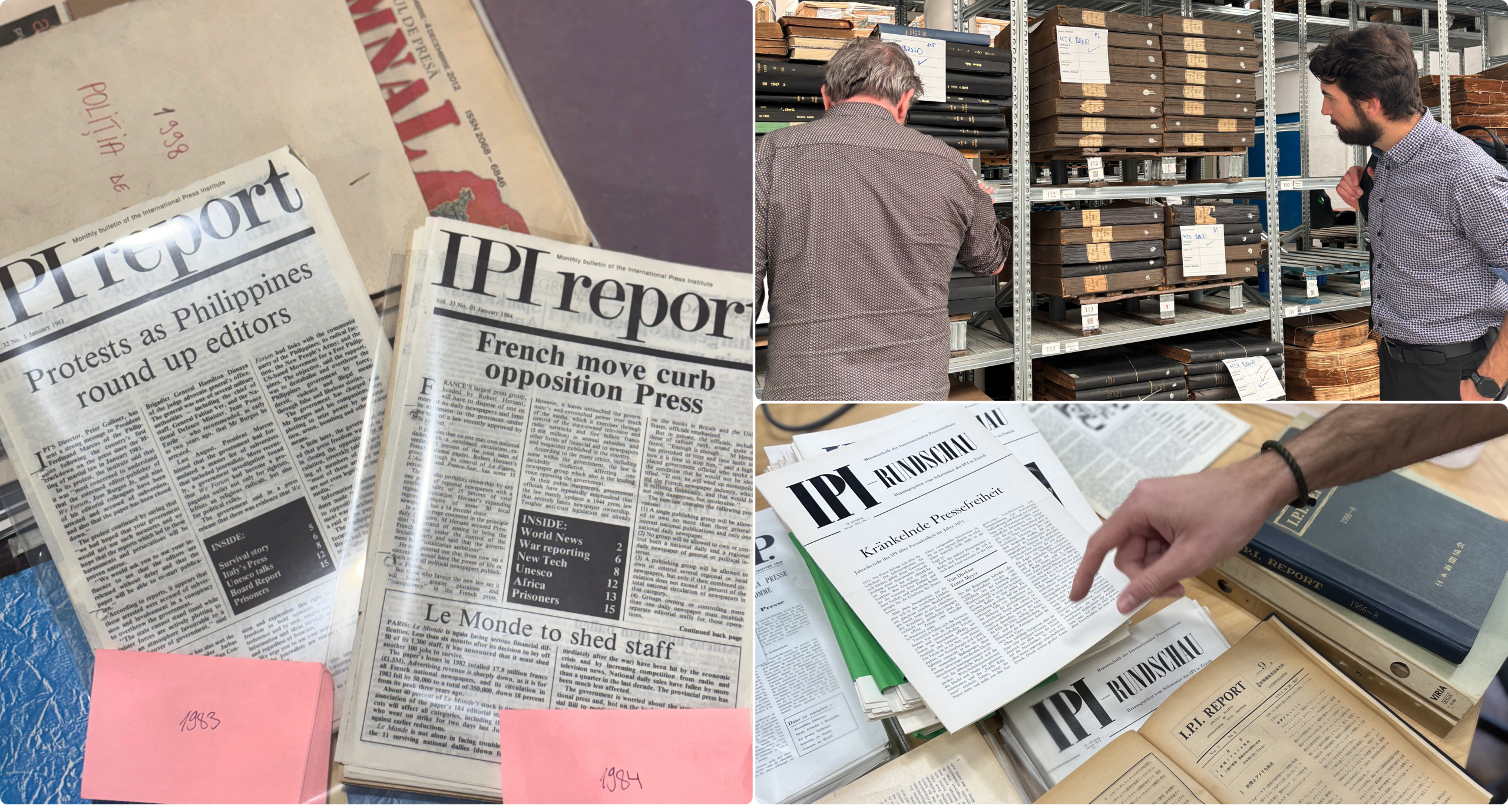
Published between 1952 and 2005, the IPI Report is a unique resource for anyone interested in historical trends related to media freedom, freedom of expression, media development, media literacy, and journalistic standards. It contains more than 18,000 pages, just over half of them in English, with editions in German, French, and Japanese, and a small number in Spanish.
The IPI Report is rich in visual materials — including cartoons and photographs — and contains book reviews, debates, General Assembly reports, and profiles of journalists. In particular, the regular section “The Freedom of the Press” (later “The Toils of the Press”) provides a monthly snapshot of press restrictions worldwide. It also offers a unique window into a changing media industry, tracing recurring fears about technology (from television to teletext to the Internet), increased participation of women, and concerns about objectivity and power. This combination of historical depth, global perspective, and insight into the media’s evolving challenges makes the IPI Report an indispensable resource for understanding both change and continuity in the media.
How to access the digitised IPI Report
The IPI Report is digitally available and fully searchable on the Arcanum platform (English, Spanish and German editions; and in French and Japanese). Arcanum is a Budapest-based company with over 30 years of experience in the field of digitisation, employing state-of-the-art technology to preserve historical materials. The platform currently hosts millions of pages from scientific and professional journals, encyclopaedias, daily and weekly newspapers, and thematic book collections.
Subscribers have unlimited access to Arcanum’s full collection, including the IPI Report, through a paid premium service. Arcanum subscriptions start at €8 a month with a yearly plan or €14 per month. Arcanum also offers a free version that allows users to search the material without creating an account. This allows users to preview content without accessing the full file or downloading it.
Alternatively, users can access the premium service for free via one of Arcanum’s nearly 200 subscriber institutions worldwide. The list includes libraries and educational institutions in Austria, the Czech Republic, Hungary, Italy, Romania, Slovakia, Sweden, Switzerland, the UK, Ukraine, and the U.S. Institutions include the Central European University, the University of Vienna, University College of London, the European University Institute, Columbia University, Yale University, Princeton University, the University of Michigan, and the Library of Congress (US).
In the future, all IPI reports will also be available for free as part of the online catalogue of the Blinken OSA Archivum. More details will be announced soon.
Where we’re headed next — and how you can help!
Our next aim is to digitise the full IPI archive, making these broader, historically rich materials accessible to researchers, media professionals, and the public. We envision the digitised archive serving not only as a premier source of knowledge and inspiration on the historical fight for press freedom but also as a starting point for multidisciplinary projects: allowing for the curation of online collections, the facilitation of knowledge sharing, and the development of educational resources that can offer lessons, best-practice models, and toolkits for journalists and media analysts, drawing on 75 years of engagement in nearly 100 countries.