This article was originally written by Ivonne Arroyo, Editorial Coordinator at the Gabo Foundation, and published in Spanish. It is re-published here with permission.
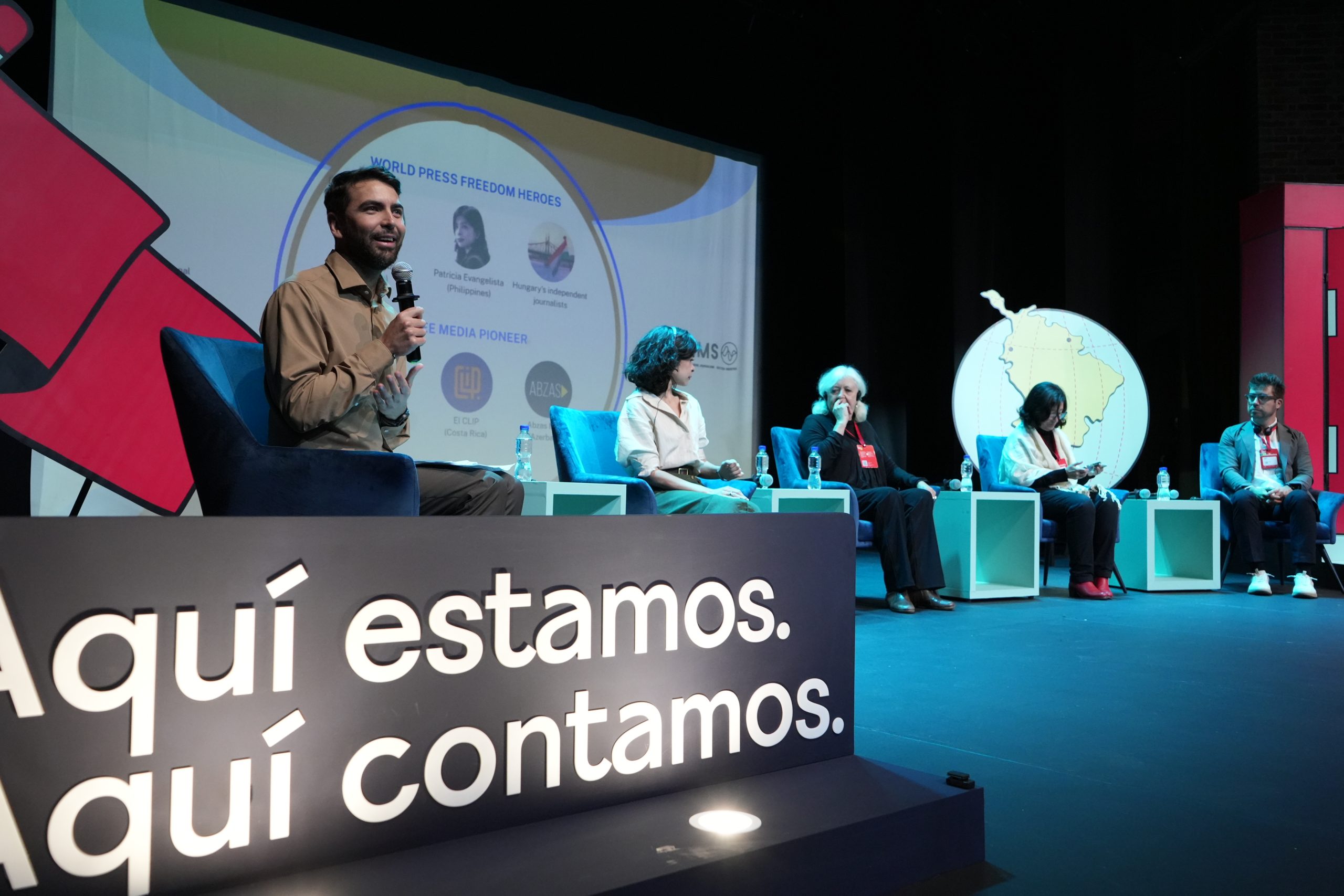
Individual courage and persistence are needed, yes, but so is “collective resilience and resistance” to report on corruption, dictatorships, and organised crime, said Jesper Højberg (Denmark), executive director of International Media Support (IMS), during his speech at the 2026 IPI-IMS press freedom awards ceremony, which took place on July 24 as part of the 14th Gabo Festival in Bogotá, Colombia.
This year, the awards recognised the courage, resilience, and ingenuity of journalists and organisations in the face of increasingly hostile conditions for independent journalism. “Thank you for your courage, for your persistence, for reminding us that journalism is strongest when it is rooted in truth, carried by people, connected to the public and protected by solidarity,” Højberg told the winning journalists before attendees in the festival’s main auditorium.
One by one, the award winners took to the stage to receive their awards: Mónica González (Chile), Patricia Evangelista (Philippines), and Szabolcs Panyi (Hungary), representing the independent journalists of his country, recognised as IPI-IMS 2026 World Press Freedom Heroes. The IPI-IMS 2026 Free Media Pioneer Award, given to the Latin American Center for Investigative Journalism (CLIP), was received by María Teresa Ronderos (Colombia), co-founder and director of the centre.
“Why are we here honouring you?” Højberg asked. “Because you remind us of something absolutely important in the challenging times we are living in,” he answered. “It truly matters what we decide to defend. It truly matters how we come together. And it truly matters how we, with limited resources and increasing threats, focus on what gives journalism protection, sustainability, and impact.”
As corruption, organised crime, disinformation, and authoritarian influence cross borders, “we journalists also have to cross borders, connect, share knowledge, and strengthen institutions and alliances to match the scale of the challenges we face,” Højberg emphasised.
During the ceremony, Abzas Media and Meydan TV, co-recipients of the Free Media Pioneer Award alongside CLIP, were also honoured. Their representatives were unable to attend the event due to visa restrictions, as they work in exile due to the persecution of the independent press in Azerbaijan. In their absence, the audience gave them a heartfelt round of applause in recognition of their resilience, courage, and commitment to press freedom in the face of repression.
Leading figures in independent journalism and press freedom
Mónica González is recognised as one of the most influential investigative journalists in Latin America. During Augusto Pinochet’s dictatorship in Chile, she exposed corruption, atrocities, and human rights abuses, work that cost her imprisonment, exile, and legal persecution.
The 2026 World Press Freedom Hero Award recognised her courage in practising investigative journalism despite enormous risks. González insisted that she is not a heroine, because heroes “are alone and cannot love.” She, on the other hand, is surrounded by people who have resisted, fought, and trusted those who dare to denounce, expose, and confront “the death machine.”
“There is a death machine that turns the children of farmers into murderers and that kills, tortures, and burns beautiful, precious people who fight to change the face of my country and defend the right to love. That is why I became an investigative journalist, because that machine had to be unraveled,” said González, who highlighted the work of an entire generation of journalists “with courage, love, and a deep connection to their communities.”
Patricia Evangelista, for her part, has challenged official narratives by documenting an incalculable number of murders and disappearances of civilians perpetrated by police and paramilitary groups in the context of former Philippine President Rodrigo Duterte’s war on drugs.
“Duterte told a story. He took every fear and every grievance fuelled by decades of failed expectations and gave the enemy a name. He called them drugistas — not just dealers, but drug users, addicts. He said if your neighbour’s child is an addict; kill him yourself. It will be a kindness to his parents. (…) He said addicts were paranoid, heartless and mindless, willing to butcher their fathers and rape their sisters and so bestial and bizarre they would fuck a goat if a goat was all that could be found,” Evangelista recounted.
Human rights organisations estimate that around 30,000 people were killed under Duterte and his death squads. During the six-year war, Evangelista uncovered how the police systematically fabricated evidence, falsified causes of death, and manipulated crime scenes to justify the persecution of some of the poorest communities in the Philippines.
Scott Griffen, executive director of the International Press Institute (IPI) and moderator of the discussion, asked Evangelista why it was so important to focus on the victims from a human perspective. The journalist responded that “journalism is not a solitary act.” If the Philippine press was reporting on these events, it was precisely because it was under the control of a dehumanising government. “The president said he was killing these people because they weren’t human,” Evangelista lamented.
Alongside González and Evangelista at the event “The Courage to Report on Corruption and Dictatorships” was Szabolcs Panyi, investigative journalist and editor at VSquare, who has investigated illegal surveillance, corruption, and authoritarianism in Central Europe. Representing the Hungarian independent press, Panyi received an award recognising the role Hungary’s journalists have played in defending press freedom and democracy in their country.
Amid a barrage of state propaganda, disinformation, and pressure, Hungary’s independent press refused to be silenced and demanded accountability from the most powerful. Their investigations and reporting were crucial in enabling citizens to make informed decisions at the polls during the April 2026 elections that ousted Orbán’s government.
“What we have experienced in these last 16 years has been unprecedented. Honestly, we felt our allies had abandoned us, even though they were actually trying to support us. It took 16 years to achieve the global political support to dismantle the regime that was in power. It was about community; it wasn’t an individual effort,” Panyi said.
Like many journalists in his country, Panyi was a constant target of surveillance by the government of former Prime Minister Viktor Orbán, and even had his phone hacked with Pegasus spyware.
“The government said we were Russian spies and tried to stifle journalistic activity. That’s when they started targeting specific journalists, and this is due to the influence and corruption that Russia exerts on our societies and electoral processes. It helped a lot to have the support of readers, Hungarian citizens, and also the international journalistic community that backed our investigations. Solidarity is what saved this profession,” said Panyi.
That same spirit of solidarity was the starting point for the Latin American Center for Investigative Journalism (CLIP), an investigative newsroom and coordination centre that promotes collaborative reporting and data journalism throughout Latin America. The 2026 Free Media Pioneer Award recognised CLIP for its pioneering role in developing a new model of cross-border investigative journalism in the region.
María Teresa Ronderos, its co-founder and director, explained that CLIP “was born almost amicably among several Latin American colleagues: Giannina Segnini, Emiliana García, Marina Walker, and Natalia Viana.” Together, they had identified a disconnect among Latin American journalists. “There were many very good people doing wonderful things, but we needed to tell the stories that each of us was telling individually in our own country, and we weren’t able to build the complete picture.”
Coming together was, therefore, an opportunity to better articulate the issues that impact the entire region, such as organised crime, corruption and abuses of power that transcend borders, and also a way to strengthen the infrastructure that supports investigative journalism.
“Many people were, and continue to be, taking enormous risks to tell stories. Many journalists do phenomenal investigations, but they face enormous risk when publishing them, and they are also very much alone,” Ronderos said. And that was the second reason, she asserted: “to protect ourselves, to shelter each other, to work with people who are in exile.”
This work in network has not only strengthened security and collaboration among journalists, but has also driven innovation in the profession, “in terms of adding more technical strength and information processing capacity, and using data in a much more effective way.” An example of this is the creation of NINA, a platform that connects databases from 21 Latin American countries, facilitating information exchange and the undertaking of journalistic investigations of public interest.
Reasons to continue practising the profession
Amid the challenges facing journalism today and in the future, Scott Griffen asked the award-winning journalists where they find hope and reasons to continue practising the profession. María Teresa Ronderos returned to a word that was present throughout the conversation: solidarity.
“If we build strong networks, support each other, show solidarity, work together, and connect, I think that’s a way to adapt to this authoritarianism, to outmaneuver it, to play a little with the beast, and not let it overwhelm us. We have to design strategies together, think together,” Ronderos said.
Mónica González agreed, stating that “good journalism” can save lives. She added that if, during the Chilean dictatorship, “we hadn’t revealed the name of a murderer, a prison, a decree, and how to act in time, there would have been more deaths.”
“The real impact is stopping the killing. And for that, it’s necessary that, in Colombia, for example, we stop hiding the true reason for the armed conflict. That’s why I like good Colombian journalism, because it recognised long ago that behind paramilitarism and those FARC files, what lies is war booty. There’s nothing else. There isn’t a single war that doesn’t have an ulterior motive,” González said.
Panyi added to that optimistic narrative, recalling that “a small nation, which had been controlled by an authoritarian, can break free from that type of regime.”
Evangelista, meanwhile, lamented not being able to share a message of hope. In the Philippines, “we remain one of the most dangerous countries in the world for journalists.” When she was 23, she recounted, 32 journalists were killed in a single day.
“I honestly tell you that I’ve changed my expectations about journalism. I used to think that things could change, and when they didn’t, I thought I wasn’t writing well, that I wasn’t reaching the right audience. Now I believe I’m not trying to end the war, but rather to leave a record of what’s happening. It’s the record that will endure and keep the story alive.”
Meeting and screening at the Gabo Festival
IPI and IMS’s activities at the Gabo Festival continued with a meeting of journalists on the global state of press freedom. This was followed by a screening of the documentary *Defending the Future of Free Media,” and then a discussion between journalists Patricia Evangelista, Kunda Dixit from Nepal, Isabela Ponce from Ecuador, and Gabriela Manuli from Argentina, co-director of the documentary.
The IPI documentary brings together voices and stories of journalists and media outlets that defend press freedom in countries including Ukraine, Turkey, the Philippines, Mexico, the United States, Gaza, and Hungary, and pays tribute to the resilience of those who practice journalism in contexts of increasing hostility.
After the screening, the panelists reflected on the challenges facing independent journalism and agreed that defending press freedom also requires the commitment of the public. “Journalists can’t be the only ones who have to fight for press freedom; the public should also be involved, because press freedom belongs to them,” Ponce stated. Evangelista maintained that “the only job of journalists is to keep writing, and if we’re very lucky, some of us might manage to change something.” Along the same lines, Dixit summarised the challenge the profession faces today with a warning: “If we kill journalism, we are condemning democracy to death.”