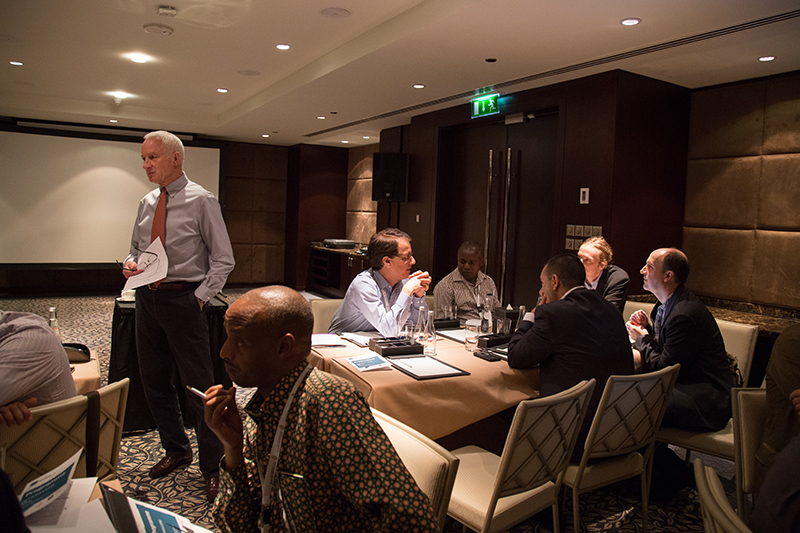
The first interactive workshop of the International Press Institute (IPI)’s 2016 World Congress, Media “Team Security – Managing the Terrorism Threat”, trained journalists on media operations in high-risk areas to help them develop the basic understanding of a contingency plan.
Rupert Reid, managing director of the UK-based security consulting company Security Exchange Ltd, led the workshop, which was held in partnership with the International News Safety Institute (INSI).
Reid, who has more than 14 years of experience in the field of corporate contingency planning, specialises in the training of crisis management and risk insurance consulting on issues such as terrorism, kidnapping and extortion.
“This year’s IPI conference addressed many critical security incidents such as terrorist attacks, and my job is to teach how to respond to these incidents at short notice,” Reid said. “Some experts tell you what should be done [in a critical situation], but I want to elaborate on what is actually achievable.”
Reid brought in case studies and realistic crisis scenarios for the attendees to discuss. He offered the group a scenario where a female reporter from one news organisation has been asked to accompany a U.N. team to border areas in South Sudan. Eventually, the reporter loses contact with her team and the news organisation receives a call demanding a ransom of $2 million for her safe release.
For this exercise, participants took on the role of staffers at the reporter’s organisation. They divided into three groups, with each asked to outline their potential security concerns and countermeasures. When the incident escalated and it was revealed that the reporter had indeed been kidnapped, group members were assigned to focus on specific aspects of the incident, ranging from decision-making, partnership, property, press etc.
Reid indicated that when news organisations face extreme situations, the first priority is to divide the roles within the team to have a balanced focus on different aspects of the incident.
“The old way of crisis management is to ‘plan for the cause’, and this does not work well when the stakes are high,” he said. “Now, we need to think about the bigger picture, and ‘plan for the effect’.”
Building on Reid’s point, Sulome Anderson, a freelance journalist based in Beirut and New York, said: “In a situation like this, the branch that negotiates with the government and the locals should be separated from the branch in charge of the press coverage. Otherwise, subjective and emotional reporting might occupy the headline.”
To protect fellow journalists’ security and the reputation of news organisations, it is important to maintain the clearest editorial judgment throughout critical incidents, Reid said.
“A three- or four-page contingency plan will help news teams achieve that,” he observed.
The workshop drew a lot of positive feedback from attendees.
“It is challenging knowing someone’s life could be dependent on your decision making,” Steven Wilson, chief producer at SBS World News in Australia, said. “As journalists, we have to write about tragedies, but this is trying to resolve or prevent tragedies. It is a completely different set of skills, but indeed a helpful one.”
*This statement was revised on March 21 to correct an inaccurate headline. IPI regrets the error.