
Originally published on Journalift.org
For my previous article on Journalift, I borrowed a sports analogy to describe the mentoring process with Ioana Epure, creator of „The Lost Expat Digest“. Apparently, that didn’t deter the Thomson team to call me back as a mentor for cohort 3. This time, with five mentees navigating the validation process for their products and services, I was particularly thrilled to see that one of them was trying to make a living from – you guessed it – sports!
To be clear: my own sports heyday is long behind me. But the case of Chris Dalby was far too intriguing not to share. Before diving into the challenges we tackled together, let me first introduce you to Chris.
Chris is a self-starter, an experienced investigative journalist, and unquestionably a far bigger sports fan than I am.
But his focus lies on the darker side of the shiny sports universe: corruption, trafficking, abuse. Unfortunately, this comes as no surprise: Wherever large sums of money are involved, power struggles and exploitation follow. What was surprising, however, was the scale.
According to the United Nations Office on Drugs and Crime, up to 1,7 trillion dollars are lost each year to corruption in sports. “Trillion,” Chris repeated in his pitch – “this is not a typo.”
Who pays the price? Mostly young, inexperienced players with big dreams, often from countries in the Global South, hoping that signing with a European club might lift their entire family out of poverty.
I started working with Chris in June 2025, when his newsletter „The Sports & Crime Briefing“ had just turned eight months old. In that short period, he had already built an impressive audience of 6,000 subscribers – mostly free ones working in or around the sports industry.
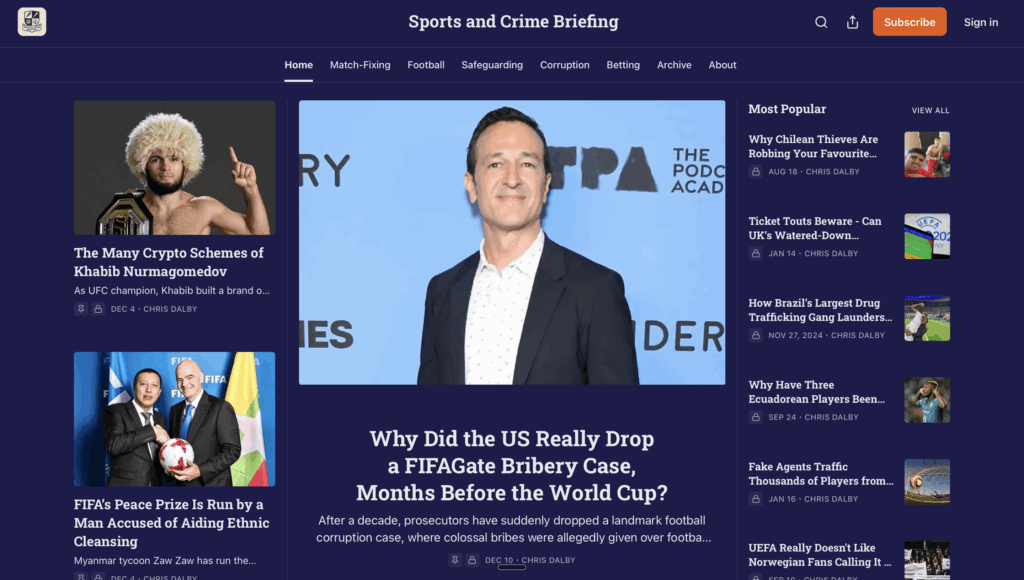
Chris wanted more. He wanted to grow the newsletter and turn it into a revenue-generating product. This raised a familiar challenge: How do you convert free subscribers into paying ones? What unique value could he offer that readers would gladly pay for?
But Chris wanted even more. Reporting on crime is one side of the coin. Preventing it is the other. With Free2Play, he planned to launch the first free platform enabling players and families to run background checks on agents before signing exploitative deals. Since the service should remain free, an alternative revenue model was necessary – sponsorship being the logical path.
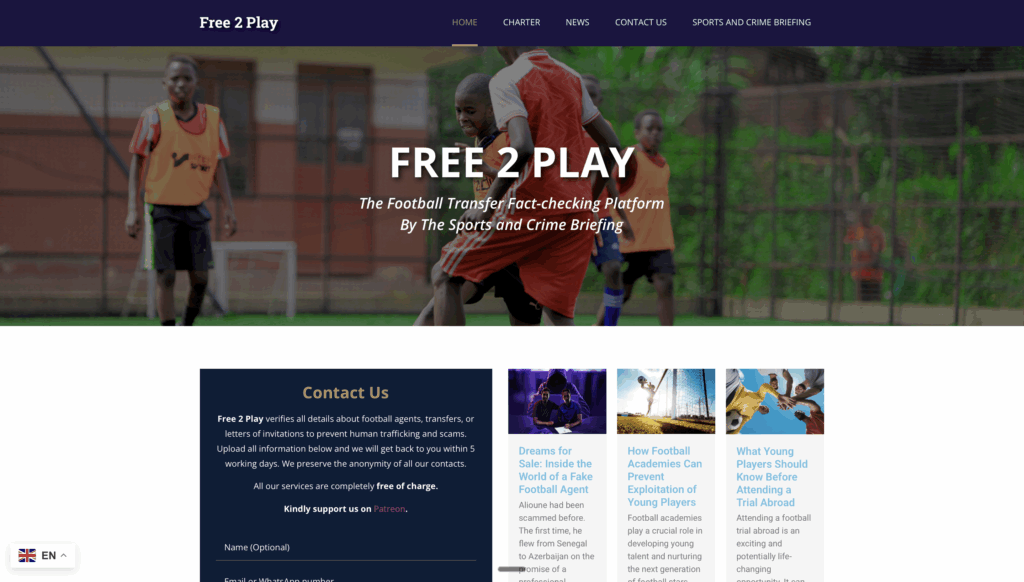
This resulted in two products under one brand, each with different audiences (paying subscribers vs. young players/sponsors), different funding mechanisms, and different growth strategies. Given this complexity, one thing became obvious early on: Chris, essentially a one-man operation, could not tackle everything at the same time. This is where the programme structure proved invaluable. The weekly workshops helped us break things down – one customer segment, one hypothesis, one objective at a time. Less is sometimes more.
For the newsletter, this meant focusing outreach on his core subscribers, those who know the product best and care about its improvement. This paid off: during the validation phase, survey insights led Chris to refine his content, and five engaged readers converted to paid subscriptions. Revenue increased by 43%.
For Free2Play, the Business Model Canvas helped map the beneficiary side (young players) and understand how to reach them once the platform is live. This is essential information also for potential sponsors, who need to see that Chris understands his audience and has direct access to it.
But sponsorship requires groundwork.
You cannot expect large sums without a well-built case. For newcomers to sponsorship, identifying aligned sponsors is key. Here, you can even get creative: During a brainstorming session, I challenged him to think “slogan-first” such as “Clean up sports with us,” appealing to facility companies involved in cleaning stadiums or jerseys.
Based on this shortlist, he prepared a survey and interview questions, but none of the potential sponsors replied. From my experience, the USAID cuts have had also an impact on sponsors. They are flooded by requests and (have to be) more selective than ever. In addition, sponsors often gravitate toward organisations or individuals they already know, or those with a proven track record and a visible public profile.
For Chris, this meant building credibility and access first. The main outcome of the validation process was a strategic pivot: instead of immediately pitching sponsors, he began contacting companies and institutions with reputational or research interests aligned to his mission. These conversations helped him refine his pitch and produced two promising sponsorship leads.
Another significant realisation: presenting both products together – the newsletter and Free2Play – strengthened credibility and resonated better with sponsors.
While they target different audiences, together they address two sides of the same problem:
- S&C Briefing exposes corruption and creates accountability.
- Free2Play helps prevent corruption from happening in the first place.
Although not a hypothesis we set out to test formally, it proved to be one of the most valuable insights from the process.
A final testament to Chris’s momentum: interest in his work is growing internationally.
A Portuguese-language edition of The Sports & Crime Briefing will launch in January 2026, aimed at the Brazilian market. Chris plans to replicate the validation process there, tailored to local needs. And we all know that practice makes perfect – whether in sports or in validating your business ideas.
Author: Christine Liehr
Originally published on Journalift.org
Validation Booster programme is implemented by Thomson Media as a part of Media Innovation Europe led by the Vienna-based International Press Institute (IPI), the consortium brings together Thomson Media (TM), The Fix Foundation (TFF), and the Balkan Investigative Reporting Network (BIRN). The programme is co-funded by the European Union.