This year marks the 30th anniversary of the adoption of UN Security Council Resolution 1325, which acknowledged the unique impact of conflict on women and created a framework for understanding how female voices contribute to peace and security.
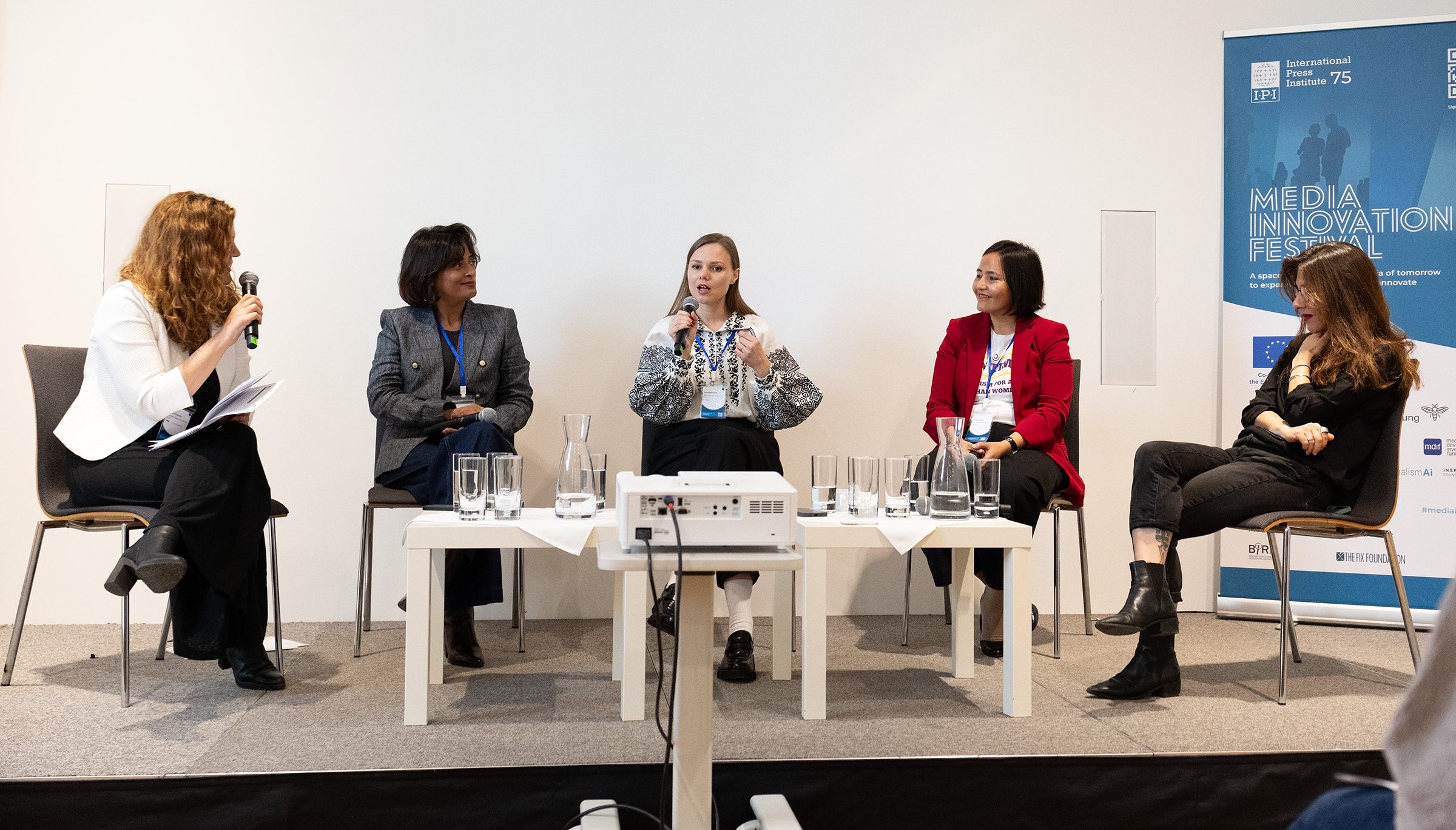
As conflicts rage around the world, the role of war reporters and the unique challenges they face was a frequent topic of conversation at the 2025 IPI World Congress. In a panel discussion moderated by Silvia Chocarro, who heads the Civic Space unit at the UN OHCHR Sudan, four female war correspondents from Ukraine, Gaza, Afghanistan and Armenia reflected on their frontline experiences and the distinct risks that women reporting on conflict navigate.
Panelists Anna Babinets and Zahra Nader didn’t go into journalism looking to become war correspondents, but felt compelled to step into the role when conflict arrived in their own countries.
Babinets originally founded Slidstvo.Info, based in Kyiv, as a platform for investigative reporting on government corruption in Ukraine. Yet after Russia’s full-scale invasion of Ukraine in February 2022, everything changed. “We started to cover war crimes, we knew it would be a lot…but we decided that we would collect all information and document all war crimes and tell the stories of people,” Babinets said, describing how her investigative team had to quickly pivot and change their focus.
Nader recalled watching live on TV as the Taliban took over Afghanistan. Seeing rights being taken away from women in Afghanistan while she was living abroad, Nader felt a sense of guilt that in turn fueled a desire to pursue journalism in Afghanistan. “As a woman journalist, I felt a lot of responsibility,” she said, explaining why she founded Zan Times, a primarily women-run, award-winning publication which covers human rights violations in Taliban-controlled Afghanistan.
Many of the panelists have years, and even decades of experience reporting on conflict. Yet even for seasoned war correspondents, the toll of documenting extreme violence and destruction – while trying to survive it themselves – is immense.
Mai Yaghi has been reporting on conflict since the very start of her career as a journalist. Since joining AFP’s team in Gaza in 2008, she has covered four wars, becoming familiar with the cycles of instability and reset that come during and following conflict. However, none of those wars have been as destabilizing – personally and professionally – as the most recent one between Israel and Hamas.
“This last war, I lost everything…There’s no office, I lost my house, no schools, no streets, no buildings,” Yaghi said. “It’s totally different for me as a journalist. It’s beyond description, to see your life collapse in front of you, and reporting it.”
Roubina Margossian, managing editor of Armenia’s EVN Report, shared her similar experience working while living through conflict, as well as the unique perspective women bring to war reporting. “Covering your own war when you’re the target and the victim – that’s a whole other dilemma and I think if that side of war is ever to be told, it’s the women who will be able to tell it.”
Yaghi and Nader agreed – the unique perspectives women journalists bring to war reporting offer an invaluable lens for analyzing and understanding conflict. “I was the only female at the office…it was a struggle and a challenge for me but it also gave me a window to raise women’s voices,” Yaghi explained, describing how she was able to tailor her journalistic focus to cover issues specific to women, such as the stories of female prisoners in Gaza. Yaghi is the only female reporter featured in the 2025 documentary “Inside Gaza,” which tells the story of AFP’s Gaza bureau.
Similarly, in Afghanistan, Nader described how she specifically created Zan Times to “be a platform to cover human rights in Afghanistan and also give Afghan women the opportunity to be authors of their own stories.”
Documenting the realities of war for all who are affected by it is not only critical for the present, but also for future understandings of conflict, panelists concluded. “Part of our job is preserving the memory of what was in the past…and passing it on to the next generation,” Nader explained. Babinets concurred: “All of what we found, published, it will have an impact in the future. We are writing the history of the war.”