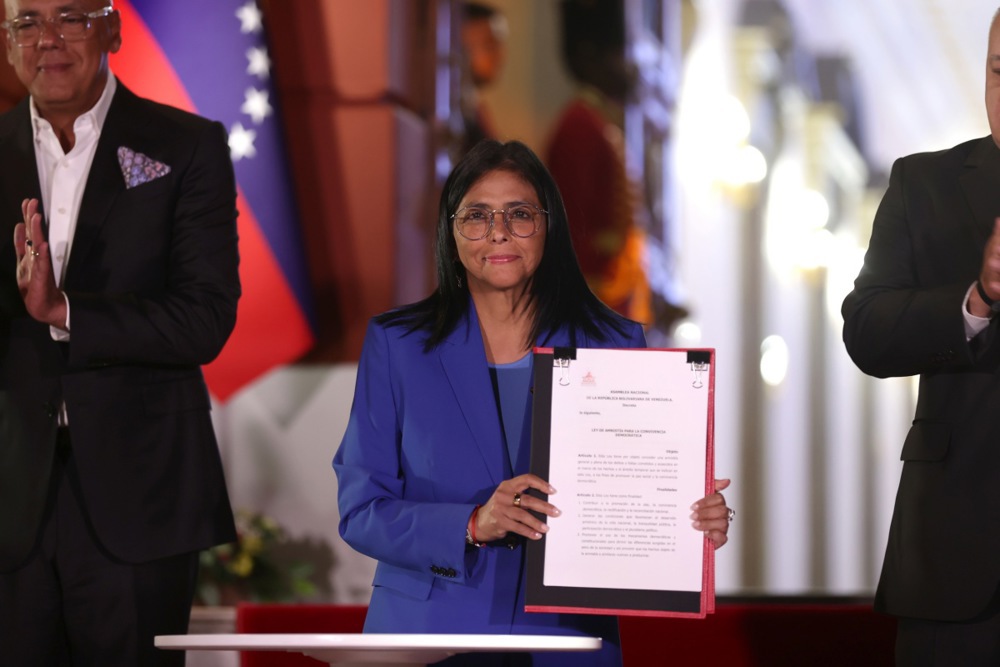
The IPI global network today calls on Venezuela’s acting president, Delcy Rodríguez, and her government to end the persecution of journalists in line with the government’s stated commitments to “redirect justice” after decades of repression under the Chavista regime. Authorities must take concrete steps to end the legal harassment of journalists, including dropping all charges against members of the press in retaliation for their work, and codifying protections for press freedom.
On February 19, Rodríguez signed into law an amnesty bill that international observers, local activists, and political prisoners themselves say does not go far enough to reverse decades of systemic repression under the Chavista regime that routinely included the persecution of journalists.
Despite claiming to grant “a general and full amnesty” to political prisoners, those eligible for amnesty are narrowly defined, while the law excludes those accused of serious crimes, which human rights activists say are routinely fabricated by authorities to silence independent voices, including members of the opposition, activists and journalists. The new law also does not invalidate sanctions placed on media outlets.
The bill stipulates that amnesty applications must be individually submitted to trial courts, which have 15 days to review requests. This clause has raised questions about how effective the law will be in practice, given that the courts that will approve amnesty are the same ones that perpetuated a decades-long era of repression in Venezuela. Journalists have already reportedly experienced administrative difficulties filing requests for the dismissal of charges against them.
Prior to the amnesty law’s passage, the Venezuelan National Union of Press Workers (SNTP) called for legislation to specifically acknowledge the judicial persecution of journalists for free expression under the Chavista regime and explicitly state that such persecutions would “never again” occur.
Venezuela has one of the most repressive and restrictive environments for media in the world. Few independent news outlets remain, as Venezuela’s recently deposed authoritarian leader, Nicolás Maduro, engaged in a systematic, yearslong campaign of legal harassment, intimidation and censorship against the free press.
According to the SNTP, 59 journalists and media workers are currently facing legal proceedings under Venezuelan law. Many more journalists have been forced to live and work in exile for fear of judicial persecution, especially in the wake of crackdowns on the media that followed Venezuela’s widely disputed 2024 presidential election.
The passage of the amnesty bill comes weeks after the Venezuelan government announced on January 8 that it would be releasing a “significant number” of prisoners as a gesture to “seek peace” following the U.S.’s capture of Maduro. Since then, more than 400 political prisoners are estimated to have been released. Several journalists were part of this wave of releases, including Rory Branker, who spent nearly a year behind bars on spurious charges of treason, financing terrorism and conspiracy.
Yet even after their release, many former political prisoners – including journalists – still face legal proceedings and restrictions.
“There can be no true amnesty in Venezuela while journalists still face unjust charges meant to intimidate them into silence,” said IPI Executive Director Scott Griffen. “Free media is a bedrock of democratic reform. If the Venezuelan government under acting President Rodríguez is serious about undoing decades of repression, it must end the judicial harassment of Venezuelan journalists and ensure they are free and safe to do their critical work, which ultimately safeguards a free society.”