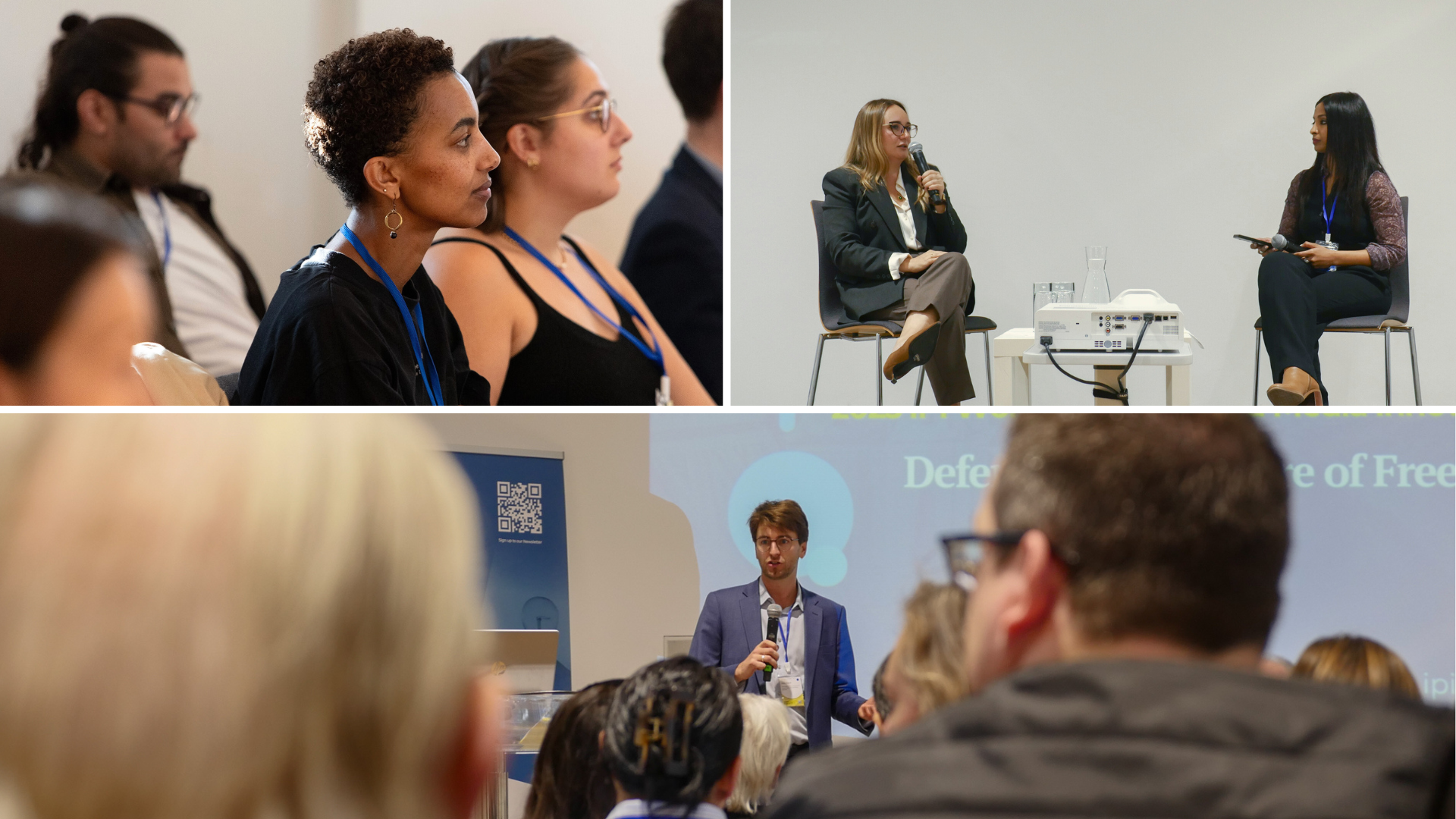
On October 24, we kicked off the Media Innovation Festival 2025 in Vienna’s Schönbrunn Apothekertrakt. Ryan Powell (Head of media innovation and business, IPI) opened the day, introducing the 4 years of Media Innovation Festival impact, and drawing a through-line for the 2 days to come: a celebration of experimentation and solutions.
Story Matters: News entrepreneurs in a disruptive age was our first session in the energizing new format of interviews. Moderated by Preethi Nallu (Co-founder and executive director at Report for the World), the session featured five powerful testimonies from media founders, all shaping how we tell stories that matter and how those stories reach their audiences. Full of unique insights, trials, errors and wins, the opening set the scene for the rest of the programme for this year’s Festival.
In part 2, we cover the interviews with Anastasiia Marushevska (Editor-in-Chief and Co-founder, Ukraїner International) and Maya Misikir (Journalist, Sifter).

Expeditions through contexts
Sometimes new stories are best found on the maps of the past. This idea was at the heart of the founding of Ukrainer International in the post-Maidan era and is still the primary approach of the outlet, shared Anastasiia Marushevska (Editor-in-Chief and Co-founder, Ukraїner International).
“We actually do not work with commentary on news; we work with context. So we try to spend time to hear, listen, and to show these amazing stories of Ukrainian society.”, said Marushevska. “Because now, during the full-scale war, I think this is something that fascinates the world.”
Their first project into uncovering untold stories of Ukraine was the extensive expeditions, spanning thousands of kilometres, hundreds across Ukraine’s regions, from remote villages to big cities, producing vlogs that have now evolved into documentaries and books.
“Ukraїner in many ways influenced the way we all in Ukraine now see the country. So when we went on expeditions, we decided to choose not to follow these Soviet era imposed regions, which are called oblast”, instead following the cultural and linguistic patterns, for example, the oblast of Lviv and Ivano-Frankivsk would be historically known as Halychyna (or Galicia), as Marushevska explains.
Telling stories in this way highlighted something that mainstream media would often look past – the resourcefulness of the people in Ukraine, local initiatives like buying satellites or a museum of local lore, community support for an artist’s first trip abroad and the hard-hitting stories of communities surviving the occupation and the longevity of the independence struggle.
Marushevska emphasized that these contexts are always in flux, and so is the journalism. “The anecdotes have changed. You just relaunch those expeditions.”
Being an antithesis to the hype, Ukraїner’s approach resonates with their audiences. As Nallu highlights, this works for revenue sustainability too. Despite being a non-profit model, Ukraїner proves it is possible to gradually increase the reader base and make partnerships with brands, from car manufacturers to local businesses.

Sifting the signal from the noise
In her testimonial, Maya Misikir (Journalist, Sifter) shared about the journey of launching the weekly English-language newsletter about Ethiopia. Sifter, inspired by Misikir’s foreign correspondent and media monitoring work, targets an audience that is a mix between diaspora living abroad, those working in Ethiopia, and those interested in local news, who might not have the time or bandwidth to keep up with the developments.
The project has developed against the background of the regressive news landscape and diminishing opportunities to cover the country as a foreign correspondent.
As another conflict started in Ethiopia in mid-2023, initially, there was so much interest in it, Misikir recalled. She had sources reaching out all the time to share evidence and stories from different locations. “And a few months down the road, all that interest disappeared.”, said Misikir. Misikir found herself in a place where people’s stories and the witness weren’t being picked up by the international media, so Sifter was born.
Trying to find the right home for the project, Misikir had a testing mailing list: “I selected a few people, about 15 to 20 people. And my mother and my sister, obviously.” Other testers were friends and foreigners working in Ethiopia, many in the human rights space. The feedback was very positive, and the test audience wanted to be kept on this list. Now Sifter has about 2000 readers.
Working on weekly updates, in a “one woman show”, as Nallu describes, means building relationships and alliances across the board.
“Working in a space where there is a lot of crackdown, not just on media, but also on actors in the civic space, it does bring us closer than in other places, the civic actors and journalists, and trust is a very precious commodity.”, says Misikir.
In the near future, Misikir will launch a new product to reach the young people by meeting them where they are. A pop-up newsletter, scheduled to kick off a month before and end a month after the elections, will aim to help the elections make sense for the younger audience, using social media as the main distribution channel.
Read Part 1 with the first round of interviews.
Story Matters: News entrepreneurs in a disruptive age (Part 1)
Make sure to sign up for the IPI Media Innovation Newsletter – The Outlook below to stay updated on all of the stories coming from the Media Innovation Festival 2025.
The Outlook: Media innovation unlocked
Subscribe to The Outlook – IPI’s media innovation newsletter, covering the latest developments in media innovation, storytelling, audience engagement, and sustainable revenue streams