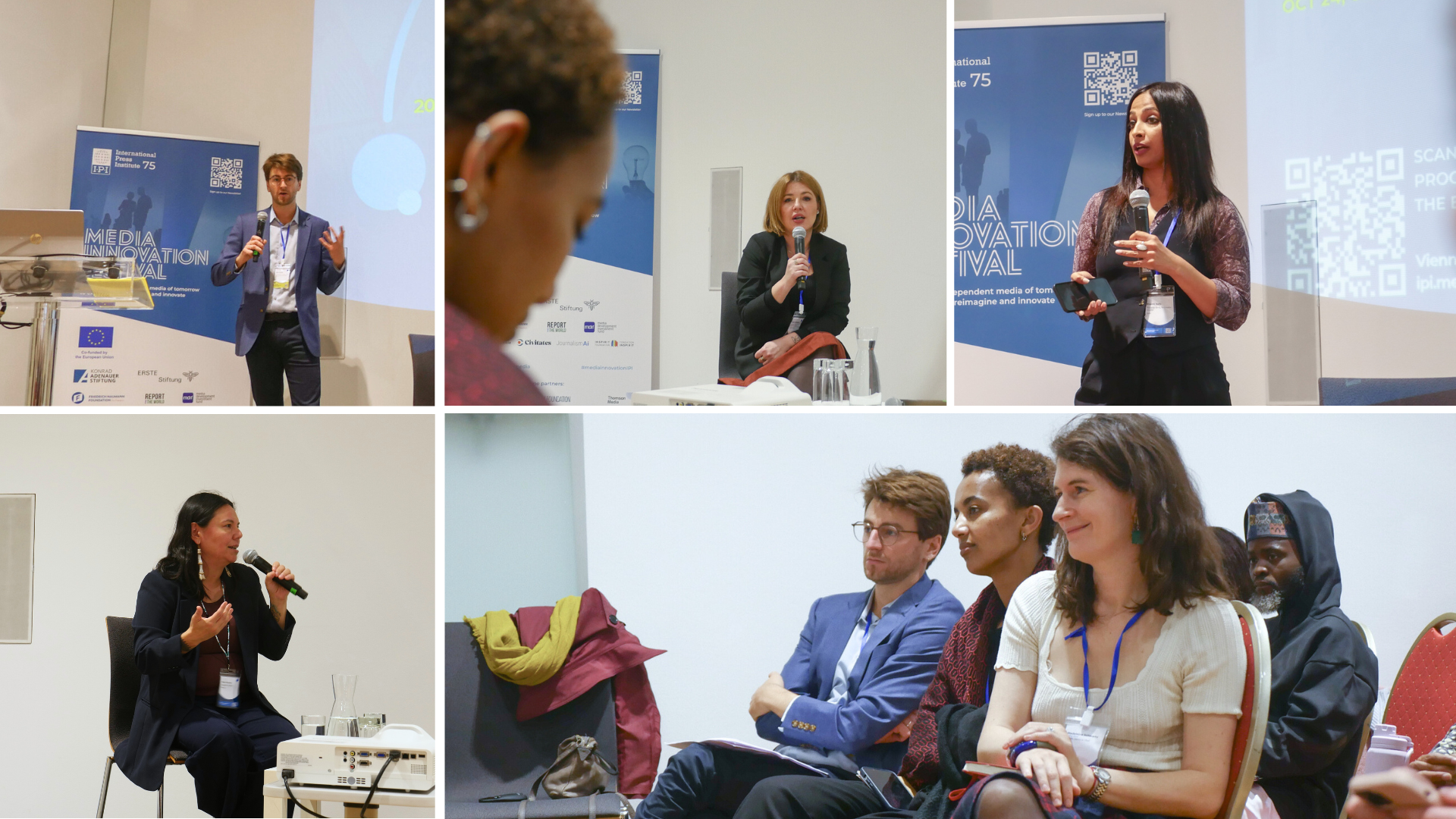
On October 24, we kicked off the Media Innovation Festival 2025 in Vienna’s Schönbrunn Apothekertrakt. Ryan Powell (Head of media innovation and business, IPI) opened the day, introducing the 4 years of Media Innovation Festival impact, and drawing a through-line for the 2 days to come: a celebration of experimentation and solutions.
Story Matters: News entrepreneurs in a disruptive age was our first session in the energizing new format of interviews. Moderated by Preethi Nallu (Co-founder and executive director at Report for the World), the session featured five powerful testimonies from media founders, all shaping how we tell stories that matter and how those stories reach their audiences. Full of unique insights, trials, errors and wins, the opening set the scene for the rest of the programme for this year’s Festival.
In part 1, we cover the interviews with Madeleine Schwartz (Editor-in-Chief, The Dial), Saska Cvetkovska (Publisher, Investigative Reporting Lab (IRL)) and Eden Fineday (Publisher, IndigiNews).

Being “delightful” when making the news
“The conversation around journalism often tends to focus on tools and what tools are gonna make us work faster, better, harder. But journalism actually starts with the people who are living through the stories, and it ends with the people who are reading the stories, and it’s really important for us to keep that human connection throughout.”, said Madeleine Schwartz (Editor-in-Chief, The Dial).
Focusing on the human is harder in a world full of news fatigue, disinformation and digital noise. For Schwartz, “… that comes with having a bit of personality and bringing other kinds of perspectives”.
The Dial publishes investigative journalism, essays and literature from writers and reporters around the world, primarily outside of the Anglosphere, catering to an audience seeking connection beyond local coverage.
“Even as our news outlets turn more and more local, what happens in a place like Cleveland, Ohio, doesn’t start in a place like Cleveland, Ohio. And so we really need to understand the global forces that are shaping our reality.”, Schwartz said.
What it looks like in practice involves a lot of collaboration, talent-spotting, mentorship and creating offline spaces for connection.
The Dial works with partner publications around the world to translate their work into English and bring forward the work of diverse voices. In contrast to the parachute journalism of traditional international publications, which focus on conflict and big events, The Dial tries to bring “a full sense of what’s happening” with in-depth pieces on everything from politics to culture and life at large.
“I think it’s important to be delightful in the work that we publish”, which can take unorthodox forms, as Schwartz explains. In one of their popular pieces, they commissioned a poet, Jessica Traynor, to cover a Clonshaugh data center project in Ireland.
When working with partner pieces, the team expands the stories by adding important context for international audiences, bringing more value and understanding to the readers. Platforming international authors also expands their visibility and can often accelerate their careers.
Another surprising insight came from bringing the editorial team to the forefront, despite their initial belief where Schwartz “wanted to sort of recede into the background, kind of like that Homer Simpson meme”. As it turns out, the audience did want to know why and how the publication was making editorial choices.
Navigating the international reporting market can push many publications like The Dial to the margins, but the team is finding ways to take control of the impact they generate.
“One of the things that’s most bittersweet is that the biggest impact that we have is when a larger outlet essentially steals our stories”, shared Schwartz. “We try to prevent that by going to larger outlets and have been very successful selling work that we’ve either commissioned or translated to two larger outlets.”

Small-town stories, big screens and lots of impact
Saska Cvetkovska (Publisher, Investigative Reporting Lab (IRL)) reflected on the founding of the IRL in 2017 in North Macedonia. In a context where the media became tools of the state, and trust in media was very low, their team knew it was time to do something different. They wanted to center audiences, reach young people and generate tangible impact unbound by preconceived notions of what works.
IRL conducted surveys in North Macedonia’s eight administrative regions to identify topics that mattered to local communities.
Cvetkovska said, “It was quite surprising. It was corruption in healthcare, corruption in the justice system, in the environment and in construction. So to this day, 70% of all our reporting and products are devoted to these topics.”
As Cvetkovska emphasized, “people need to be connected personally with their journalists”, and when traditional formats failed to build trust, IRL chose creative solutions.
IRL has a robust film production team that experiments with structured fiction scripts for their documentaries on real investigations. This strategy was used in the award-winning Murder in Tetovo, where journalists behind the story became protagonists of the documentary.
Off-screen, one to two times per year, IRL move their whole office outside of Skopje, often to the country’s news deserts with their signature mobile newsroom project. Being on the ground in these regions allows them to meet the local residents, build relationships and find new stories amid deep polarization in society.
“The goal is to do an investigation, a local investigation, that will have national relevance.”, said Cvetkovska.
Nallu noted that this value proposition proved successful for IRL. As of January, and as a result of two investigations, 90 people have been jailed.
“They (corrupt institutions and individuals) are afraid of the support we are getting from the citizens. And this is a result of our presence in small communities everywhere in the country”., said Cvetkovska.

On the basis of Indigenous knowledge and solidarity
“There is so much brilliance in the margins. There’s so much warmth and love and tenderness in these old people who the mainstream culture doesn’t really value.”, said Eden Fineday (Publisher, IndigiNews) on the outlet’s mission to amplify not only the Indigenous journalism, but the Indigenous knowledge itself.
IndigiNews is an online Indigenous-run newsroom primarily covering Western Canada, as well as stories of national relevance that tend to be overlooked by the mainstream media. Their mission is to decolonise journalism and strengthen Indigenous media ecosystems by amplifying Indigenous voices.
This work involves navigating both structural racism affecting the Indigenous peoples, news industry-level marginalisation and the personal sense of isolation.
As Fineday said, “There’s this certain loneliness that is part of being an Indigenous journalist in Canada because there are so few of us. But also, there’s this undertone of disrespect in a lot of mainstream news organizations that maybe what we’re doing is more activism than journalism.”
To tackle isolation at multiple levels, the outlet provides capacity-building for Indigenous journalists, investing in the future of Indigenous reporting: “It’s very hard to find Indigenous reporters,” Fineday shared, “so we find sometimes that we have to create those reporters.”
Working with people who live at many intersections of inequality also requires another level of awareness, with the newsroom using trauma-informed practices that help new journalists and community members alike to feel supported.
Working against the many gaps in the Canadian curricula and policy, a big effort goes into recovering Indigenous wisdom itself. It’s critical not only for the newsrooms but for the communities at large.
As Fineday shared: “I sit down with kokums (Cree for grandmothers), or moshums (Cree for grandfathers). They’re some of the most brilliant people I’ve ever met… And sometimes they’re actually carrying stories that are thousands of years old. Like my father is a knowledge keeper… And I’m not talking about like modern stories, but our cultural stories – our creation stories. There are so few people who know anymore, but those who do are very old and they’re wearing t-shirts and jeans and they’re poor and they might not be respected by folks who are more affluent, right? But to me, that’s where the value is.”
Their readers resonate with the care poured into this project. IndigiNews newsletter has been steadily growing and has already proven insightful to the audience research. After conducting two surveys, IndigiNews found out that 75% of their readers are non-Indigenous, and 25% are Indigenous. At first surprising, these findings show the potential to advance cross-cultural understanding, educational change and last but not least, sustainable funding for the newsroom.
Growing international solidarity with other Indigenous newsrooms and communities – for example, the Indigenous Journalists Association (US) – is key.
“Just to give each other support, to offer validation, and to build strength in numbers, so that we can unify and talk about Indigenous media and make that message go further.”, as Fineday explained.
With more resources and capacity, the newsroom would explore audio formats and live events, which can deepen the impact and strengthen their relationships with the audience.
Read Part 2 of the interview series.
Story Matters: News entrepreneurs in a disruptive age (Part 2)
Make sure to sign up for the IPI Media Innovation Newsletter – The Outlook below to stay updated on all of the stories coming from the Media Innovation Festival 2025.
The Outlook: Media innovation unlocked
Subscribe to The Outlook – IPI’s media innovation newsletter, covering the latest developments in media innovation, storytelling, audience engagement, and sustainable revenue streams