Last year, press freedom in Georgia continued to rapidly decline as the ruling Georgian Dream party intensified its crackdown on dissent. Journalists were arbitrarily detained, brutally assaulted and intimidated, amidst wider democratic erosion.
IPI World Press Freedom Hero and founder of prominent independent media outlets Batumelebi and Netgazeti, Mzia Amaglobeli, has now been unjustly held behind bars on politically- motivated charges for over a year.
The ruling Georgian Dream (GD) party has also intensified legal harassment of media and civil society by adopting draconian laws targeting independent media, including a recent bill that, if adopted, will significantly expand state control over foreign funding and criminalise a wide range of cooperation with foreign entities.
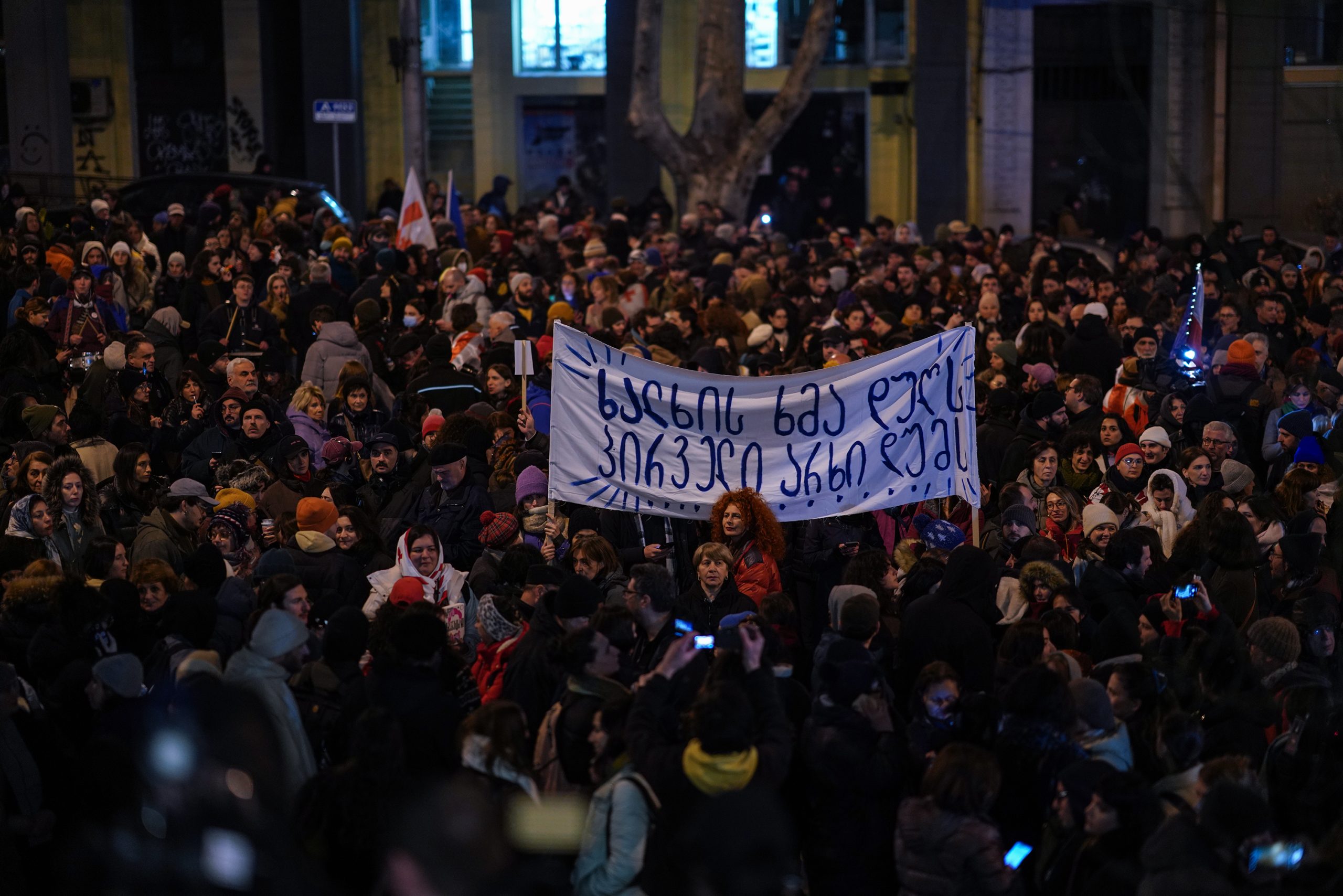
Since the government’s announcement in November 2024 that it would halt Georgia’s EU-integration process, protestors have taken to the streets of the capital Tbilisi daily to challenge the democratic decline which followed.
One of the repeated targets of these protests has been Georgian Public Broadcaster (GPB) – which under the influence of the ruling party has slowly been distorted into a propaganda arm of the government and now represents a politically-captured institution.
While the broadcaster previously suffered sustained challenges to its editorial independence and sustainable funding under previous administrations, the shift after November 2024 has been dramatic – resulting in warnings and assessments from the EU.
Critical employees have been fired and public interest programmes have been removed from the airwaves. Censorship is heavy and editorial policy is biased towards the ruling party. News channels have been used as a propaganda tool to promote pro-government narratives and anti-Western rhetoric.
Amidst a further erosion of the broadcaster’s independence over the last year, IPI spoke with former GPB employee and producer of the now-cancelled political talk show Real Space, Tamar Mshvenieradze, to understand how we reached this point and what the situation inside the broadcaster is now.
Radio silence
As the protests broke out in 2024, demonstrators gathered outside the headquarters of GPB in the capital to protest what they saw as its unacceptable silence on reporting what was happening in the streets.
“People were knocking at the door of the public broadcaster. They wanted their voices to be heard. They needed the public broadcaster. And you are responding with just not being on air”, Mshvenieradze recalled. People demanded that GPB cover the demonstrations and the violence against protestors and journalists.
Instead GPB’s main television channel, First Channel, broadcasted films and documentaries with nothing to do about the immediate situation in the country, Mshvenieradze explained. The official reasoning given by GPB management for not going on air was that the company was moving to a new building.
“We carefully investigated this and I want to emphasize that it was technically perfectly possible to go on air and organize a special discussion format”, Mshvenieradze said.
In response to escalating demonstrations across the country, GPB began a special broadcast on First Channel. But the coverage was distorted and did not examine the complexities of the protests or the heavy handed response of authorities, Mshvenieradze continued.
“The public broadcaster was not covering the stories of people who have been brutally beaten outside, captured and imprisoned, including journalists, our colleagues and its own employees”, she continued.

Warning signs
Mshvenieradze and several colleagues who called themselves ‘GPB Guardians’ joined protestors in demanding daytime and unbiased coverage for political issues. While some air time was permitted, this soon stopped and GPB management took the special broadcast off air.
Another early sign of this worrying editorial shift, Mshvenieradze said, was how GPB failed to properly report on the case of veteran journalist Mzia Amaglobeli.
“When GPB Guardians organized a simple activity in the lobby of the public broadcaster in support of Mzia Amaglobeli, GPB did not cover that and there was no sign of solidarity or will to be a part of it”, she said.
Instead, the broadcaster began openly spreading the ruling party’s political propaganda and rhetoric about the protests. In its reporting, the broadcaster started using terms such as ‘deep state’ and referring to the opposition as the ‘global war party’ on its website, without quotation marks.
“I suggested to the Board of Trustees and to management that maybe, if we are using these terms without quotation marks, we should explain to our audience what they mean”, Mshvenieradze recalled. Instead, GPB management refused to listen and started censoring critical voices.
Dismissal of critical voices
In early 2025, several GPB journalists explicitly expressed support for Amaghobeli and criticized GPB’s lack of editorial independence. Among them was the anchor of First Channel’s major news program, Vasil Ivanov-Chikovani, who also openly criticized Vasil Maglaperidze, the Chair of the GPB Board of Trustees and a former deputy chair of GD, accusing him of influencing editorial decisions. Following Ivanov-Chikovani’s criticism, he was suspended.
Maglaperidze, the chair, then accused critical GPB employees of slander. He was re-elected as the head of the Board of Trustees in April 2025. Soon after, Ivanov-Chikovani and anchor of the Real Space programme, Nino Zautashvili, were dismissed by GBP Director General Tinatin Berdzenishvili. GPB management proposed that Mshvenieradze and a few of her colleagues who worked for Real Space be reassigned, which they refused.
“The management has a very subtle policy”, Mshvenieradze explained: “They fired some journalists, and then others were put into a situation where there was no other option than to leave. Some of our colleagues left because of solidarity.”
Since these changes, Mshvenieradze said GPB has been further distorted into a propaganda tool of the ruling Georgian Dream party: “Vasil Maglaperidze has publicly confessed he is a representative of the ruling party in the public broadcaster. But what’s more, he said he is very proud that he managed to really fulfill GD party politics into the public broadcaster”.
Media monitoring shows that balanced coverage of the protests remain restricted and opposition views are marginalised. The EU’s 2025 Enlargement Package report concluded that GPB “lacks independence, has biased editorial policy and contributed to the promotion of anti-EU rhetoric,” making Georgia a “candidate country in name only.”
Despite continued warnings from press freedom groups and international organisations, little appears to have changed inside the broadcaster. GPB management and much of the Board of Trustees – the broadcaster’s oversight body – maintain close ties to Georgian Dream, enabling editorial control and the continued suppression of dissent of journalists trying to do their job.
“I’m losing my hope”, Mshvenieradze continued. “I think everything is clear. And everybody who is there right now and doesn’t do anything, doesn’t challenge what is happening, is complicit.”
Fight for independent media not over
Despite severe pressure, Georgia’s independent journalists have shown remarkable resilience.
Former GPB employees, including Ivanov-Chikovani, along with the “GPB for the People” movement launched an initiative titled ‘Sakhalkho Moambe,’ which is broadcast online. Within this media platform, journalists and activists take to the streets in different regions, to interview people and cover social and political events.
However, as IPI and its partner MFRR warned, the already unprecedented clampdown on the country’s media is likely to intensify, and without sustained international pressure, Georgia’s independent media landscape is unlikely to survive.
- In 2025 and 2026, IPI documented 153 alerts in Georgia on the Mapping Media Freedom (MapMF) database which affected 276 journalists and media entities.
- In 2025, IPI recorded five incidents on the Mapping Media Freedom (MapMF) concerning loss of employment resulting from GPB management decisions, affecting 21 journalists and media workers.
- More of IPI’s press freedom work on Georgia
- Georgia: Restrictive new funding law would further cut off media and journalists
This article by IPI is part of the Media Freedom Rapid Response (MFRR), a Europe-wide mechanism which tracks, monitors and responds to violations of press and media freedom in EU Member States and Candidate Countries.