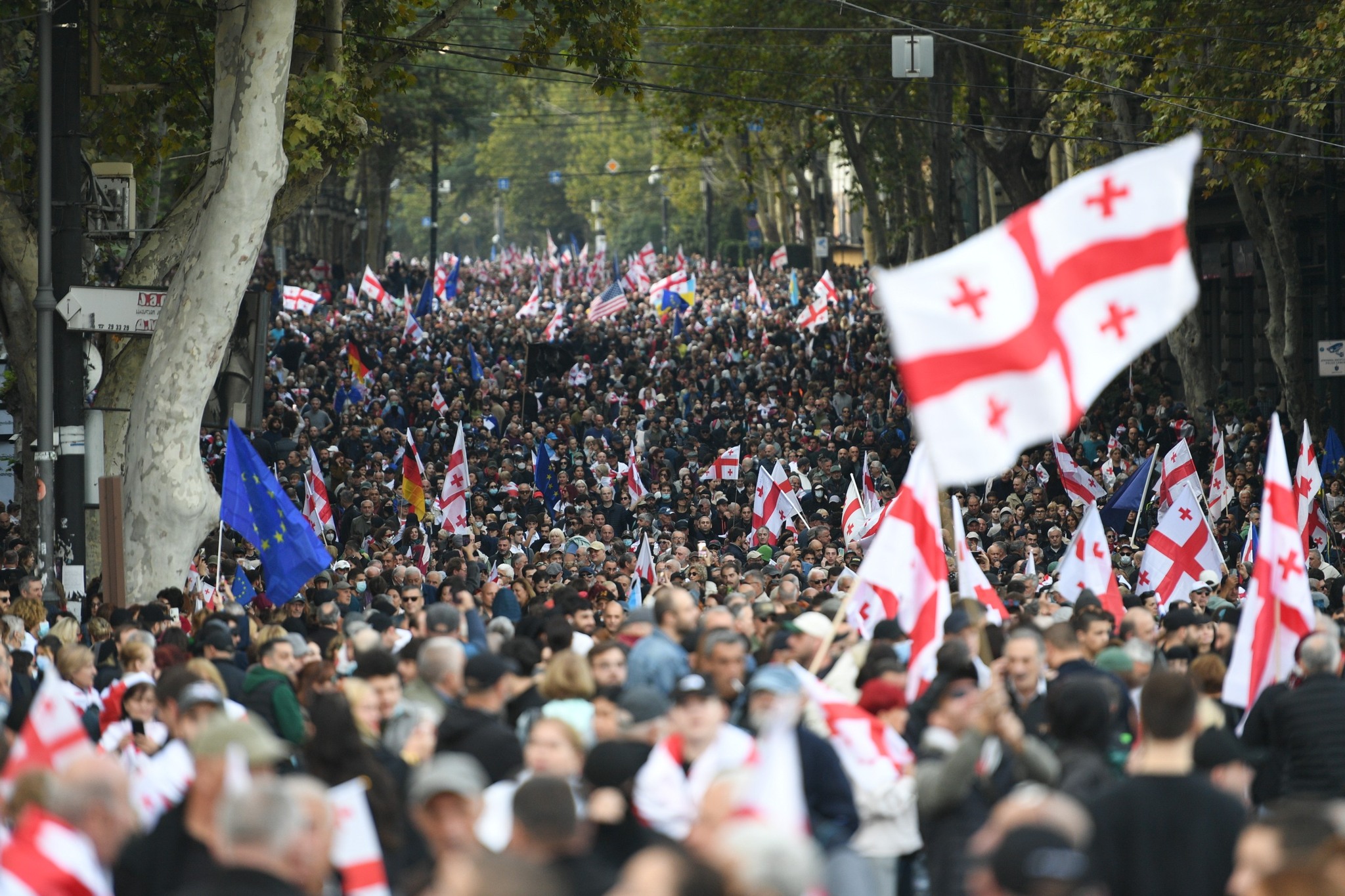
The International Press Institute (IPI) today strongly condemns the Georgian parliament’s adoption of a sweeping new legislative package that criminalizes foreign funding and cooperation, warning it will paralyze the operations of the country’s vital independent media sector.
The measures threaten to cut independent journalism and civil society off from vital lifelines of financial support and impose new forms of censorship. IPI calls on Georgia to immediately repeal these laws and cease legal harassment of the media.
Adopted on 4 March 2026, the Georgian Dream–led parliament’s legislative package dramatically expands state control over foreign funding and introduces potential criminal sanctions for cooperation with international entities or donors. It also criminalizes public criticism of the government’s legitimacy, imposing additional censorship on critical reporting. Taken together, these amendments equate watchdog reporting with criminal activity.
The amendments significantly broaden the definition of a “grant” requiring government approval and introduce criminal liability, including prison sentences, for violations. The new definition of “grant” covers virtually any form of foreign funding or assistance if it serves vaguely defined political goals. Additionally, the list of entities considered as grant recipients has been expanded and now includes foreign-based organizations working on Georgia-related issues.
Under the new law, which IPI previously raised alarm over, violations may result in fines, 300–500 hours of community service, or imprisonment of up to six years, with harsher penalties in certain cases. The legislation also applies retroactively: unused grants received before the law’s enactment will require new government approval, and recipients will be barred from using the funds if permission is denied. The law will directly affect media receiving international funding for journalism projects, grants, training or travel to conferences or events outside Georgia.
In addition, the law introduces an “extremism” provision, punishing acts that “systematically” question the government’s legitimacy with up to three years’ imprisonment for individuals. Organizations, including media outlets, could face heavy fines or even forced closure if accused of committing such acts.
Intensified legal harassment
The latest proposals add to an alarming list of restrictive pieces of legislation that undermine media freedom and civil society in Georgia that were already passed in 2025 and 2024.
The adoption of repressive and undemocratic legislation, along with widespread political persecution, is unfolding at an unprecedented scale in Georgia, an EU candidate country once widely considered as a beacon of democracy in the South Caucasus.
IPI warns the GD is increasingly relying on the Russian authoritarian playbook to silence critics, undermine human rights and dismantle democratic institutions.
GD adopted the legislative package on the same day as the Supreme Court of Georgia rejected considering an appeal of two-year prison sentence of IPI World Press Freedom Hero Mzia Amaglobeli, once again signalling its determination to fully suffocate the space for independent journalism.
Moving forward, IPI renews our call on the European Union and the international community to respond robustly to the ruling party’s clampdown on media and civil society, including through additional targeted sanctions. This pressure must be applied to not only the Georgian Dream officials but every decision maker as well as judges, responsible for the crackdown on media freedom.
The OSCE’s Moscow Mechanism, for which IPI and press freedom partners provided a recent briefing on media freedom, should directly address the new legislative package and its upcoming findings. This report should prompt OSCE participating states to take concrete steps to address the situation in Georgia, as well as additional scrutiny by the Venice Commission.
Media freedom and freedom of expression are essential pillars of democracy and European values, and should be placed at the center of Georgia’s relationship with the EU and international community.
-
Click here for more of IPI’s press freedom advocacy work on Georgia
-
Click here to see IPI’s monitoring of Georgia on the Mapping Media Freedom platform
This statement by IPI is part of the Media Freedom Rapid Response (MFRR), a Europe-wide mechanism which tracks, monitors and responds to violations of press and media freedom in EU Member States and Candidate Countries. The project is co-funded by the European Commission.
