IPI is joined by MFRR partners in strongly condemning the proposals of the Georgian Dream (GD) ruling party to implement a series of legislative amendments that would impose additional restrictions and penalties on recipients of grants and foreign funding.
If implemented, our organisations warn the amendments would strengthen an already restrictive web of legislation targeting financial support to media and civil society and could eliminate the ability of Georgian journalists and media outlets to receive any form of independent funding.
The proposed changes were announced on January 28 by Georgian Dream’s parliamentary majority leader and are set to be adopted on February 3. Under the fast-tracked proposals that were registered in the Parliament, violations of the new law would be punishable by a fine, 300 to 500 hours of community service, or imprisonment for a term of up to six years.
The proposals would significantly broaden the scope of what is considered a “grant”, defining virtually any foreign-linked funding connected to public, political or policy-oriented activities as a grant. Media organisations and journalists who receive these grants or funding without prior government authorisation could face criminal penalties of up to six years’ imprisonment.
Payments for journalism-related services, research or expertise by foreign actors could also be treated as illegal grants. Government approval would also be required for foreign organisations seeking to provide grants to their own local branches, for foreign-registered entities mostly engaged in activities related to Georgia, and for foreign actors hiring experts in Georgia.
In addition, the criminal code would introduce an “aggravating circumstance” for “money laundering related to activities concerning Georgia’s internal political affairs,” punishable by a prison term of between 9 to 12 years.
The latest proposals add to an alarming list of restrictive pieces of legislation that undermine media freedom and civil society already passed in 2025. According to Mapping Media Freedom monitoring, Georgia experienced a sharp rise in legal incidents, which accounted for 42.0% of all recorded cases. With 60 legal incidents documented in 2025, the number nearly doubled compared to 33 alerts in 2024.
Repressive legislation adopted by GD within the last two years included the foreign agents law, a Georgian version of FARA, amendments to Georgia’s Law on Freedom of Speech and Expression, as well as amendments to the laws on Grants and Broadcasting. Collectively, these legal measures not only threatened the survival of the media but also imposed restrictive censorship, pushing Georgian journalism to the brink of survival.
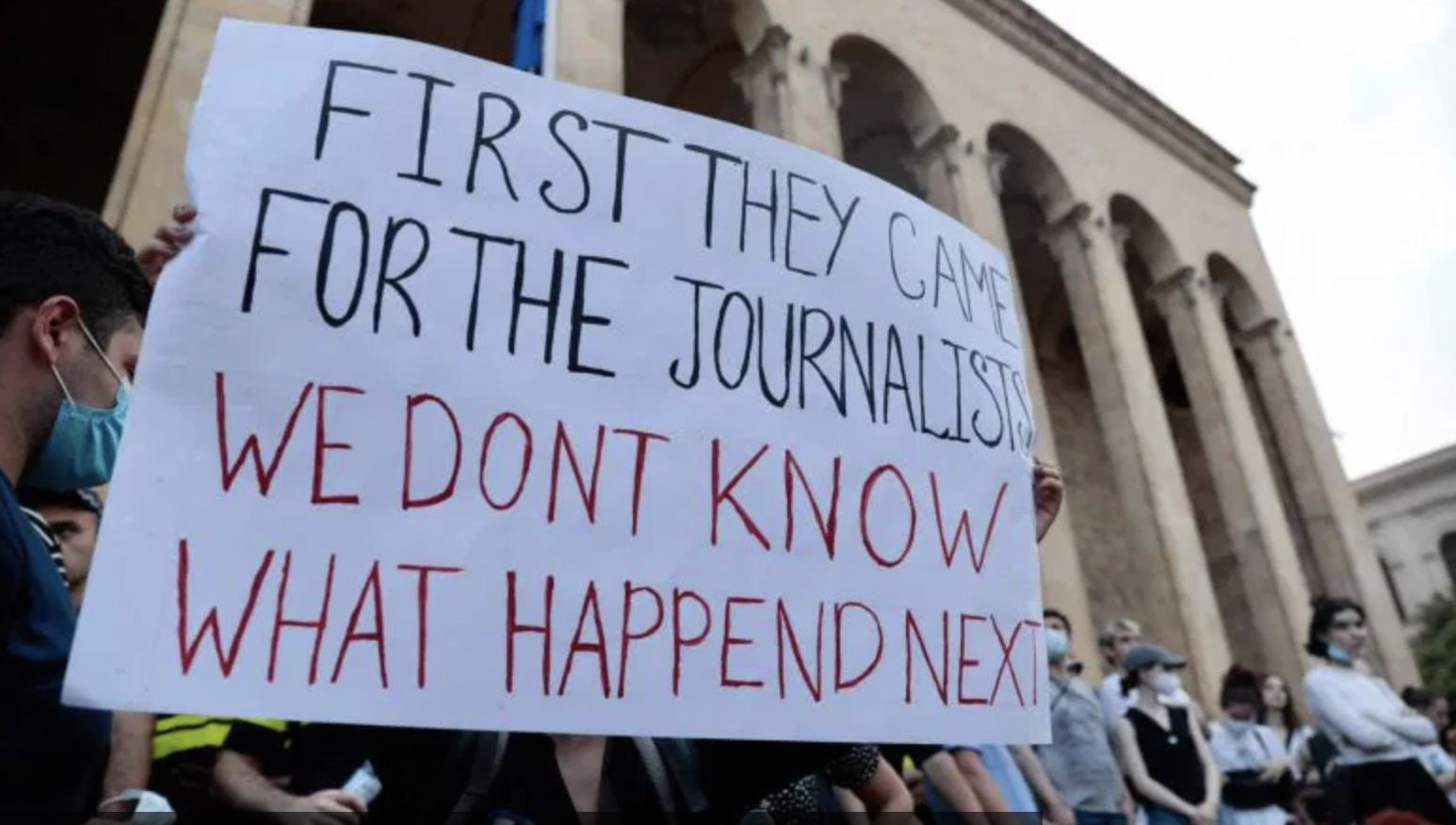
MFRR partners have repeatedly warned that the already unprecedented clampdown on the country’s media would only intensify without sustained international pressure. Despite an increasingly hostile environment for free media, independent journalists remain in the country and refuse to be silenced or forced into exile. However, they urgently need international support.
The proposed amendments are incompatible with Georgia’s international human rights obligations, including its commitments under the European Convention on Human Rights and its membership in the Council of Europe. They also conflict with Georgia’s obligations under the OSCE, which require the protection of freedom of expression and the ability of the media to operate independently.
We therefore welcome the invoking of the OSCE Moscow Mechanism to launch an expert mission on the deteriorating human rights situation in Georgia.
Moving forward, our organisations urge the GD-led parliament to immediately scrap plans to adopt these restrictive amendments and repeal existing repressive legislation, including the foreign agents law, the Georgian version of the Foreign Agents Registration Act (FARA), and the amendments to the laws on Grants and Broadcasting. Finally, we reiterate our call on the European Union and the international community to respond forcefully to the ruling party’s clampdown on media and civil society, including through additional targeted sanctions.
- In 2025 and 2026, Mapping Media Freedom (MMF) database documented 149 alerts in Georgia which affected 268 journalists and media entities.
Signed:
International Press Institute (IPI)
European Federation of Journalists (EFJ)
Free Press Unlimited (FPU)
Osservatorio Balcani Caucaso Transeuropa (OBCT)
European Centre for Press and Media Freedom (ECPMF)
This statement is part of the Media Freedom Rapid Response (MFRR), a Europe-wide mechanism which tracks, monitors and responds to violations of press and media freedom in EU Member States and Candidate Countries.