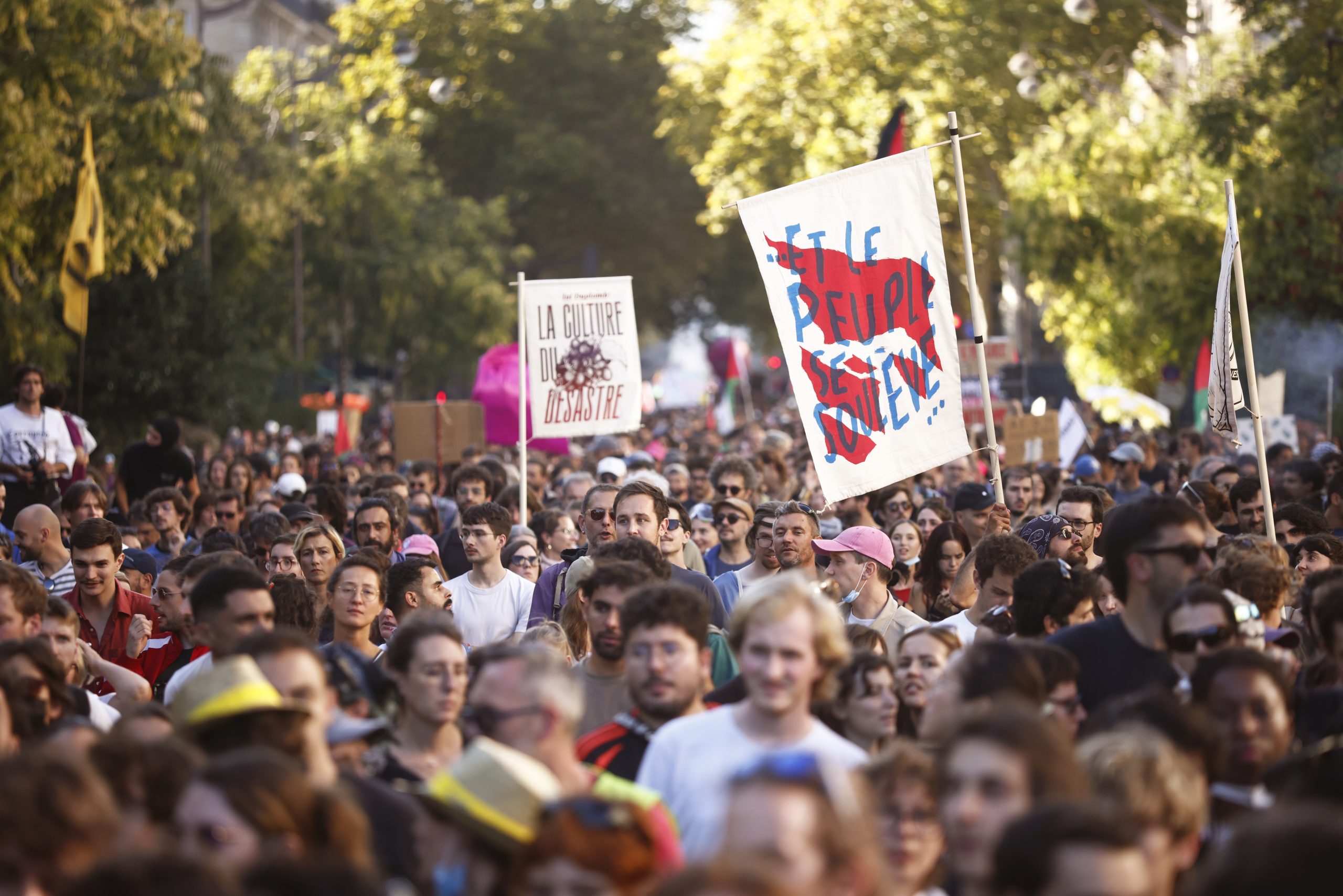
Several journalists have been injured since early September while covering the protests against the 2026 national budget plan. IPI joins the Media Freedom Rapid Response (MFRR) partners in condemning the deliberate violence by law enforcement officers. We jointly call on the French authorities to protect and recognise the work of journalists as essential during protests.
On 18 September 2025, a journalist from the public television channel France 2 was hospitalised in Lyon after being injured while covering the second day of the “Bloquons tout” (Block Everything) protests against the French government. The journalist suffered burns and tinnitus after a projectile – believed to have been fired by a police officer – hit him in the back and tore his shirt.
This incident is part of a broader pattern documented by Mapping Media Freedom (MapMF), with at least six assaults on journalists by law enforcement reported earlier this month. On 10 September, on the first day of the national strike in Montpellier, the reporter Samuel Clauzier was strangled and had his camera destroyed. In Paris, four more journalists were assaulted, with two injured while covering the protests: they were subjected to tear gas, beatings and shoving.
The situation is particularly alarming considering the country’s history of police violence targeting journalists and demonstrators during previous social movements. In anticipation of the upcoming protests, the Ministry of Interior quietly published a new document in July 2025, the National Urban Violence Scheme (SNVU), presented as a practical guide for law enforcement. Unlike the National Law Enforcement Plan (SNMO) of 2020, which legally guaranteed protection for journalists covering nationwide demonstrations, the SNVU initially ignored the role of journalists in the specific context of “urban violence”. It stated that “the consideration of journalists’ status as enshrined in the national law enforcement plan does not apply”. Following strong criticism from journalists’ organisations, the Interior Ministry eventually withdrew this wording.
The MFRR partners call for an independent and swift investigation into the registered attacks, and reiterate that journalists who document social movements and police actions do so in the public interest. With a new day of mobilisation now planned for 2 October, we demand an end to police violence, and call for unambiguous protection for journalists, including during clashes, in order to safeguard the fundamental right to information.
Our organisations will continue to closely monitor the situation and provide support to journalists in need.
Signed:
European Federation of Journalists (EFJ)
European Centre for Press and Media Freedom (ECPMF)
Osservatorio Balcani Caucaso Transeuropa (OBCT)
Free Press Unlimited (FPU)
International Press Institute (IPI)
This statement is part of the Media Freedom Rapid Response (MFRR), a Europe-wide mechanism which tracks, monitors and responds to violations of press and media freedom in EU Member States and Candidate Countries.