
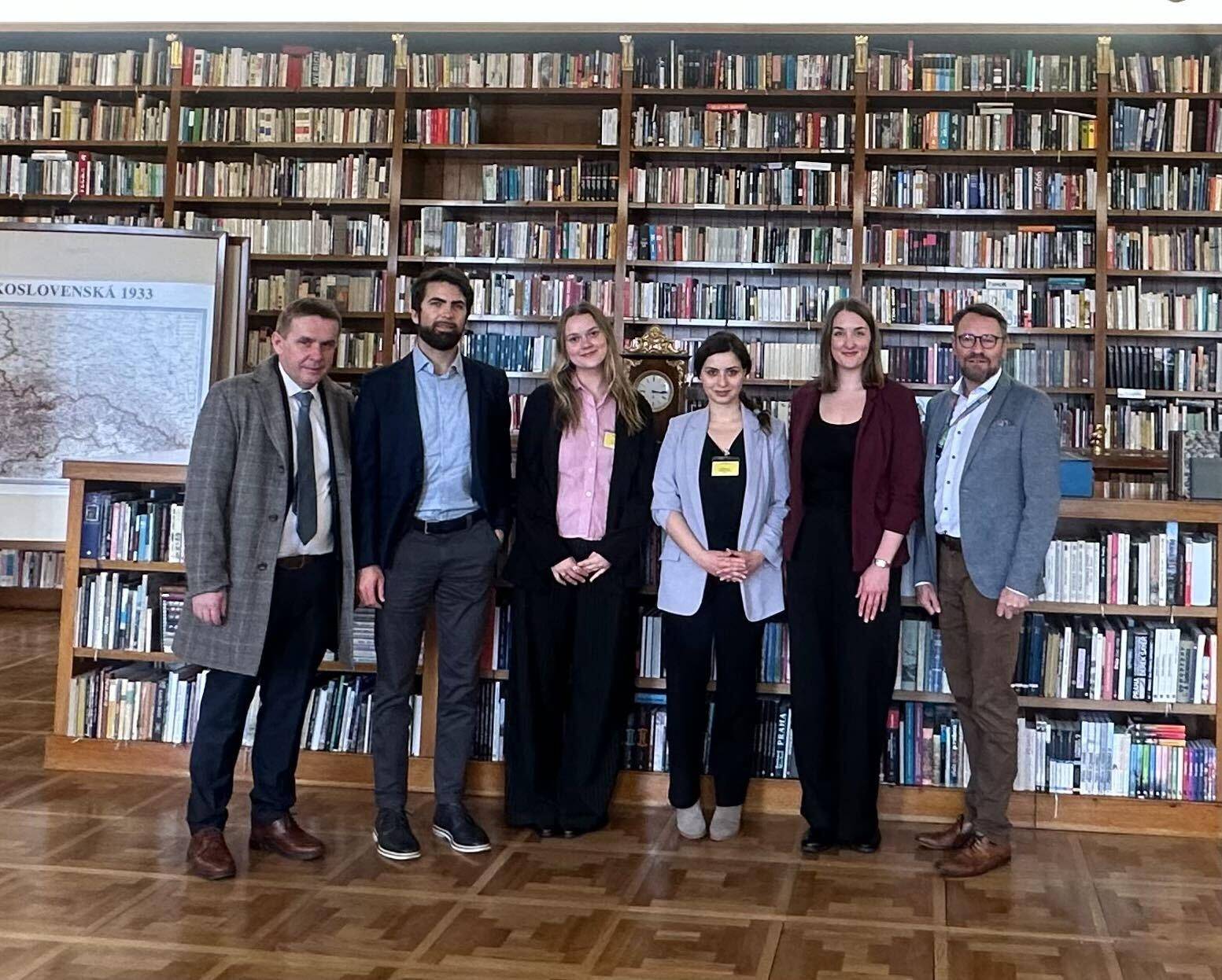
On 10–11 March, the International Press Institute (IPI) conducted an advocacy mission to Prague together with the IPI National Committee in the Czech Republic (CZ IPI), during which we met with media stakeholders, policymakers and government representatives to assess the media environment in the country.
During the visit, IPI and CZ IPI met with the new Minister of Culture, Oto Klempíř, as well as MPs from the Chamber of Deputies and Senate working on media policy, and representatives of the Office of President Petr Pavel. The delegation also met senior and editorial leadership from public broadcasters Czech Television (ČT) and Czech Radio (ČRo), and leading Czech editors and media executives.
Discussions focused on growing concerns over threats to the independence and sustainable financing of the Czech Republic’s public broadcasters, following the stated intention of the governing coalition to abolish the current licence fee funding model. The meetings also addressed the alignment of Czech legislation with the European Media Freedom Act (EMFA) and challenges facing private media.
While in Prague, the IPI delegation also discussed with the civil society stakeholders the ruling coalition’s recently reported draft foreign agent–style funding bill and its potential implications on media and civil society in the country.
Following the meetings, IPI and CZ IPI strongly urge the Czech authorities that any proposed changes to the public media funding model must be developed in a transparent and inclusive consultation process which includes leadership from the public broadcasters, as well as media professionals, civil society and independent media experts.
IPI also reminds the government of its legal obligations under the EMFA to guarantee editorial independence and sustainable financing for public broadcasters and stress that attack on independent media or attempts to bypass democratic safeguards undermines Czech Republic’s commitments to upholding media freedoms and democratic norms.
Growing pressure on public broadcasters
Stakeholders expressed deep concern about plans announced by the government to implement changes to the funding system of ČT and ČRo. It is understood that the proposal would abolish the current licence fee system (150 CZK for Czech TV and 55 CZK for Czech Radio) and would replace it with a model based on direct state funding, although details are unclear. Stakeholders warned that such a change could threaten public service media independence by increasing the state control over its funding.
IPI and CZ IPI were informed that, despite repeated requests from both ČT and ČRo, the Czech authorities have so far not disclosed any concrete details regarding proposed changes to key stakeholders, including the leaders of the public broadcasters.
For more than three decades, ČT and ČRo have served as independent and trusted public-service broadcasters, reaching some of the largest audiences in the country. The licence fee model has been a crucial guarantee of their financial and editorial independence.
IPI and CZ IPI have consistently called on the authorities in the Czech Republic, past and present, to ensure secure and sustainable funding for the country’s public media system and to refrain from implementing major overhauls that could undermine the organisations’ independence.
Before being reelected in October 2025, Prime Minister Andres Babiš, vowed to make the merging of ČT and ČRo a central manifesto pledge, in addition to plans to replace the licence fee with direct financing from the state budget. The governing coalition, in particular the Freedom and Direct Democracy party (SPD) has dialled up pressure against the broadcasters and strongly advocated for the change in the funding model.
Article 5 of the European Media Freedom Act (EMFA), in full force since August 2025, requires all EU Member States, including Czech Republic, to guarantee the independent functioning of public media and ensure the funding procedures “are based on transparent and objective criteria laid down in advance” and broadcasters are provided with “adequate, sustainable and predictable financial resources corresponding to the fulfilment of and the capacity to develop within their public service remit”.
Preparation of foreign funding bill
During IPI’s visit, Czech media broke the news that MPs from the ruling ANO and SPD parties are currently preparing a draft of a foreign agent–style funding law which could affect NGOs and media operating in the country. According to reports, the development of the bill is being led by an advisor of the Prime Minister.
According to reports, the bill would create a new database run by the Ministry of Justice where any organisations with “public, political, media, educational, academic” activities and which receive any form of foreign funding would have to register. Plans for this registry reportedly include obliging organisations to provide a list of their employees and their job descriptions and list all relations with foreign states and their financial flows. Organisations which do not register would reportedly face a fine of up to 15 million crowns (€614,000) or a ban on “foreign ties” for up to five years.
IPI discussed with civil society stakeholders the impact this reported bill could have on non-profit and investigative media in the Czech Republic which are registered as NGOs. The exact scope of the bill and its potential inclusion of other media or journalistic activities is not clear.
In recent months, Prime Minister Babiš has accused some journalists of being part of a ‘deep state’ and running “political” NGOs. This hostile rhetoric and the labeling of media outlets raise concerns that the proposed law could be weaponised against independent media organisations.
Foreign agent laws have increasingly been used by authoritarian and illiberal regimes, including some in Europe, to stifle dissent, stigmatize civil society and independent media, and cut off critical financial support. While such narratives are often couched in language of transparency or national security, their real purpose has often been to restrict access to funding, and weaken the public’s access to independent information.
Following the revelations about the development of the foreign funding bill, IPI calls on Czech authorities and political parties to refrain from the development of any plans for legislation that could threaten independent media, including non-profit media that are registered as NGOs.
IPI and CZ IPI will closely monitor the draft foreign funding bill and assess any potential impact on the media sector. We also renew our support for independent public service broadcasting in the Czech Republic and will continue to advocate for press freedom and media pluralism.
*On 23 March 2026, following a coalition council meeting, SPD party announced that the government coalition plans to submit a parliamentary bill to the Chamber of Deputies which would abolish television and radio license fees for seniors over 75, companies, unsupported young people under 26, and people with physical disabilities. This proposal would return the public broadcasters’ Czech television (ČT) and Czech radio (ČRo) funding to the level of 2024 and also abolish the provision for regular inflation-related fee increases.
IPI is concerned by these recent developments, which were not disclosed during the meeting with the Minister of Culture. IPI reiterates that any changes to the license fee should be formulated only by a broad working group that includes media experts, academics, and international media freedom organisations. IPI and its partners will conduct a more detailed assessment of the proposal following the publication of the bill in the coming weeks.
IPI also highlights the work of our Czech National Committee’s new journalist safety platform – the first of its kind in the country – and encourages all journalists and media professionals in the country to utilise the platform and its safety and support mechanisms.
-
Czech Republic: IPI National Committee launches new journalist safety platform
-
Click here for IPI’s monitoring of media freedom in the Czech Republic on the MFRR’s Mapping Media Freedom platform.
This statement by IPI is part of the Media Freedom Rapid Response (MFRR), a Europe-wide mechanism which tracks, monitors and responds to violations of press and media freedom in EU Member States, Candidate Countries, and Ukraine. The project is co-funded by the European Commission.
