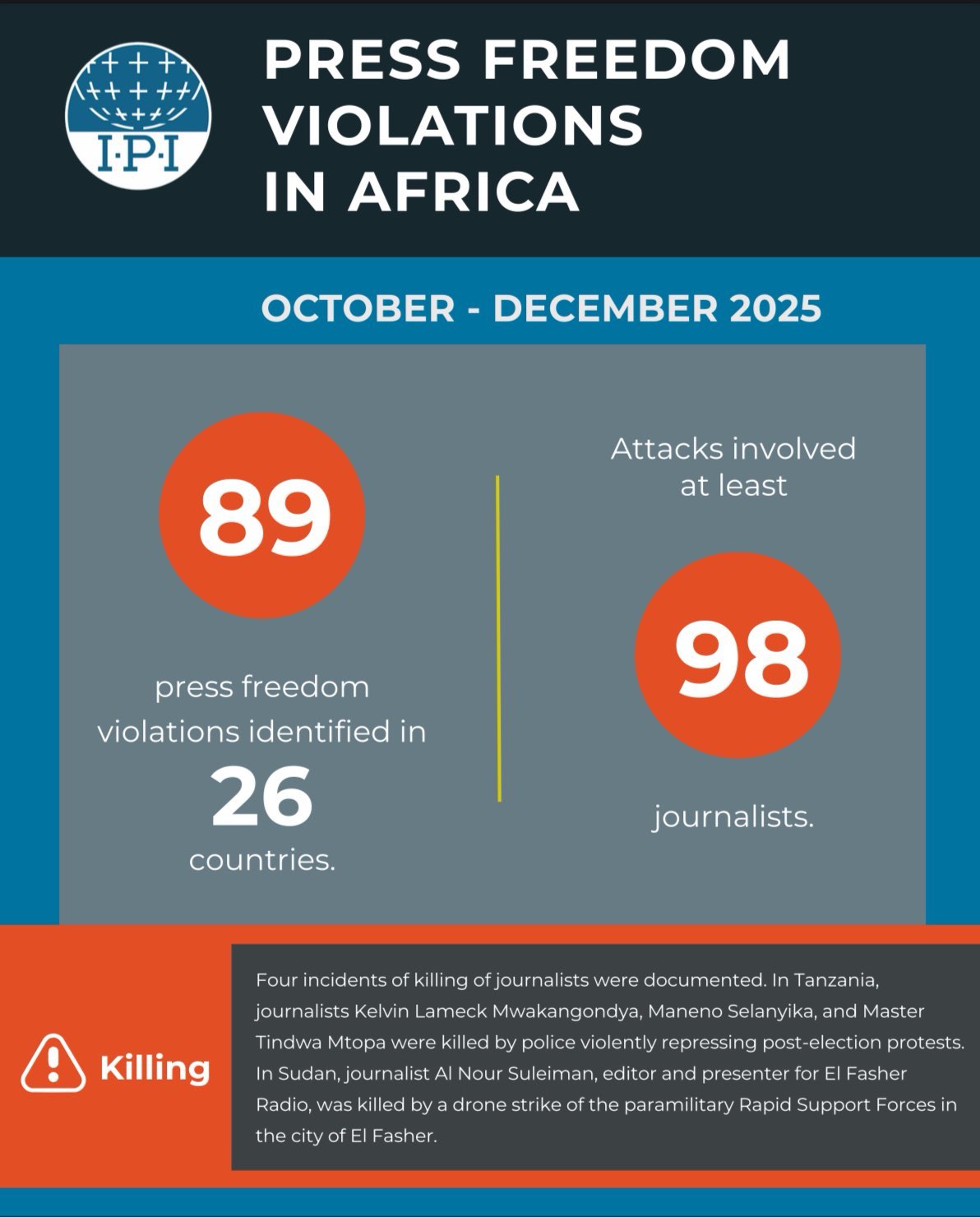
IPI’s Africa monitoring programme documented at least 89 incidents of threats to press freedom across 26 countries in sub-Saharan Africa between October and December 2025. These threats included the killings of three journalists in Tanzania amid post-election protests and one during the ongoing civil conflict in Sudan.
Similar to previous quarters, state authorities were responsible for the overwhelming majority – nearly 80% – of recorded violations during this period. In most of these cases, police or other security actors were behind the attacks on journalists. In addition to incidents of physical attacks, state authorities arbitrarily detained journalists and imposed legal restrictions that amounted to harassment and SLAPPs.
Examples of press freedom violations documented during this period include the following:
In Tanzania, three journalists – Kelvin Lameck Mwakangondya, Maneno Selanyika, and Master Tindwa Mtopa – were among the more than 700 people killed during a brutal crackdown on protests by security personnel after the disputed October 29 general elections that delivered a widely disputed 97.66% win to incumbent President Samia Hassan. Authorities also arrested reporters, shut down the internet, and reportedly blocked foreign journalists from reporting.
In Uganda, on November 7, security forces from the Uganda Police Force and the Uganda People’s Defence Forces reportedly electrocuted and assaulted journalist Ssematimba Bwejiire of Radio Simba while he was covering a violent confrontation between security officials and the team of opposition presidential candidate Robert Kyagulanyi. Bwejire said that he sustained abdominal and chest injuries as a result of the incident.
In the DRC, on November 29, a group of youths brutally assaulted journalist Caroline Ndoba of Congolese National Radio and Television (RTNC) while she was reporting near Gbadolite in Nord-Ubagni province. The local press freedom defence group OLPA called on authorities to investigate the attack and hold those responsible to account.
In Sudan, journalist Al Nour Suleiman of El Fasher Radio died after sustaining injuries from a drone strike on October 3 by the paramilitary Rapid Support Forces (RSF) that targeted his home in the city of El Fasher. The Sudanese Journalists’ Union denounced what it called multiple violations against journalists by the RSF. Since the war began in April 2023, the conflict has forced over 90% of the country’s journalists out of work, with many fleeing abroad.
In Niger, in November, at least seven journalists and media workers were arrested after publicly sharing an invitation to a press conference organised by the Solidarity Fund for the Safeguarding of the Homeland, an organisation created by the military regime to mobilise resources in support of the nation. Authorities accused them of “complicity in disseminating a document likely to disturb public order” under Niger’s cybercrime law. Four of the detained – Moussa Kaka, owner of Radiotélévision Saraounia, and his driver; Souleymane Brah, a freelance investigative journalist; and Abdoul Aziz, a journalist with Saraounia – were released on November 1. However, three others: Omar Kané, editor-in-chief of Le Hérisson newspaper; Issoufou Seriba, editor-in-chief of the Les Échos group; and Ibro Chaibou, editor-in-chief of Saraounia, remained in detention following a hearing at the High Court on November 3.