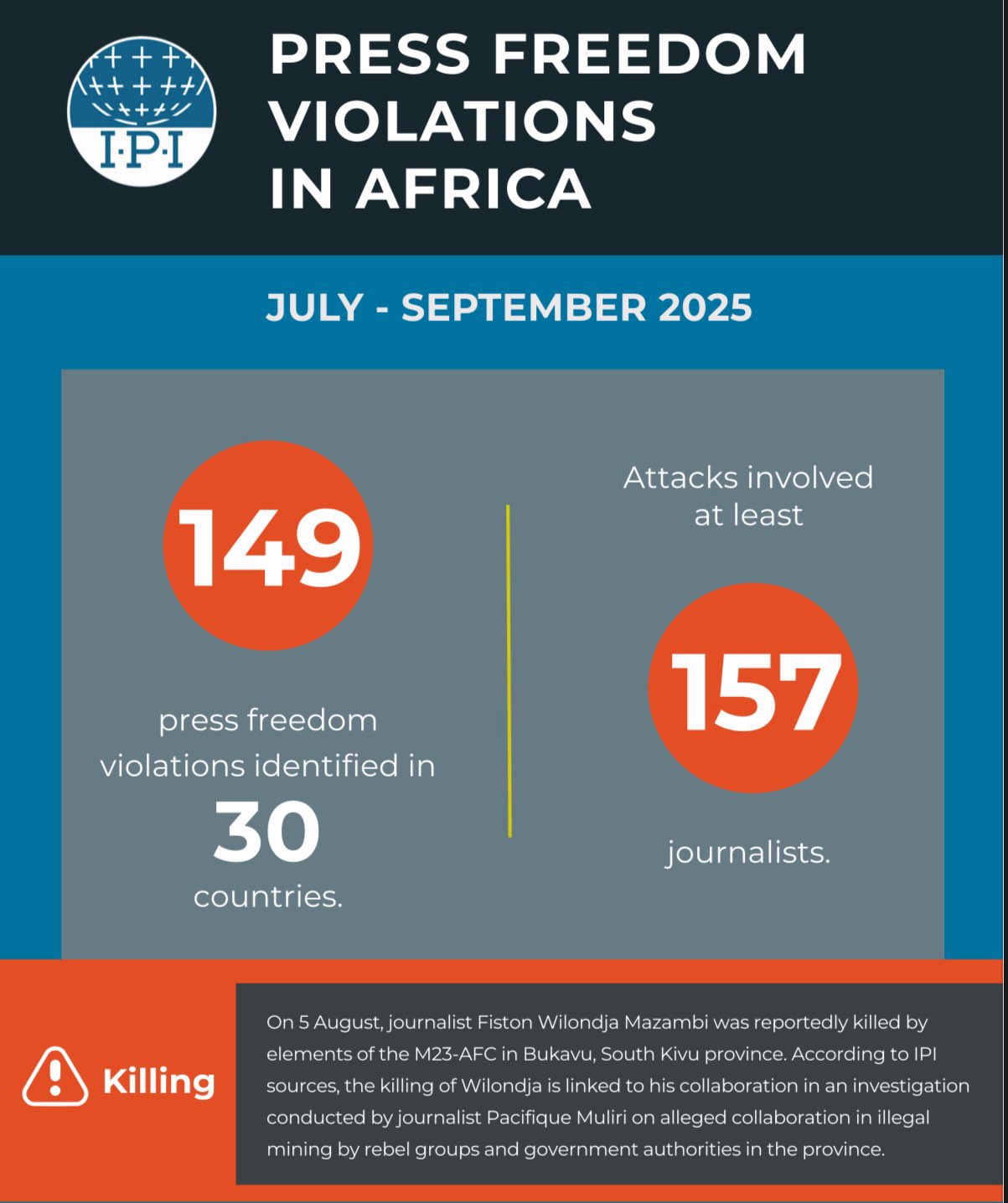
IPI recorded 149 threats to press freedom in 30 countries across sub-Saharan Africa in the period under review. These incidents involved 138 male journalists and 19 women journalists.
DOWNLOAD THE FULL FACT SHEET HERE
Three-quarters of the incidents recorded were either arrests and detentions or physical and verbal attacks targeting journalists. State actors were the primary sources of these threats, accounting for 83% of the incidents. Of these, 58% of threats came from the police or other state security actors, who were responsible for incidents of physical attacks and arbitrary arrest and detention.
One journalist was killed during this period. In the DRC, on August 5, journalist Fiston Wilondja Mazambi, who collaborated in investigating illegal mining activities in the DRC eastern region with journalist Pacifiaue Muliri, was killed by an armed group of elements of the M23-AFC rebellion in the town of Bukavu, in South Kivu province, after he was reportedly abducted from his home and tortured by the M23/AFC armed group.
Also in the DRC, in North Kivu, military officers arrested and detained journalist Aime Paluku of the state-owned RNTC broadcaster at the military headquarters in Butembo. His phone and laptop were confiscated. Authorities accused him of spying for the M23. In a different incident, on September 8, elements of the Armed Forces of the DRC (FARDC) assaulted three journalists in Kivu, in the east: André Alimasi, Cléophas Kyembwe and Hussein Djumaine, from Lumière Média TV, Lukula Radio and Television, respectively. The military officials damaged their work instruments. Kyembwe was seriously injured and admitted to the hospital for medical care.
In Somalia, on August 3, Hamar Jajab Police in Mogadishu assaulted three journalists: Osman Abdullahi Mohamed and Hussein Isse Mohamed of SMS Somali TV, and freelance journalist Mahad Mohamed Abdirahman. The trio was detained at Hamar Jajab Police Station, although their arrest was not recorded in the police occurrence book, the journalists told SJS. The incident unfolded while the journalists were covering forced evictions in Mogadishu of families from public land that was allegedly sold to wealthy businessmen. The journalists were released without being charged.
In Nigeria, on September 7, security forces arrested and detained journalist Hassan Mai-Waya Kangiwa in Kebbi State. The incident followed the release of a video that exposed the deplorable state of Kangiwa General Hospital, where an elderly patient was seen lying on a bed frame without a mattress. According to reports, his arrest was ordered by Governor Nasir Idris. His phone and work equipment were seized, raising serious concerns about the protection of his privacy and the security of his information sources. However, following overwhelming condemnation of the arrest, the journalist was released and was paid the equivalent of 115 euros in compensation for violations of his rights.
In Madagascar, at least four journalists were targets of assaults and threats while reporting on the protest that led to the toppling of President Andry Rajoelina. Journalist Léonard Joseph Andriamparany of Real TV Madagasikara was assaulted while filming protests in the capital, and L’Express photojournalist Alan Rakotondraibe was hit twice on September 25. In a different incident, freelance journalist Gaëlle Borgia and RFI journalist Pauline Le Troquier faced threats of criminal prosecution following a news report on the death of 32 people.
In Ethiopia, on August 14, journalist Yonas Amare of the Reporter newspaper was abducted by military elements from his home in the Koye Feche condominium area of Sheger City. His whereabouts remained unknown for several days until a security source confirmed he was in state custody.
In Ghana, on July 30, elements of the Ghana Armed Forces physically assaulted JoyNews journalist Carlos Calony and his cameraman, Jonas Dodzi Voegborlo, in Accra while covering a demolition exercise. The military men also damaged the Voegborlo camera, seized Calony’s phones, and detained him before releasing him after the personal intervention of the minister for the interior. Pressured by local press defence groups, the Ghana Armed Forces issued a statement stating that an investigation has been launched into the incident, and assured the public that suspected culprits will be held accountable according to the Army’s disciplinary laws. However, at the time this write-up was finalized, there were no public reports of military officials being held accountable for the incident.