On a quarterly basis, IPI’s Africa programme will be producing factsheets highlighting the press freedom violations and threats that have occurred across sub-Saharan Africa. This data is collected as part of our ongoing monitoring of threats to press freedom and independent journalism in the region.
DOWNLOAD THE FULL FACT SHEET HERE
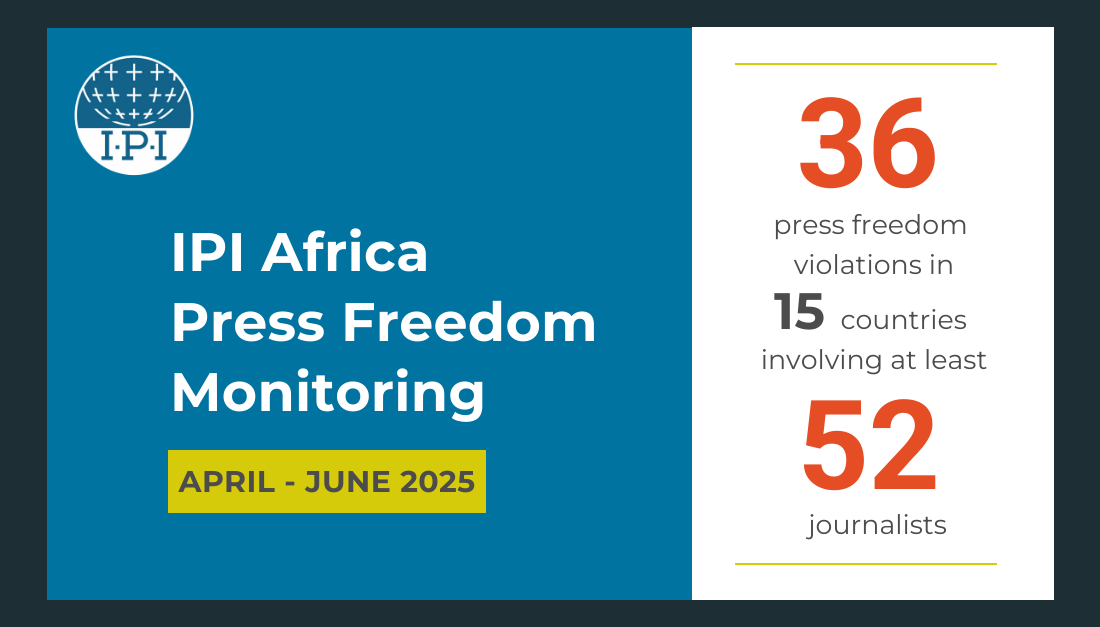
In April, May and June 2025, IPI’s Africa monitoring programme recorded at least 36 incidents of threats to press freedom in 15 countries across sub-Saharan Africa. According to our data, these attacks involved at least 52 journalists, including seven women journalists. Journalists in Ethiopia, Somalia, and the Democratic Republic of the Congo faced significant pressure, including arrests and violence, during the second quarter of 2025, according to IPI’s monitoring of press freedom threats from April to June 2025.
A vast majority of the violations – 86% of the documented cases – involved state actors, such as police, security agents, or judicial authorities. Among state actors, nearly 40% of these cases were linked to police and other security actors. The judiciary in several states has put journalists behind bars or imposed legal sanctions over their critical work. For example, police in Hargeisa, Somaliland, arrested freelance journalist Abdiqadir Mohamed Aw-Hassan on May 23 over a “satirical piece” published on Facebook (later deleted), allegedly criticising President Abdirahman Abdillahi Irro of Somaliland. Aw-Hassan was detained at Hargeisa Police Criminal Investigation Prison and later sentenced to six months in prison by the Maroodi-Jeh court in Hargeisa for “insulting the president.”
This quarter also records an incident where artificial intelligence, in the form of deepfakes, was used to spread false information. In the build-up to the presidential elections in Cameroon, French public media RFI revealed that an AI tool was used to replicate the voices of RFI journalists, which was deployed to spread disinformation about the presidential election.
Ethiopia had the highest number of press freedom threats or violations (6) during the second quarter of 2025, according to our data. The majority of these cases involved state actors arbitrarily detaining journalists for criticising authorities, often without charges. On June 8, 2025, police arrested and detained journalist Tesfalem Waldyes of the Ethiopia Insider for six days, despite a court granting him bail. He was finally released on June 13, after three separate courts had granted him bail. Tesfalem Waldyes was honored as an IPI-IMS World Press Freedom Hero in October 2025.
On April 17, police officers raided the office of the privately owned newspaper Addis Standard and unlawfully arrested and detained several journalists and media workers. The police also confiscated some work equipment, including mobile phones, computers, and other digital devices, during the raids. Reports also indicated that the police raided the home of the outlet’s IT manager, assaulting him in front of his family. The journalists were later released, and the seized devices were returned the following week. Nevertheless, the raid cast a chill over the Ethiopian journalist community, knowing that they could be targets of unlawful arrests with impunity. The incident also raises serious concerns over data protection and digital surveillance conducted by state actors in the country.
The self-proclaimed state of Somaliland had the second-highest number of press freedom violations (5) documented by IPI during the second quarter of 2025. Similar to Ethiopia, the majority of cases recorded during this period were linked to arbitrary arrests and detentions of journalists. In nearly all of these cases, authorities arrested the journalists for publishing content on their personal Facebook pages.
For instance, on May 29, police arrested journalist Warsame Kaafi in Erigabo, Somaliland, for a May 14 post on his Facebook page that interviewed a woman who alleged she had been physically assaulted by the chairman of the local Appeals Court. Warsame reported that the woman was the second to accuse the Appeals Court chairman of physical assault, following a similar allegation made by another woman earlier in January. Instead of investigating the matter, police arrested Kaafi and detained him for four days before releasing him without charge or explanation.
In the Democratic Republic of Congo (DRC), the safety of journalists has dramatically worsened, creating an intense chilling effect among journalists. Both state actors and non-state actors were involved in press freedom threats and violations, according to our data. On April 8, 2025, militiamen from the armed group “Zaire” at the Mabanga mining centre, 60 km from the eastern town of Bunia, the capital of Ituri province, confiscated the camera and telephone of journalist Flori Drajiro, of Radio Télévision Avenir (RTA). The militiamen physically assaulted Drajiro and accused him of taking photos without permission. According to the local press defence group OLPA, the journalist escaped the grips of the militia but sustained several physical injuries.
In Kenya, threats to press freedom during the second quarter were linked to media coverage of the first anniversary of anti-government protests against the 2024 Finance Bill. In both Kenya and Togo, authorities disrupted access to social media platforms to silence dissent. Additionally, Kipchumba Murkomen, the cabinet secretary for interior, verbally attacked journalists over their independent editorial line during a press conference held a day after the first anniversary of protests across the country.
In Niger, three journalists, Hamid Mahmoud, Mahaman Sani, and Massaouda Jaharou, from the privately owned radio station Sahara FM in Agadez, a city in northern Niger, were arrested and detained in May by security officers due to their broadcasting of an article published by LSI Africa, an online news portal. Massaouda Jaharou was released on June 13, while the other two journalists remained in custody. The journalists had aired a report by LSI Africa that claimed Niger authorities were quietly ending their contractual agreements with the Russian mercenary Wagner Group. Mahmoud and Sani are being accused of “undermining national defence” and “conspiracy against state authority” under the Nigerien Penal Code. They are currently being held at Kollo prison, about 30 km from Niamey.