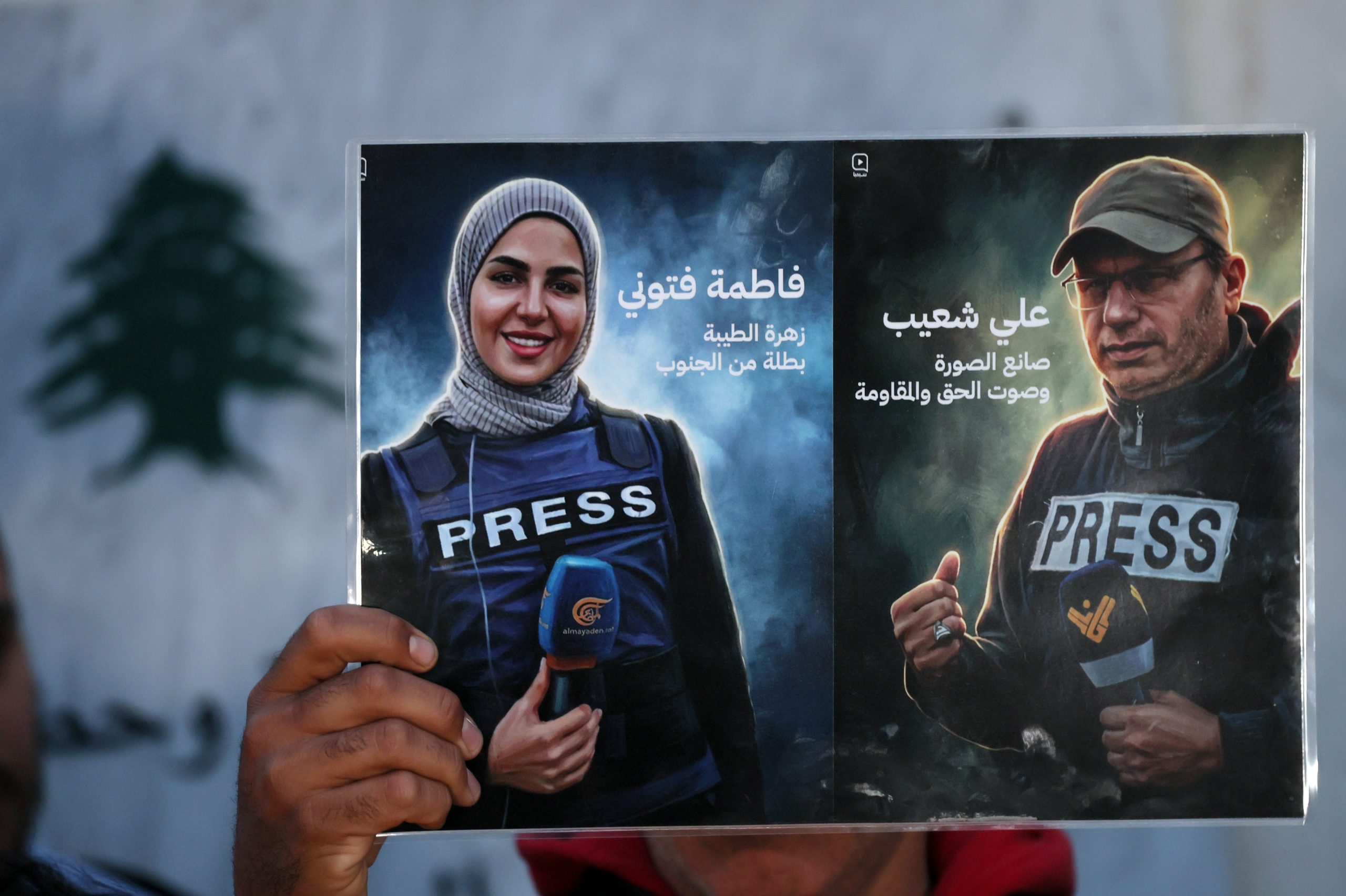
The IPI global network strongly condemns the recent killings of three Lebanese journalists by Israeli forces while they were on assignment in southern Lebanon. IPI calls for an immediate, independent investigation into the killings and repeats its call on the international community to hold Israel accountable for its targeted attacks against the press.
On March 28, an Israeli airstrike killed three journalists, Ali Shoeib, Fatima Ftouni and Mohammed Ftouni, as they were traveling in a clearly marked press vehicle in the south Lebanon town of Jezzine.
Ali Shoeib was a prominent Lebanese war correspondent who worked for Hezbollah-affiliated broadcaster Al-Manar TV for nearly 30 years. Reporter Fatima Ftouni and her brother, Mohammed Ftouni, a cameraman, worked for pan-Arab outlet Al-Mayadeen. The two had filmed a live report just prior to the Israeli strike.
In statements following the killings, the Israeli military acknowledged the attack had been targeted against Shoeib and Mohammed Ftouni, claiming they were Hezbollah operatives. The Israeli military did not present any evidence of the allegations, and admitted later that an image it had posted on social media of Shoeib wearing a military uniform had been photoshopped.
The Lebanese government condemned the attack. President Joseph Aoun called the strike a “brazen crime” against “civilians doing their professional duty,” while Prime Minister Nawaf Salam said Israel’s actions were a “flagrant violation of international humanitarian law and a clear breach of the rules that guarantee the protection of journalists in times of war.”
The killings of the three journalists comes as Israel expands its military campaign in southern Lebanon amidst the U.S.-Israeli war against Iran which began February 28.
Several other journalists have been killed in Lebanon in the weeks since the conflict began. On March 25, Hussain Hamood, a freelance photojournalist, was killed reportedly while filming an Israeli raid in southern Lebanon. On March 18, Mohamed Sherri, the head of political programming of Al-Manar TV, was killed in an Israeli strike on a Beirut residential building.
The March 28 attack echoes similar tactics deployed by Israel in Gaza during its war against Hamas which began on October 7, 2023. Throughout the conflict, Israeli forces were responsible for the killings of hundreds of journalists in Gaza. Evidence shows that many of these killings were deliberate and targeted. In some cases, the Israeli military publicly acknowledged direct targeting of members of the press, often claiming they were terrorists working with Hamas, without citing credible evidence.
In 2025, two-thirds of all journalists killed around the world were killed by the Israeli military, according to reports.
The deliberate targeting of journalists – regardless of political affiliation – amounts to a war crime.