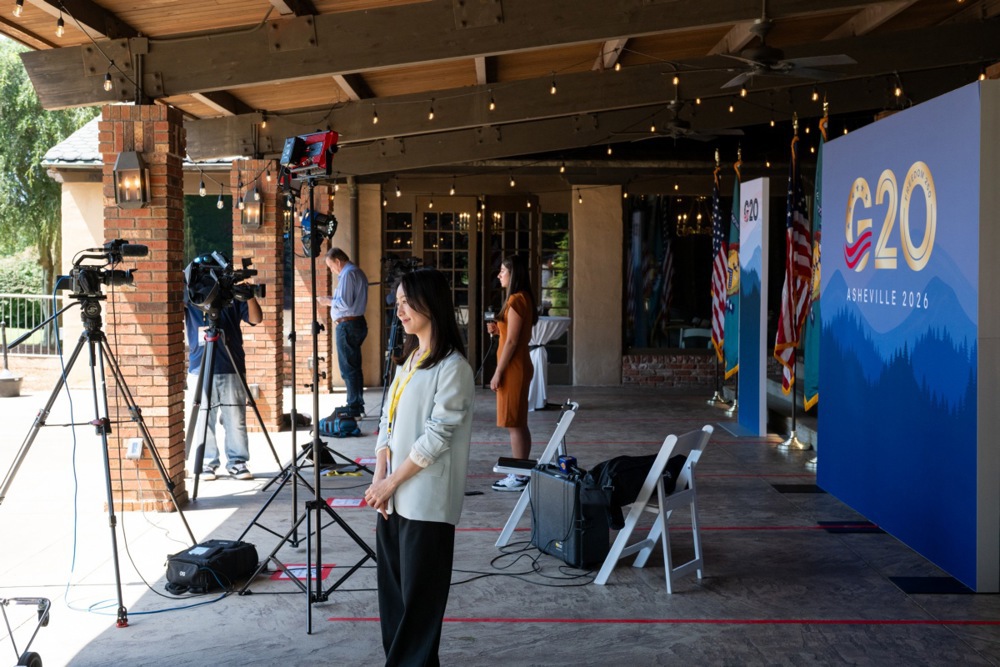
In a September 3, 2026, letter, the International Press Institute (IPI) and 19 other organisations and experts urged G20 leaders to ensure all media organisations have fair and equal access to future G20 meetings. The letter follows the U.S. Treasury Department’s decision to block several journalists from prominent outlets from covering the most recent finance ministers’ meeting in Asheville, North Carolina.
The Treasury denied credentials to reporters from The New York Times, The Wall Street Journal, Bloomberg News, and Asheville Watchdog, and did not explain the decision. Treasury Secretary Scott Bessent said the rejections had nothing to do with any particular outlet’s “point of view”. The U.S. currently holds the rotating G20 presidency.
“Barring reporters from a G20 meeting, without explanation, sets a dangerous precedent that any future host can follow,” IPI Director of Advocacy Amy Brouillette said. “Accreditation must not be used as a tool for deciding which journalists get to report on critical economic decisions and discussions that affect everyone.”
The signatories called on the G20 to adopt a transparent accreditation process and to maintain an open and safe reporting environment at the summit.
Read the letter below:
September 3, 2026
To G20 Leaders,
We are a coalition of press freedom advocates, civil society organizations, and academic leaders. We are also members of the Media 20, an independent initiative working to ensure that the Group of 20 supports a free, independent and sustainable media ecosystem. With the 2026 G20 Leaders’ Summit approaching in Miami, we are calling on all G20 members to ensure the media accreditation process for all summits and meetings is transparent, impartial, and accommodates the maximum number of media outlets possible. Further, the G20 should clearly affirm that journalists and news organizations will be able to freely cover deliberations by representatives of the world’s largest economies, whose decisions have broad ramifications around the world.
We are particularly alarmed that the U.S. Treasury Department blocked several journalists from The New York Times, The Wall Street Journal, Bloomberg News, and the Asheville Watchdog from covering the finance ministers’ meeting in North Carolina on August 31 and September 1, 2026. U.S. President Donald Trump, head of this year’s summit, has repeatedly attacked and filed lawsuits against two of the aforementioned news outlets, The New York Times and The Wall Street Journal, suggesting that their exclusion may have been retaliatory or politically motivated.
While U.S. Treasury Secretary Scott Bessent said the decision to bar the journalists from the meeting had nothing to do with “point of view,” the department has yet to offer an explanation as to why certain reporters were not granted the necessary credentials alongside other news colleagues. This inexplicable exclusion sends a chilling message to news organizations and raises legitimate questions about their ability to cover the G20 Miami summit in December.
The G20 and its annual summit serve as a global, agenda-setting discussion on economic growth and stability, international trade, and fiscal policy. Journalists play a crucial role in informing the public on these issues and holding leaders to account.
No single country or official should have the authority to limit or hand-pick which journalists or news organizations may cover the event. Press access is not a privilege to be granted to favored journalists. It is essential to the public’s right to know.
We urge you to implement a fair and transparent media accreditation process that upholds the right to a free and independent press and to maintain an open and safe reporting environment at the summit.
Thank you for your consideration.
Sincerely,
Reporters Without Borders (RSF)
Committee to Protect Journalists
Free Press
Freedom of the Press Foundation
Joseph E. Stiglitz, 2021 Nobel laureate (economics)
Dr. Anya Schiffrin
Momentum – Journalism and Tech Task Force
The Center for News, Technology and Innovation
Moxii Africa
Siddharth Varadarajan, Founding Editor, The Wire
International Press Institute (IPI)
Global Forum for Media Development (GFMD)
Churchill Otieno
The African Editors Forum (TAEF)
Eastern Africa Editors Society (EAES)
NMT Media Foundation
South African National Editors’ Forum (Sanef)
Collaboration on International ICT Policy for East and Southern Africa (CIPESA)
African Women in Media
Centre for Information Integrity in Africa (CINIA)
Press Council of South Africa (PCSA)